Supply Chain Email List | Targeted Supply Chain Contacts
On this page
- What Is a Supply Chain Email List?
- Why Supply Chain Contacts Matter for B2B Lead Generation
- Types of Supply Chain Companies You Can Target
- Logistics and Transportation Companies
- Procurement and Purchasing Professionals
- Warehouse and Distribution Contacts
- Manufacturing Supply Chain Professionals
- Supply Chain Decision-Makers by Job Title
- What Information Should a Supply Chain Database Include?
- Supply Chain Companies by Size and Revenue
- Supply Chain Email List by Location
- Supply Chain Technology and Software Users
- How to Build a Targeted Supply Chain Contact Database
- How Email Verification Improves Supply Chain Data Quality
- Data Cleansing and Enrichment for Supply Chain Contacts
- Supply Chain Leads for B2B Marketing
- Using Supply Chain Contacts for Account-Based Marketing
- Supply Chain Contacts for Sales Outreach
- Supply Chain Data for Existing CRM Systems
- Email Validation Before Supply Chain Outreach
- How to Verify an Email Without Sending a Message
- Common Supply Chain Email List Mistakes
- Responsible B2B Data and Supply Chain Outreach
- Sample Supply Chain Email List
- What Makes a Supply Chain Email List Useful?
- Frequently Asked Questions
- Editorial Policy
- Content Transparency
- About the Author
- Conclusion
Supply Chain Email List for Targeted Logistics, Procurement and Operations Decision-Makers
Modern supply chains connect manufacturers, suppliers, distributors, warehouses, transportation providers, retailers, technology companies, and customers. As businesses expand across multiple markets, identifying the right supply chain professionals has become an important part of B2B sales and marketing.
A Supply Chain Email List provides a structured way for businesses to identify professional contacts associated with supply chain management, logistics, procurement, purchasing, warehousing, transportation, distribution, inventory, and operations.
However, an effective contact database is not simply about collecting a large number of email addresses. The real value comes from identifying relevant companies, matching the right job functions, segmenting prospects by business characteristics, and maintaining contact-data quality.
A company selling warehouse-management software, for example, may need warehouse directors and operations leaders, while a procurement platform may require sourcing managers, procurement directors, and purchasing executives.
Businesses preparing a supply-chain prospecting campaign can also review B2B email verification techniques as part of their broader data-quality process.
What Is a Supply Chain Email List?
A Supply Chain Email List is a B2B database containing professional contacts connected to supply chain and related operational functions.
Depending on the source and targeting requirements, records may contain:
- Full name
- Professional email address
- Job title
- Department
- Company name
- Company website
- Business phone
- Company location
- Industry
- Employee size
- Revenue range
- SIC or NAICS classification
- Business function
- Technology information
Supply chain and logistics databases commonly emphasize fields such as job title, company size, revenue, location, industry classifications, and contact information.
The exact fields available will vary by data provider and collection methodology.
For B2B marketers, the purpose of a supply chain database should be to create a clearly defined audience that matches an ideal customer profile.
Why Supply Chain Contacts Matter for B2B Lead Generation
Supply chain organizations purchase and manage a wide range of products and services.
Potential requirements can include:
- Logistics software
- Transportation management systems
- Warehouse management systems
- Procurement software
- Inventory technology
- Supply chain analytics
- Fleet technology
- Automation
- Packaging
- Freight services
- Warehousing
- Consulting
- Recruitment
- Cybersecurity
- Business intelligence
- Financial services
This creates opportunities for many B2B companies, but each product requires a different buyer profile.
For example, a company offering warehouse automation may need to approach warehouse and distribution leaders. A freight-management platform may target transportation or logistics directors. A procurement solution may need purchasing and sourcing professionals.
For businesses building company-level audiences, verified B2B company contacts can complement a specialized supply-chain prospecting strategy.
Types of Supply Chain Companies You Can Target
Supply chain is a broad business category rather than a single industry.
Potential target organizations include:
- Logistics providers
- Freight companies
- Freight forwarders
- Third-party logistics providers
- Warehousing companies
- Distribution companies
- Manufacturing businesses
- Retailers
- Wholesalers
- Transportation companies
- Shipping companies
- Procurement organizations
- Fulfillment companies
- Supply chain technology providers
- Inventory-management companies
A database can therefore be segmented according to the specific type of organization.
For example, a technology vendor selling transportation software could create a campaign specifically for transportation and freight organizations instead of contacting every company classified under supply chain.
Logistics and Transportation Companies
Logistics and transportation are closely connected to supply chain operations.
Relevant segments may include:
- Freight forwarding
- Trucking
- Shipping
- Air freight
- Ocean freight
- Rail transportation
- Last-mile delivery
- Distribution
- Transportation management
- Customs services
- Third-party logistics
- Fleet management
Industry database structures commonly separate logistics, supply chain, warehousing, freight, shipping, and transportation as related but distinct segments.
A business selling transportation technology can therefore narrow its audience based on transport type, company role, location, and organizational size.
Procurement and Purchasing Professionals
Procurement is one of the most important functions within a supply chain organization.
Potential contacts include:
- Procurement Managers
- Procurement Directors
- Purchasing Managers
- Purchasing Directors
- Sourcing Managers
- Strategic Sourcing Directors
- Category Managers
- Vendor Managers
- Procurement Executives
- Supply Chain Buyers
These professionals may evaluate vendors, compare suppliers, manage purchasing processes, negotiate contracts, or coordinate sourcing activities.
Businesses selling procurement software, supplier-management platforms, consulting services, packaging, industrial products, or B2B services may find this audience particularly relevant.
Organizations that already have company records but need additional business information can explore data appending services as one possible component of a contact-enrichment workflow.
Warehouse and Distribution Contacts
Warehousing plays a central role in inventory storage, fulfillment, distribution, and order management.
Relevant roles can include:
- Warehouse Manager
- Warehouse Director
- Distribution Manager
- Distribution Director
- Fulfillment Manager
- Inventory Manager
- Warehouse Operations Manager
- Distribution Center Manager
- Logistics Operations Manager
- Fulfillment Director
Businesses selling warehouse-management systems, automation, robotics, racking, packaging, inventory technology, or facility services may need to target these professionals separately from general logistics contacts.
This type of role-based segmentation makes it easier to create a message around the specific operational responsibilities of the recipient.
Manufacturing Supply Chain Professionals
Manufacturers rely on supply chain processes for sourcing materials, production planning, inventory management, supplier relationships, transportation, and distribution.
Potential manufacturing supply chain contacts include:
- Supply Chain Director
- Supply Chain Manager
- Procurement Director
- Purchasing Manager
- Production Manager
- Operations Director
- Inventory Manager
- Sourcing Manager
- Logistics Manager
- Plant Operations Manager
A supply chain technology provider could therefore create a manufacturing-specific audience rather than combining manufacturers with logistics companies and retailers.
Industry segmentation can make outreach more relevant because the operational problems faced by a manufacturer may differ significantly from those of a freight company.
Supply Chain Decision-Makers by Job Title
Job-title targeting is particularly important when building a professional contact database.
Common titles include:
- Chief Supply Chain Officer
- VP of Supply Chain
- Supply Chain Director
- Supply Chain Manager
- VP of Operations
- Operations Director
- Operations Manager
- Logistics Director
- Logistics Manager
- Procurement Director
- Procurement Manager
- Purchasing Director
- Purchasing Manager
- Sourcing Director
- Sourcing Manager
- Warehouse Director
- Warehouse Manager
- Distribution Director
- Inventory Manager
- Transportation Manager
- Fleet Manager
Not every professional with a senior-sounding title will be the final purchasing authority. The purpose of job-title targeting is to identify professionals whose responsibilities are relevant to the product or service being offered.
Companies targeting technology leaders can also consider IT decision-maker contacts when technology purchasing is part of the campaign.
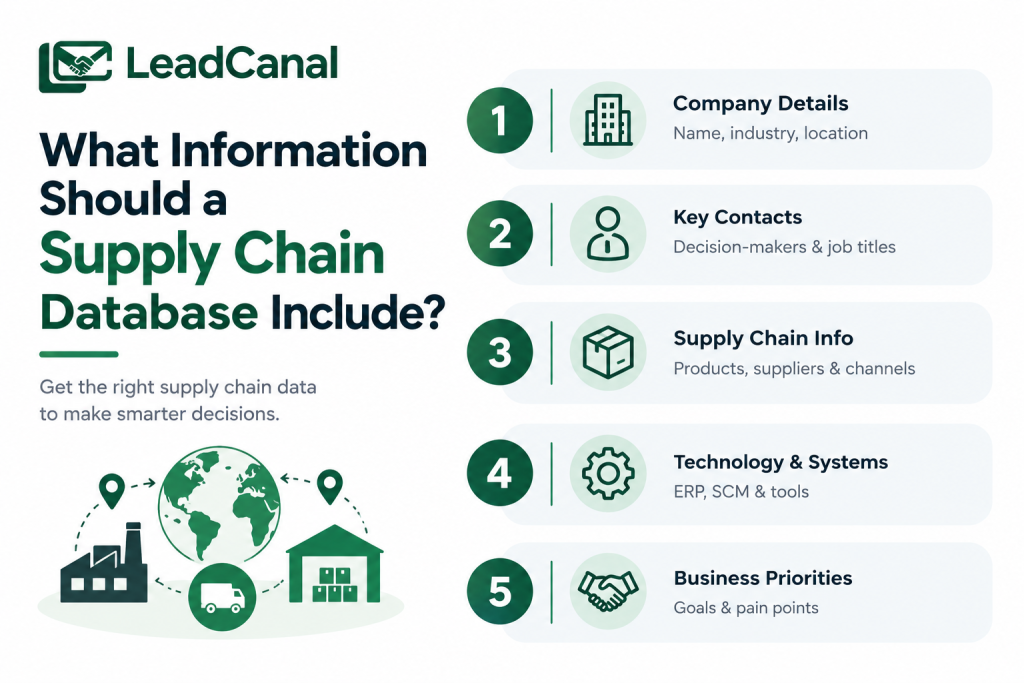
What Information Should a Supply Chain Database Include?
A useful supply chain database can combine contact, company, and segmentation information.
Contact Information
- First name
- Last name
- Professional email
- Job title
- Department
- Seniority
- Business phone
Company Information
- Company name
- Website
- Industry
- Company size
- Revenue range
- Location
- Business type
Supply Chain Information
- Supply chain function
- Logistics category
- Procurement role
- Transportation segment
- Warehouse function
- Distribution activity
- Technology environment
The best fields depend on the campaign objective.
For example, a warehouse automation company may prioritize warehouse role, facility type, employee size, and location, while a procurement software company may prioritize sourcing roles, company size, and purchasing function.
Supply Chain Companies by Size and Revenue
Company size can influence technology requirements, purchasing structures, operational complexity, and sales cycles.
A database may divide prospects into:
- Small businesses
- Growing companies
- Mid-market organizations
- Large enterprises
- Multinational companies
Revenue can also be used as an additional firmographic filter where reliable data is available.
A software company selling an enterprise supply-chain platform may have a different ideal customer profile from a consulting firm serving small logistics businesses.
The goal is not to target the largest companies automatically, but to identify companies that fit the actual customer profile.
Supply Chain Email List by Location
Geographic targeting allows companies to focus their campaigns on markets where their products or services are available.
Potential filters include:
- Country
- State
- Province
- City
- Region
- Sales territory
- Distribution region
For example, a company operating only in North America may prioritize U.S. and Canadian supply chain organizations.
An international logistics technology provider may instead need campaigns covering Europe, Asia-Pacific, North America, Latin America, or the Middle East.
Location can also be combined with company size and job title to create highly specific audiences.
Supply Chain Technology and Software Users
Technology is increasingly connected with modern supply chain operations.
Relevant technology categories can include:
- Warehouse Management Systems
- Transportation Management Systems
- Enterprise Resource Planning
- Procurement platforms
- Inventory software
- Fleet management
- Supply chain analytics
- Demand planning
- Supplier management
- Route optimization
- Supply chain visibility
- Warehouse automation
- Artificial intelligence
- Robotics
- IoT tracking
Technology vendors can use these categories to identify businesses that may have relevant operational environments.
Technology information should still be reviewed for freshness and accuracy. A technology signal can help with targeting, but it does not automatically indicate that an organization is currently shopping for a replacement.
How to Build a Targeted Supply Chain Contact Database
Building a useful database starts with a clear definition of the target audience.
Step 1: Define the Ideal Customer
Determine:
- Industry
- Supply chain segment
- Location
- Company size
- Job titles
- Department
- Technology environment
Step 2: Identify Target Companies
Create a company-level prospect pool based on the defined criteria.
Step 3: Identify Relevant Professionals
Find professionals whose responsibilities align with the solution.
Step 4: Standardize the Data
Use consistent formatting for company names, titles, locations, domains, and contact fields.
Step 5: Review Email Quality
Evaluate professional email addresses before using them in outreach.
Step 6: Segment the Database
Create separate audiences for procurement, logistics, warehousing, transportation, manufacturing, and other functions.
Step 7: Maintain the Records
Review changes in job roles, companies, domains, and business information.
If existing records are missing professional email information, email appending services can be considered as part of a larger enrichment workflow.
How Email Verification Improves Supply Chain Data Quality
Email quality is an important component of B2B database management.
Contact records can become outdated when employees change jobs, companies change domains, departments are reorganized, or business addresses change.
Email verification can help evaluate potentially problematic addresses before they are added to an active outreach workflow.
A verification process may consider factors such as:
- Syntax
- Domain status
- Mail-server signals
- Disposable-email indicators
- Role-based addresses
- Catch-all status
- Duplicate records
Verification does not guarantee that a prospect will respond or purchase. Its primary purpose is to help improve the quality of email data.
Businesses can use an email verification tool as one component of a broader contact-data hygiene process.
Data Cleansing and Enrichment for Supply Chain Contacts
Supply chain databases can change rapidly because people move between organizations and companies adjust their operations.
Data cleansing can include:
- Removing duplicate contacts
- Standardizing company names
- Correcting formatting
- Reviewing outdated information
- Updating job titles
- Checking company domains
- Removing irrelevant records
Data enrichment can add missing information such as:
- Company size
- Industry
- Revenue
- Location
- Department
- Job function
- Technology information
Businesses managing larger databases can review business data enrichment as part of their broader data-management strategy.
Supply Chain Leads for B2B Marketing
A targeted supply chain database can support multiple B2B marketing models.
SaaS Companies
Supply chain software providers can target procurement, logistics, warehouse, inventory, and operations professionals.
Consulting Firms
Consultants can segment organizations according to their operational requirements.
Logistics Providers
Transportation and logistics businesses can identify potential commercial accounts.
Equipment Vendors
Warehouse equipment, automation, packaging, and industrial suppliers can target operational decision-makers.
Recruitment Agencies
Recruiters can build audiences around supply chain, procurement, logistics, and operations roles.
Technology Providers
Technology companies can identify organizations with relevant operational or technology profiles.
A specialized email campaign database can help organize different audiences according to campaign objectives.
Using Supply Chain Contacts for Account-Based Marketing
Account-based marketing requires a deeper understanding of target organizations.
Instead of collecting one contact per company, businesses can map multiple stakeholders within a target account.
For example, a supply chain software vendor may identify:
- Chief Supply Chain Officer
- VP Operations
- Procurement Director
- Logistics Director
- IT Director
- Warehouse Director
Each person may have a different role in evaluating or approving a solution.
This account-level approach allows sales and marketing teams to understand the organization before starting outreach.
It also reduces the risk of relying on a single contact who may not be involved in the purchasing process.
Businesses looking for broader targeted B2B contacts can use company-level targeting alongside their supply-chain segmentation.
Supply Chain Contacts for Sales Outreach
A segmented database becomes more useful when the message is aligned with the recipient’s role.
For example, a warehouse director may be interested in:
- Warehouse automation
- Inventory accuracy
- Order fulfillment
- Facility efficiency
A procurement director may care more about:
- Supplier management
- Purchasing workflows
- Vendor performance
- Contract management
A logistics director may prioritize:
- Transportation efficiency
- Freight visibility
- Route optimization
- Delivery performance
The message should therefore reflect the recipient’s responsibilities rather than simply promoting a product.
Teams developing outbound campaigns can review a structured B2B outreach strategy when connecting audience segmentation with personalized messaging.
Supply Chain Data for Existing CRM Systems
Many businesses already have supply-chain-related company records in their CRM.
However, these records may be incomplete.
For example, a CRM record might contain:
- Company name
- Website
- Industry
- Location
but lack:
- Procurement contact
- Supply chain director
- Operations executive
- Business email
- Department
- Technology information
Enrichment can help turn basic company records into more useful prospect profiles.
The objective should be to improve the quality and usefulness of the CRM rather than simply increase the number of records.
Email Validation Before Supply Chain Outreach
Before launching a campaign, businesses can review the quality of the email addresses within their target audience.
This may help identify potentially invalid or risky records before they enter an active campaign.
Companies interested in this process can learn more about email validation and how it fits into broader B2B database hygiene.
Email validation should be considered alongside segmentation, personalization, suppression management, and responsible communication practices.
How to Verify an Email Without Sending a Message
Some businesses may assume that the only way to test an email address is to send a message.
There are other approaches to email verification that can evaluate available technical signals without requiring an outreach email to be sent.
Businesses preparing a supply-chain contact database can review how to verify an email without sending before beginning a campaign.
This can be useful when organizations want to review their database before activating contacts in an outreach platform.
Common Supply Chain Email List Mistakes
1. Focusing Only on Database Size
A large database can still contain irrelevant or outdated contacts.
2. Ignoring Job Functions
A warehouse manager, procurement director, and supply chain executive have different responsibilities.
3. Combining All Supply Chain Segments
Logistics, manufacturing, warehousing, procurement, and transportation should not automatically be treated as one audience.
4. Using Generic Messaging
A message written for procurement may not be relevant to a logistics director.
5. Skipping Verification
Poor-quality email records can reduce the practical usefulness of a database.
6. Ignoring Technology
Technology information can be valuable for software and automation vendors when the information is reliable.
7. Failing to Update Records
Supply chain professionals frequently change roles and organizations.
8. Over-Collecting Data
Businesses should focus on information that is relevant to legitimate business purposes.
Responsible B2B Data and Supply Chain Outreach
Supply-chain prospecting should be approached with attention to applicable privacy, marketing, and data-management requirements.
Requirements can vary depending on the country, recipient type, communication method, data source, and business relationship.
A responsible process can include:
- Documenting data sources
- Using appropriate professional information
- Maintaining suppression records
- Respecting opt-out requests
- Clearly identifying the sender
- Reviewing applicable requirements
- Avoiding unnecessary personal information
- Maintaining accurate records
Businesses researching responsible B2B data practices can review compliant B2B data practices as part of their internal planning.
Sample Supply Chain Email List
The following table is fictional and illustrative. The companies, people, and contact information are examples only.
A real database may include additional fields such as professional email, company website, employee size, revenue, industry classification, department, technology information, and business phone.

What Makes a Supply Chain Email List Useful?
A useful database can be evaluated through several practical factors.
Relevance
Do the companies actually fit the target market?
Contact Quality
Are the professional contact fields maintained appropriately?
Job-Title Accuracy
Does the contact’s role match the campaign?
Industry Segmentation
Can logistics, procurement, manufacturing, warehousing, and transportation contacts be separated?
Geographic Coverage
Does the database cover the markets where the business operates?
Firmographic Context
Are company size, location, revenue, or other useful business characteristics available?
Maintainability
Can the database be updated as companies and professionals change?
These factors can provide a more useful framework than judging a database only by its record count.
Frequently Asked Questions
What is a Supply Chain Email List?
A Supply Chain Email List is a B2B database containing professional contacts associated with supply chain, logistics, procurement, transportation, warehousing, inventory, distribution, and operations.
Who can use a supply chain email database?
SaaS companies, logistics providers, warehouse technology companies, procurement software vendors, consulting firms, equipment manufacturers, recruitment agencies, automation companies, and other B2B providers can use supply-chain contact data when the audience matches their offering.
Which job titles can be targeted?
Potential roles include Chief Supply Chain Officers, Supply Chain Directors, Supply Chain Managers, Logistics Directors, Procurement Directors, Purchasing Managers, Warehouse Managers, Operations Directors, Transportation Managers, and related professionals.
Can logistics companies be included?
Yes. Logistics is closely connected with supply chain operations and can be treated as a separate audience segment.
Can procurement professionals be targeted separately?
Yes. Procurement, purchasing, sourcing, and category-management roles can be segmented separately from general supply chain contacts.
Can warehouse managers be included?
Yes. Warehouse managers and distribution professionals can be particularly relevant for warehouse automation, inventory, fulfillment, equipment, and logistics solutions.
Can supply chain contacts be segmented by location?
Yes. Geographic segmentation can include country, state, province, city, region, or sales territory.
Why is email verification important?
Email verification can help identify potentially problematic contact addresses before outreach and can be incorporated into broader database-quality processes.
Is a larger supply chain database always better?
Not necessarily. Relevant companies, appropriate job titles, data freshness, segmentation, and contact quality can be more important than the total number of records.
How can existing supply chain CRM records be improved?
Businesses can combine data cleansing, contact enrichment, email verification, job-title research, company research, and regular database maintenance to improve existing records.
Editorial Policy
This article provides educational information about supply chain prospecting, B2B contact databases, segmentation, email verification, data enrichment, and professional outreach.
The sample records in this article are fictional and are included only to demonstrate a possible database structure.
Provider-specific claims regarding contact volume, accuracy, deliverability, verification rates, or database performance should not be treated as universal industry benchmarks.
Content Transparency
Competitor and industry research was used to identify recurring topics such as logistics, procurement, warehousing, transportation, supply chain management, decision-maker roles, geographic segmentation, company size, revenue, SIC/NAICS classifications, and technology-related targeting.
The article intentionally focuses on practical database structure and targeting rather than repeating provider-specific contact counts or performance guarantees.
About the Author
This article is intended for B2B marketers, sales professionals, supply chain technology vendors, logistics providers, procurement solution companies, consultants, recruiters, manufacturers, and other organizations researching supply-chain prospecting.
For additional B2B data, lead-generation, verification, and outreach resources, explore LeadCanal resources.
Conclusion
A Supply Chain Email List can provide a structured foundation for B2B prospecting across logistics, procurement, transportation, warehousing, manufacturing, distribution, inventory management, and supply chain technology.
The most effective approach is not simply to collect a large number of supply-chain contacts. Businesses should first define their ideal customer, identify the appropriate industry segment, select relevant job titles, apply geographic and company-level filters, and maintain contact quality through verification and data management.
A warehouse automation company may focus on warehouse directors and operations leaders. A procurement platform may target sourcing and purchasing professionals. A transportation technology provider may focus on logistics and fleet management roles. A supply chain analytics company may target senior operations and technology decision-makers.
This demonstrates why segmentation is central to a useful supply-chain prospecting strategy.
When company targeting, job-title segmentation, geographic filtering, data enrichment, email verification, and relevant messaging are combined, a supply chain database becomes more than a collection of contacts. It becomes a structured resource for identifying relevant B2B opportunities.
Businesses can also explore B2B lead generation resources when building a broader prospecting system.
The core principle is straightforward: identify the right supply-chain companies, reach the right professionals, understand their business function, and communicate with relevant information.