Logistics Professionals Email List | Targeted B2B Contacts
On this page
- What Is a Logistics Professionals Email List?
- Quick Answer
- Why Logistics Contacts Matter for B2B Lead Generation
- Logistics Professionals vs. Logistics Decision-Makers
- Types of Logistics Companies You Can Target
- Freight Forwarding and Transportation Contacts
- Warehouse and Distribution Professionals
- Supply Chain Management Contacts
- 3PL and Logistics Service Providers
- Logistics Managers and Directors
- What Information Should a Logistics Database Include?
- Logistics Companies by Industry
- Logistics Companies by Size and Revenue
- Logistics Email List by Location
- Logistics Technology and Software Users
- How to Build a Targeted Logistics Contact Database
- Why Email Verification Matters for Logistics Contacts
- Data Cleansing and Enrichment for Logistics Leads
- Using Logistics Contacts for B2B Marketing
- Logistics Leads for Sales Outreach
- Logistics Contacts for Account-Based Marketing
- Logistics Data for CRM Enrichment
- Email Validation Before Logistics Campaigns
- Real-Time Validation for Logistics Lead Forms
- How to Verify a Logistics Email Without Sending an Email
- Common Logistics Email List Mistakes
- Responsible B2B Data and Logistics Outreach
- Sample Logistics Professionals Email List
- How to Segment Logistics Professionals
- Frequently Asked Questions
- Editorial Policy
- Content Transparency
- About the Author
- Conclusion
Logistics Professionals Email List for Targeted Transportation, Freight and Supply Chain Decision-Makers
The logistics industry connects manufacturers, suppliers, retailers, distributors, freight companies, warehouses, carriers, and customers across complex networks.
For B2B companies selling software, equipment, transportation services, consulting, automation, recruitment, insurance, or other professional solutions, reaching the right logistics professionals can be more valuable than simply building a large contact database.
A Logistics Professionals Email List provides a structured way to identify business contacts across logistics, freight, transportation, warehousing, distribution, fleet management, supply chain, fulfillment, and related operational functions.
Modern logistics databases can be segmented by job title, company size, industry, location, specialization, and technology.
Competitor offerings commonly emphasize roles such as logistics managers, supply chain directors, warehouse managers, fleet managers, operations leaders, and freight professionals.
However, effective prospecting requires more than collecting email addresses. A logistics campaign becomes more useful when businesses understand which companies to target
which professionals influence purchasing decisions, what services they provide, and what operational problems their solution addresses.
Before activating a logistics campaign, businesses can also review B2B email verification techniques to make contact-data quality part of the prospecting process.
What Is a Logistics Professionals Email List?
Quick Answer
A Logistics Professionals Email List is a B2B contact database containing professional contacts associated with logistics and related business operations.
Depending on the database source and targeting requirements, records may include:
- Full name
- Professional email address
- Job title
- Department
- Seniority
- Company name
- Company website
- Industry
- Business location
- Employee size
- Revenue range
- Business phone
- Logistics specialization
- Technology information
- SIC or NAICS classification
The exact information available varies between providers and data-collection methods.
A useful database should help a sales team answer more than “Who works in logistics?” It should help identify which logistics segment a company belongs to, which professional is relevant, what role that person performs, and whether the account matches the ideal customer profile.
Businesses reviewing individual addresses before outreach can use an email verification tool as one part of their database-quality workflow.
Why Logistics Contacts Matter for B2B Lead Generation
Logistics companies operate across many different business models.
Potential target organizations include:
- Freight forwarders
- 3PL providers
- Trucking companies
- Shipping companies
- Warehousing businesses
- Distribution companies
- Courier services
- Fulfillment providers
- Fleet operators
- Customs brokers
- Transportation companies
- Supply chain service providers
- Logistics technology companies
Each segment can have different buying priorities.
For example, a warehouse operator may need warehouse automation, while a freight forwarder may need transportation-management software. A trucking company may be interested in fleet technology, while a 3PL provider may be evaluating warehouse, routing, customer-visibility, or integration solutions.
For businesses collecting logistics leads through forms or applications, a real-time email verification API can also support email-quality checks during data collection.
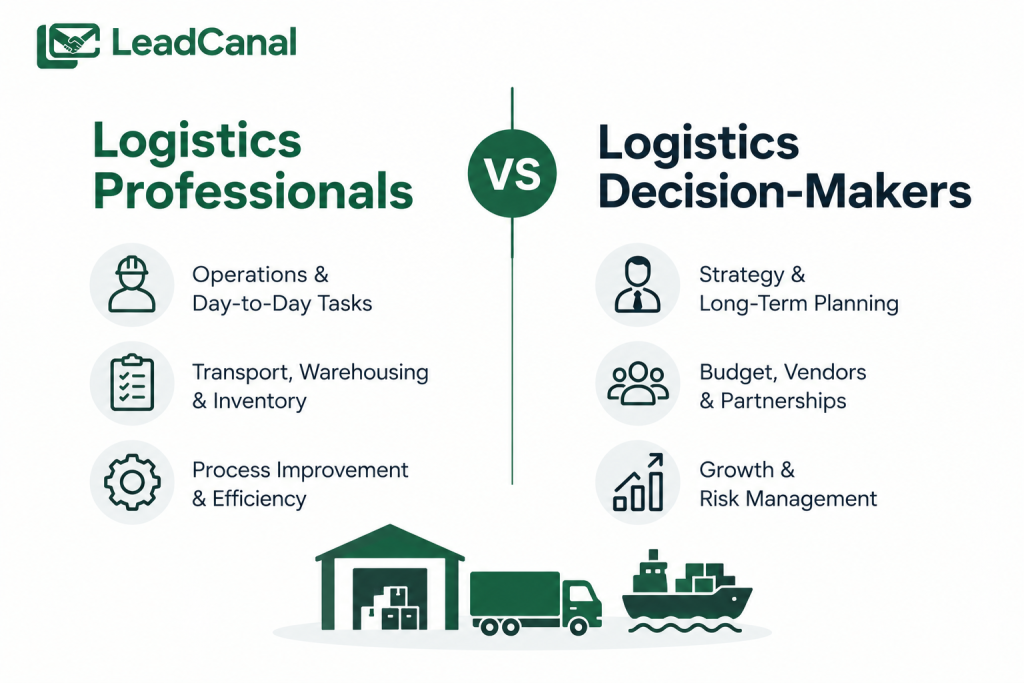
Logistics Professionals vs. Logistics Decision-Makers
Not every logistics professional has the same role in a purchasing process.
A database can therefore distinguish between different levels of influence.
Operational Users
These professionals use systems, equipment, vehicles, warehouses, or processes on a daily basis.
Technical Evaluators
They may assess whether a technology or solution fits operational requirements.
Managers
Managers may oversee teams, budgets, vendors, or operational performance.
Directors
Directors can influence departmental strategy, technology adoption, supplier relationships, and investment decisions.
Executives
Senior executives may participate in strategic decisions involving large contracts, technology investments, partnerships, and operational expansion.
Procurement Professionals
Procurement teams may compare suppliers, negotiate contracts, and manage commercial purchasing.
This stakeholder structure is particularly useful for complex B2B sales where several people may participate in the buying process. Current logistics-data pages commonly segment audiences around operations, logistics, supply chain, procurement, warehouse, fleet, and executive roles.
Types of Logistics Companies You Can Target
The logistics sector is broad, so a targeted database should ideally separate different business models.
Freight Companies
The Freight carriers and freight-service providers handle the movement of goods between locations.
Freight Forwarders
Forwarders coordinate shipments, carriers, documentation, and transportation arrangements.
Third-Party Logistics Providers
3PL companies provide outsourced logistics services such as transportation, warehousing, fulfilment, and distribution.
Warehousing Companies
Warehouse operators manage storage, inventory, fulfilment, and distribution activities.
Transportation Companies
Transportation providers may specialize in trucking, rail, air freight, ocean shipping, or multimodal transportation.
Last-Mile Providers
These companies focus on final delivery to customers, businesses, stores, or distribution points.
Logistics Technology Companies
These organizations develop systems for transportation management, warehouse management, route optimization, visibility, analytics, and automation.
Segmenting these categories can make a campaign substantially more relevant than sending the same message to every organization classified broadly as “logistics.”
Freight Forwarding and Transportation Contacts
Freight and transportation represent important logistics segments for B2B prospecting.
Potential job titles include:
- Freight Manager
- Transportation Manager
- Transportation Director
- Freight Operations Manager
- Fleet Manager
- Dispatch Manager
- Logistics Director
- Transportation Coordinator
- Freight Forwarding Manager
- Operations Director
A company selling transportation-management software may focus on transportation directors and logistics managers, while an equipment supplier may target fleet or operations managers.
Competitor databases similarly separate transportation, freight, fleet, shipping, and logistics roles rather than treating them as one identical audience.
Warehouse and Distribution Professionals
Warehousing is another important part of the logistics ecosystem.
Relevant contacts can include:
- Warehouse Manager
- Warehouse Director
- Distribution Manager
- Distribution Director
- Fulfilment Manager
- Inventory Manager
- Warehouse Operations Manager
- Distribution Centre Manager
- Fulfilment Director
- Logistics Operations Manager
These professionals may be involved with warehouse-management systems, automation, racking, conveyors, inventory software, packaging, material handling, labor management, and fulfillment solutions.
A warehouse automation provider, for example, can build a campaign specifically around warehouse and distribution leadership instead of targeting every logistics employee.
Supply Chain Management Contacts
Logistics and supply chain are closely connected but are not identical.
Supply chain professionals may focus on:
- Supplier management
- Procurement
- Planning
- Inventory
- Distribution
- Transportation
- Demand forecasting
- Strategic sourcing
- Network optimization
- Vendor management
Potential job titles include:
- Supply Chain Manager
- Supply Chain Director
- VP Supply Chain
- Chief Supply Chain Officer
- Supply Chain Analyst
- Supply Chain Planner
- Procurement Director
- Sourcing Manager
- Operations Director
A logistics technology company can therefore create separate supply-chain and transportation audiences when their products address different stages of the business process.
For companies with incomplete company records, data appending services can be considered as part of a broader business-data enrichment workflow.
3PL and Logistics Service Providers
Third-party logistics providers can represent a distinct prospecting segment.
3PL organizations may provide:
- Transportation
- Warehousing
- Fulfillment
- Freight management
- Inventory services
- Distribution
- Cross-docking
- Last-mile delivery
- Reverse logistics
Potential decision-makers include:
- VP Operations
- Logistics Director
- Warehouse Director
- 3PL Operations Manager
- Supply Chain Director
- Procurement Manager
- Technology Director
- Business Development Director
The buying priorities of a 3PL can differ from those of a manufacturer with an internal logistics department. Therefore, separating 3PL contacts from in-house logistics teams can improve campaign relevance.
Logistics Managers and Directors
Job-title targeting is one of the most useful ways to refine a logistics contact database.
Common leadership roles include:
- Logistics Manager
- Logistics Director
- VP Logistics
- Operations Manager
- Operations Director
- Supply Chain Manager
- Supply Chain Director
- Transportation Director
- Warehouse Director
- Distribution Director
- Fleet Manager
- Procurement Director
Recent logistics database pages also emphasize operations managers, logistics managers, supply chain executives, warehouse leadership, fleet professionals, and procurement roles.
The appropriate title depends on the product. A fleet solution may require fleet managers, while warehouse software may need warehouse directors and operations leaders.
What Information Should a Logistics Database Include?
A practical logistics database can contain several categories of information.
Contact Data
- Name
- Business email
- Job title
- Department
- Seniority
- Business phone
Company Data
- Company name
- Website
- Industry
- Employee size
- Revenue range
- Headquarters
- Business location
Logistics Data
- Logistics segment
- Transportation type
- Freight specialization
- Warehouse activity
- Distribution function
- Service category
Technology Data
- TMS
- WMS
- ERP
- Fleet software
- Route optimization
- Supply chain analytics
- Automation technology
The exact fields depend on the source and intended use. Competitor pages commonly advertise combinations of job role, company size, revenue, geography, industry, specialization, technology, and classification data.
Logistics Companies by Industry
Logistics does not exist independently from other industries.
Many logistics operations serve specific vertical markets, including:
- Manufacturing
- Retail
- E-commerce
- Automotive
- Healthcare
- Pharmaceuticals
- Food and Beverage
- Chemicals
- Electronics
- Construction
- Agriculture
- Consumer Goods
- Wholesale
- Energy
A logistics provider specializing in pharmaceutical transportation may need a very different prospecting strategy from a company focused on retail fulfillment.
Industry segmentation therefore allows sales teams to connect their value proposition with the operational environment of each prospect.
Businesses that want to build a broader company-level audience can also explore verified B2B company contacts when developing their target-account strategy.
Logistics Companies by Size and Revenue
Company size can influence logistics requirements.
A small carrier may have a simple technology stack and centralized decision-making.
A mid-market logistics provider may have dedicated operations, sales, fleet, warehouse, and technology teams.
A large enterprise may have separate procurement, IT, supply chain, transportation, warehouse, and finance departments.
Possible segmentation categories include:
- Small businesses
- Mid-market companies
- Large enterprises
- Multinational organizations
Revenue range can also be used as a firmographic filter where reliable information is available.
The goal should be to identify organizations that match the actual ideal customer profile rather than automatically prioritizing the largest businesses.
Logistics Email List by Location
Geographic targeting is useful for companies that operate within specific markets.
Potential filters include:
- Country
- State
- Province
- City
- Region
- Sales territory
- Distribution market
Common search segments include:
- Logistics Email List USA
- US Logistics Companies
- UK Logistics Professionals
- Canada Logistics Companies
- Australian Logistics Contacts
- European Logistics Database
- Global Logistics Professionals
Some competitor databases promote country and regional coverage alongside job title, industry, and company filters.
Geographic targeting can be especially useful for regional transportation companies, local logistics providers, warehouse operators, and businesses whose sales teams cover defined territories.
Logistics Technology and Software Users
Technology has become an important segmentation layer within logistics.
Relevant categories include:
- Transportation Management Systems
- Warehouse Management Systems
- Enterprise Resource Planning
- Fleet Management Software
- Route Optimization
- Supply Chain Analytics
- Logistics Visibility Platforms
- Inventory Management
- Telematics
- Warehouse Automation
- Robotics
- IoT Tracking
- AI-Based Logistics Tools
Technology vendors can use these signals to identify organizations that may have relevant operational environments.
However, technology information should be treated as a targeting signal rather than proof that an organization is actively looking to replace its current platform.
For logistics technology campaigns that overlap with IT purchasing, IT decision-maker contacts can complement logistics-specific targeting.
How to Build a Targeted Logistics Contact Database
A strong database starts with a clearly defined ideal customer profile.
Step 1: Define the Offer
Determine exactly what logistics problem your product or service solves.
Step 2: Select the Business Segment
Choose freight, warehousing, 3PL, transportation, fulfillment, supply chain, or another relevant segment.
Step 3: Select Job Functions
Identify managers, directors, executives, technical users, procurement teams, or other relevant professionals.
Step 4: Add Firmographic Filters
Use company size, industry, location, and other relevant criteria.
Step 5: Add Technology Filters
For software products, consider relevant technology environments.
Step 6: Review Contact Quality
Check email addresses and remove obvious duplicates or irrelevant records.
Step 7: Segment the Audience
Create separate groups according to campaign objective.
Step 8: Maintain the Database
Review changes to companies, domains, job titles, and contact information.
Businesses building a broader prospecting system can also use B2B lead generation resources to connect database development with other sales and marketing activities.
Why Email Verification Matters for Logistics Contacts
Logistics databases can become outdated when professionals change jobs, companies change domains, departments are reorganized, or businesses merge.
Potential data-quality issues include:
- Invalid addresses
- Typographical errors
- Inactive mailboxes
- Outdated domains
- Disposable addresses
- Duplicate contacts
- Generic role-based addresses
Email verification can help identify potentially problematic addresses before they enter an active outreach campaign.
Verification should not be viewed as a guarantee of engagement or sales. Its primary purpose is to improve email-data quality.
A structured email verification process can therefore be included alongside segmentation, cleansing, and campaign preparation.
Data Cleansing and Enrichment for Logistics Leads
A logistics database needs ongoing maintenance.
Data cleansing can include:
- Removing duplicate records
- Standardizing company names
- Reviewing outdated job titles
- Checking domains
- Removing irrelevant contacts
- Correcting formatting
Enrichment can add information such as:
- Company size
- Revenue
- Industry
- Location
- Job function
- Seniority
- Logistics specialization
- Technology environment
A business that wants to improve its existing records can explore business data enrichment as part of a wider CRM-management process.
Using Logistics Contacts for B2B Marketing
Logistics professionals can represent several different B2B audiences.
Logistics Technology Companies
Target operations and technology leaders interested in TMS, WMS, analytics, automation, and visibility solutions.
Equipment Suppliers
Reach warehouse, fleet, transportation, and operations professionals.
Consulting Firms
Identify companies with logistics and supply chain functions relevant to their services.
Recruitment Agencies
Target logistics managers, warehouse professionals, transportation specialists, and supply chain leadership.
Insurance and Financial Services
Develop campaigns around transportation, fleet, cargo, risk, and operational management roles.
Professional Service Providers
Reach companies that need accounting, legal, HR, cybersecurity, training, or other business services.
A structured email campaign database can help separate these audiences and support more focused messaging.
Logistics Leads for Sales Outreach
A logistics database becomes more useful when the outreach message reflects the recipient’s responsibilities.
For example, a warehouse manager may care about:
- Inventory accuracy
- Warehouse efficiency
- Labor management
- Fulfillment speed
- Automation
A transportation director may be more interested in:
- Fleet performance
- Carrier management
- Route optimization
- Transportation costs
- Delivery visibility
A procurement director may focus on:
- Supplier selection
- Contract management
- Pricing
- Vendor performance
- Strategic sourcing
Personalization should therefore go beyond inserting a recipient’s first name.
Businesses developing outbound campaigns can review cold email outreach resources when connecting audience segmentation with messaging and follow-up.
Logistics Contacts for Account-Based Marketing
Account-based marketing can be useful when selling complex logistics technology or enterprise services.
Instead of contacting one person at a target company, a sales team can map multiple stakeholders.
For example:
Target Account
- VP Logistics
- Operations Director
- Warehouse Manager
- Supply Chain Director
- IT Director
- Procurement Manager
- Fleet Manager
Each stakeholder may have a different role in evaluating the solution.
The engineering, operational, financial, and procurement perspectives can all matter depending on the product and purchasing process.
Businesses looking for broader targeted B2B contacts can combine company-level targeting with logistics-specific stakeholder mapping.
Logistics Data for CRM Enrichment
Many companies already have logistics organizations in their CRM but may not have complete stakeholder coverage.
An account record might contain:
- Company name
- Website
- Industry
- Location
but lack:
- Logistics Director
- Warehouse Manager
- Procurement Manager
- Fleet Manager
- Supply Chain Director
- Professional email
Enrichment can help identify missing fields and improve account coverage.
The objective should be to create a useful, maintainable CRM rather than simply increase the number of records.
Email Validation Before Logistics Campaigns
Before launching a campaign, marketers can review the quality of email addresses within their logistics database.
This can help identify potentially invalid records before they are moved into an active campaign.
Businesses can use email validation as one stage in a broader workflow that also includes deduplication, segmentation, suppression management, and message personalization.
Real-Time Validation for Logistics Lead Forms
Logistics companies and vendors may collect leads through:
- Quote forms
- Demo requests
- Webinar registrations
- Contact forms
- Software trials
- Shipping inquiries
- Trade-show forms
- Resource downloads
A real-time validation process can help assess an email address when it enters the system.
Businesses interested in integrating verification into digital workflows can review the real-time email verification API approach.
This can be particularly useful for organizations that continuously collect new B2B contacts from websites and applications.
How to Verify a Logistics Email Without Sending an Email
Some businesses prefer to review contact quality before initiating communication.
Email-verification methods can evaluate available technical signals without requiring a traditional marketing message to be sent to the address.
This makes pre-campaign checking useful when a logistics database contains older records or contacts collected from multiple sources.
Businesses can review how to verify an email without sending as part of their data-quality research.
Common Logistics Email List Mistakes
1. Treating All Logistics Companies as One Segment
Freight forwarders, 3PLs, warehouse operators, carriers, and last-mile providers can have very different business models.
2. Targeting the Wrong Job Title
A generic logistics contact may not be responsible for the problem your product solves.
3. Ignoring Geography
A prospect outside your service territory may not be commercially useful.
4. Ignoring Company Size
Enterprise logistics organizations can have very different purchasing structures from smaller providers.
5. Sending One Message to Every Contact
Operations, procurement, technology, warehouse, and executive roles have different priorities.
6. Relying Only on Database Size
A large list can still contain irrelevant or outdated records.
7. Skipping Verification
Problematic email records can reduce the usefulness of a campaign database.
8. Failing to Maintain Data
Job titles, companies, domains, and business structures change over time.
Responsible B2B Data and Logistics Outreach
B2B prospecting should be conducted with attention to applicable privacy, marketing, and data-management requirements.
Requirements vary depending on factors such as jurisdiction, recipient type, communication channel, data source, and business relationship.
A responsible workflow can include:
- Documenting data sources
- Using relevant professional information
- Maintaining suppression records
- Respecting opt-out requests
- Identifying the sender clearly
- Reviewing applicable requirements
- Avoiding unnecessary personal information
- Maintaining accurate CRM records
Businesses researching this subject can review compliant B2B data practices before implementing a large-scale prospecting workflow.
Sample Logistics Professionals Email List
The following table is fictional and illustrative only. The people, companies, and contact information are examples created to demonstrate possible database fields.
A production database may contain additional fields such as business email, business phone, company website, employee size, revenue, industry, technology information, seniority, logistics specialization, and verification status.
Here you can see the sample list. If you want to download these samples with dentists’ emails, please contact us or get a quote.

How to Segment Logistics Professionals
A strong logistics database can be divided into multiple layers.
By Business Type
- Freight
- 3PL
- Warehousing
- Transportation
- Distribution
- Fulfillment
- Shipping
- Last-mile delivery
By Job Title
- Managers
- Directors
- Executives
- Procurement
- Operations
- Fleet
- Warehouse
- Supply chain
By Industry
- Manufacturing
- Retail
- E-commerce
- Healthcare
- Automotive
- Food
- Pharmaceuticals
- Wholesale
By Geography
- Country
- State
- Province
- City
- Region
By Technology
- TMS
- WMS
- ERP
- Fleet software
- Analytics
- Automation
This layered structure can help businesses build smaller, more relevant campaign audiences.
Frequently Asked Questions
What is a Logistics Professionals Email List?
It is a B2B database containing professional contacts working in logistics and related areas such as freight, transportation, warehousing, distribution, fulfillment, supply chain, and fleet management.
Which logistics professionals can be targeted?
Potential roles include Logistics Managers, Logistics Directors, Supply Chain Managers, Transportation Directors, Warehouse Managers, Fleet Managers, Operations Directors, Procurement Managers, and related professionals.
Can freight forwarders be included?
Yes. Freight forwarding can be treated as a distinct logistics segment for campaigns involving freight services, transportation software, insurance, finance, technology, or other B2B solutions.
Can 3PL companies be targeted separately?
Yes. 3PL providers can be segmented separately because their operations and technology requirements may differ from carriers, manufacturers, or warehouse-only organizations.
Can warehouse managers be included?
Yes. Warehouse managers, warehouse directors, distribution managers, and fulfillment leaders can be relevant for warehouse technology, automation, equipment, inventory, and operational services.
Can logistics contacts be filtered by company size?
Yes. Company-size segmentation can help businesses focus on small, mid-market, enterprise, or multinational organizations according to their ideal customer profile.
Can logistics contacts be targeted by location?
Yes. Geographic targeting can include country, state, province, city, region, or sales territory where appropriate data is available.
Why is email verification useful?
Email verification can help identify potentially problematic addresses before they enter an active campaign and can form part of a broader database-maintenance process.
Is a larger logistics database automatically better?
No. Relevance, job-title accuracy, segmentation, data freshness, company fit, and contact quality can be more useful than record count alone.
Can logistics data support account-based marketing?
Yes. Businesses can map several relevant stakeholders within the same logistics organization, such as operations, procurement, technology, warehouse, fleet, and executive contacts.
Editorial Policy
This article provides educational information about logistics prospecting, B2B contact databases, segmentation, email verification, CRM enrichment, and professional outreach.
The sample database shown above is fictional and should not be interpreted as real contact information.
Claims made by individual data providers regarding their own database size, accuracy, deliverability, verification rates, or performance are provider-specific and should not automatically be treated as universal industry benchmarks. Competitor pages frequently publish such claims, so they should be evaluated in their original context.
Content Transparency
This article was developed around recurring topics found across logistics-data providers, including freight, transportation, warehousing, 3PL, supply chain, fleet management, operations, procurement, technology, company size, geography, and job-title segmentation.
Rather than focusing only on contact volume, the article emphasizes practical segmentation, ideal-customer-profile development, stakeholder mapping, database hygiene, email verification, CRM enrichment, and role-specific B2B outreach.
About the Author
This article is intended for B2B marketers, sales teams, logistics technology providers, freight companies, warehouse technology vendors, transportation businesses, 3PL providers, manufacturers, consultants, recruiters, equipment suppliers, and other organizations targeting logistics professionals.
For additional lead-generation and B2B data resources, readers can explore LeadCanal resources.
Conclusion
A Logistics Professionals Email List can provide a structured foundation for B2B prospecting across freight, transportation, warehousing, distribution, fulfillment, fleet management, 3PL, and supply chain operations.
The most useful approach is not simply to collect as many logistics contacts as possible. Businesses should define their ideal customer first and then identify the appropriate logistics segment, company type, job function, seniority, location, industry, and technology environment.
A freight-forwarding software provider may focus on freight and transportation managers. A warehouse automation company may prioritize warehouse directors and operations leaders. A fleet technology provider may need fleet managers and transportation directors. A procurement platform may target purchasing and sourcing professionals.
For complex solutions, several stakeholders may need to be mapped within the same account. Operations may evaluate the practical impact, technology teams may review integration, procurement may negotiate commercial terms, and senior leadership may participate in strategic approval.
That makes segmentation an important part of logistics prospecting.
Businesses can combine company targeting, job-title filtering, logistics specialization, geographic segmentation, technology signals, data enrichment, email verification, and role-specific messaging to create a more structured B2B outreach workflow.
The objective is simple: identify relevant logistics organizations, connect with the professionals who matter to the buying process, understand their operational context, and communicate with information that is relevant to their role.
For businesses building a broader prospecting strategy, B2B lead generation can serve as another resource for connecting logistics data with wider sales and marketing activities.