 Skip to content

Best B2B Lead Generation Strategies: A Practical Guide to Building a Predictable Sales Pipeline
Quick Answer
The best B2B lead generation strategy-intent content, optimize for search and AI answers, build authority on LinkedIn, run personalized outbound campaigns,
use account-based marketing, create conversion-focused landing pages, and nurture prospects until they are ready to buy.
The strongest results come from combining these methods into one connected system rather than relying on a single channel.
B2B lead generation is not simply about collecting email addresses.
It is about attracting the right decision-makers, earning their trust, and moving them toward a meaningful sales conversation.
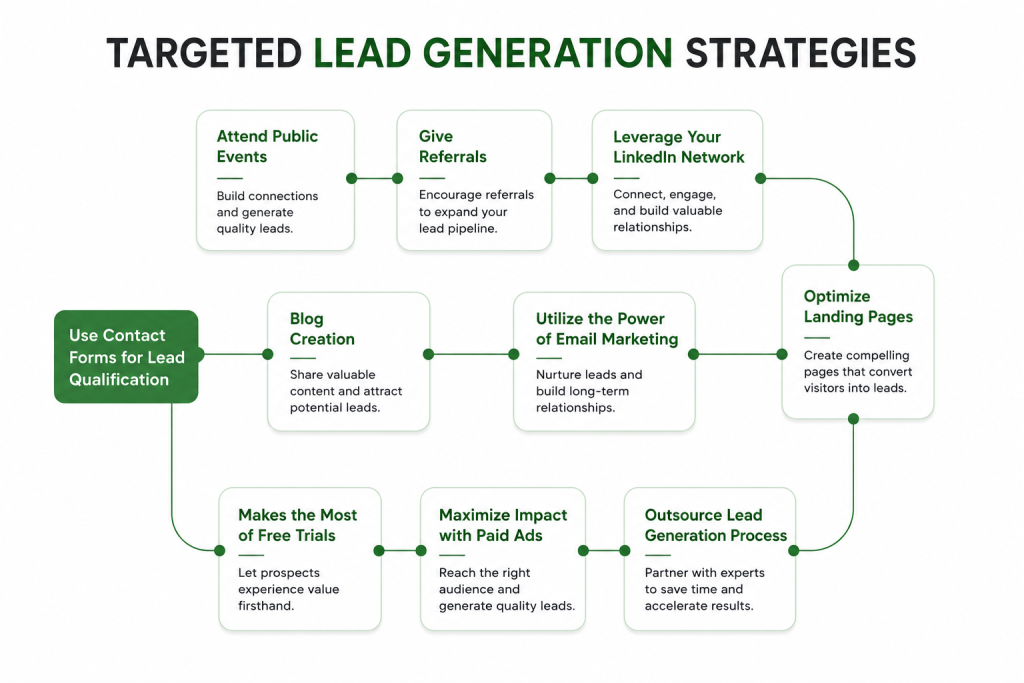
1. Start With a Clear Ideal Customer Profile
Every effective B2B lead generation campaign begins with focus. Before choosing channels, writing content, or launching outreach,
define exactly which companies are most likely to need your solution.
Your ideal customer profile should cover the target industry, company size, location, technology, business challenges, decision-making roles, and events that may trigger a purchase.
For example, “small businesses” is too broad. “US-based B2B software companies with 20 to 100 employees that need a more consistent outbound sales pipeline” is much more useful.
This detail improves targeting, messaging, content relevance, and sales efficiency.
2. Create Content Around Buyer Problems
B2B buyers rarely begin by searching for a company. They usually search for an answer to a problem.
Build content around real commercial questions, such as how to generate qualified B2B leads, improve outbound response rates,
choose between LinkedIn and cold email, calculate lead generation costs, or evaluate a B2B lead generation agency.
Create content for different stages of the buying journey. Educational guides attract early-stage visitors
Comparison pages help prospects evaluate alternatives. Case studies reduce perceived risk. Service pages support visitors who are ready to speak with a provider.
Avoid broad articles that repeat what is already available. Add practical steps, original examples, useful frameworks, and clear decision criteria.
The objective is to become the most useful source for a specific buyer question.
3. Optimize for SEO, Answer Engines, and AI Search
Buyers now discover companies through search engines, AI-generated summaries, answer engines, and conversational assistants.
Your content should therefore be easy for both people and machines to understand.
Use a clear answer-first structure:
- Give a direct answer near the beginning.
- Divide the topic into descriptive sections.
- Use headings that match real questions.
- Explain important terms in plain language.
- Include examples and actionable steps.
- Keep company, service, author, and contact information consistent.
- Update the page when your market or offering changes.
For the keyword “Best B2B Lead Generation Strategies,” answer the core question immediately, then explain each strategy in depth.
Related phrases such as qualified B2B leads, sales pipeline growth, LinkedIn lead generation, outbound prospecting, account-based marketing
and lead nurturing should appear naturally.
Technical foundations also matter. Make sure the page is indexable, mobile-friendly, included in your XML sitemap, and supported by logical internal links.
Use a descriptive title, a useful meta description, and structured data that accurately matches the visible content.
4. Build Trust and Demand on LinkedIn
LinkedIn brings professional identities, company information, job roles, and industry conversations into one environment.
A strong LinkedIn lead generation strategy has three parts.
First, optimize the profiles of founders, sales leaders, and subject-matter experts. Each profile should clearly explain who the person helps, which problem they solve,
and what action a prospect can take next.
Second, publish useful content consistently. Share practical observations, frameworks, industry lessons, customer questions, and informed opinions.
Strong posts create recognition and trust before outreach begins.
Third, build relationships through relevant engagement and personalized messages. Avoid opening with a long sales pitch.
The first goal is to establish relevance, not force a meeting.
5. Use Personalized Outbound Email
Outbound email remains valuable when it is targeted, relevant, and respectful. Mass-produced messages fail because they treat every recipient as identical.
Build small prospect lists based on your ideal customer profile. Personalize each message around the recipient’s role, company situation, likely priority, or a visible trigger event.
A useful outbound email includes a specific reason for contact, a relevant business problem, a concise explanation of value, and one simple call to action.
Do not overload the email with features, attachments, or calendar requests.
A short message that starts a conversation is usually more useful than a full sales presentation.
Follow up with a brief sequence that adds a new angle, example, or resource instead of repeating the same request.
6. Apply Account-Based Marketing to High-Value Prospects
Account-based marketing, or ABM, focuses sales and marketing effort on a selected group of valuable target accounts.
It is particularly useful when deal sizes are high, buying committees are complex, or the total addressable market is limited.
Select accounts that strongly match your ideal customer profile. Research their priorities, market position, likely challenges, and relevant decision-makers.
Then coordinate touchpoints across email, LinkedIn, content, advertising, events, and direct sales outreach.
An ABM campaign might include a tailored industry guide, a personalized landing page, outreach to several stakeholders, and a focused consultation offer.
The advantage is relevance: your team creates a stronger business case for a smaller number of high-potential accounts.
7. Offer High-Value Lead Magnets
A lead magnet gives prospects a practical reason to share their contact information.
The best lead magnets solve a narrow problem and provide immediate value.
Useful B2B examples include:
- Industry benchmark reports
- ROI calculators
- Audit checklists
- Planning templates
- Buyer’s guides
- Outreach scripts
- Readiness assessments
- Webinar recordings
A specific tool or assessment is more likely than a generic ebook to attract people facing the exact problem your service solves.
Connect each resource to a relevant next step.
Someone who downloads a pipeline audit checklist could be offered a short pipeline review rather than a generic newsletter.
8. Improve Landing Page Conversion
Traffic does not create pipeline unless the page converts the right visitors.
Each campaign should lead to a focused landing page with one primary objective.
The page should explain the buyer’s problem, present a clear solution, show who the offer is for, address common concerns, and provide a simple call to action.
Use a specific headline, concise offer explanation, relevant proof, clear process information, a low-friction form, frequently asked questions, and one visible next step.
Remove competing calls to action. Test headlines, offers, forms, proof, and CTAs based on lead quality rather than clicks alone.
9. Nurture Leads Until They Are Sales-Ready
Many B2B prospects are not ready to buy during their first visit. Lead nurturing keeps the relationship active while helping the prospect understand the problem,
compare solutions, and build confidence.
Segment leads by industry, interest, source, buying stage, and engagement.
Then send relevant follow-up content instead of the same newsletter to everyone.
A practical nurturing sequence can include:
- Delivery of the promised resource
- An explanation of the underlying problem
- A relevant example or case study
- A comparison or decision guide
- An invitation to a consultation or demo
Nurturing should make the next step easier when the buyer is ready.
10. Use Webinars, Partnerships, and Referrals
Trust-based channels can produce highly qualified opportunities.
Webinars demonstrate expertise while answering real buyer questions.
Choose a focused topic linked to an urgent business problem and keep the session educational.
Strategic partnerships can introduce your company to an established audience.
Look for agencies, software providers, consultants, and professional communities that serve the same market without directly competing with you.
Referrals transfer trust through an introduction. Create a simple process and ask satisfied clients, partners, and professional contacts for introductions when appropriate.
11. Measure Revenue Impact, Not Vanity Metrics
The best B2B lead generation strategies are measurable from first touch to revenue.
Important metrics include:
- Qualified lead rate
- Cost per qualified lead
- Meeting-booked rate
- Opportunity conversion rate
- Sales cycle length
- Customer acquisition cost
- Pipeline value by channel
- Closed revenue by campaign
Traffic, impressions, downloads, and email opens can help diagnose performance, but they are not the final goal.
A channel that produces fewer leads may be more valuable if those leads become larger or faster deals.
Create a shared definition of a qualified lead between marketing and sales.
Review lead quality regularly, identify where prospects leave the funnel, and improve the weakest stage.
How LeadCanal Can Support B2B Growth
A reliable lead generation system requires research, positioning, content, outreach, conversion, nurturing, and measurement to work together.
LeadCanal approaches B2B lead generation as a connected growth process rather than a collection of isolated tactics.
The right channel mix depends on your market, sales cycle, deal value, resources, and growth targets.
Some companies need stronger search visibility. Others need focused outbound prospecting, LinkedIn authority, account-based campaigns, or better conversion systems.
LeadCanal can help businesses identify suitable channels, create a structured acquisition plan, and turn market attention into qualified sales conversations.

Frequently Asked Questions
What is the most effective B2B lead generation strategy?
The most effective strategy is a coordinated system that combines precise targeting, useful content, search visibility, personalized outreach,
lead nurturing, and sales follow-up. The right combination depends on the target market and sales cycle.
How can a B2B company generate qualified leads?
A company can generate qualified leads by defining its ideal customer profile, targeting decision-makers with relevant messaging,
publishing high-intent content, and using forms or qualification questions to identify genuine buying interest.
Is LinkedIn effective for B2B lead generation?
LinkedIn can support B2B lead generation through professional content, profile optimization, relationship-building, targeted outreach,
paid campaigns, and direct access to relevant roles and companies.
How long does B2B lead generation take?
The timeframe depends on the strategy. Outbound outreach may create conversations relatively quickly, while organic search, brand authority,
and content marketing usually require consistent investment. A balanced strategy supports both immediate opportunities and long-term growth.
Should businesses outsource B2B lead generation?
Outsourcing can be useful when a company lacks internal research, content, outreach, technology, or campaign-management resources.
The provider should understand the target market, use transparent methods, and measure qualified pipeline rather than only contact volume.
Final Thoughts
The best B2B lead generation strategies combine precise targeting, useful content, search visibility,
personalized outreach, account-based marketing, conversion-focused pages, and consistent nurturing. No single tactic creates predictable growth on its own.
Start with a clear ideal customer profile. Choose the channels where your buyers already research and communicate.
Build content that answers real commercial questions. Personalize outreach. Measure qualified pipeline and revenue. Then improve the system based on evidence.
For businesses seeking a more focused and repeatable approach, LeadCanal provides a practical path from market research to qualified B2B opportunities.


