Skip to content
B2B Buyer Journey in 2026: Stages, Mapping, Examples & Strategy
A B2B buyer journey is the process a business customer follows from recognizing a problem to researching solutions, comparing vendors, making a purchase, and evaluating the result after implementation.
Buyers move between search engines, AI assistants, review sites, vendor websites, LinkedIn, peer recommendations, sales conversations, and internal meetings.
Gartner describes modern B2B buying as a set of recurring jobs, including problem identification, solution exploration, requirements building, supplier selection, validation, and consensus creation.
In 2026, this matters because much of the decision is shaped before a prospect speaks with sales. 6sense’s 2025 global study of nearly 4,000 B2B buyers found that first seller contact happened around 61% of the way through the buying process, while 95% of winning vendors were already on the buyer’s Day One shortlist.
For marketers and sales teams, the lesson is simple: you cannot wait for a demo request to start influencing the decision.
Table of Contents
- What Is a B2B Buyer Journey?
- Why the B2B Buyer Journey Matters in 2026
- Five Stages of the B2B Buyer Journey
- B2B Buyer Journey vs. Sales Funnel vs. Customer Journey
- How to Map the B2B Buyer Journey Step by Step
- Pros and Cons of B2B Buyer Journey Mapping
- Practical B2B Buyer Journey Example
- Real Screenshot Recommendations
- FAQs
- Conclusion
What Is a B2B Buyer Journey?
The B2B buyer journey is the path a company or buying group takes while identifying a need, researching solutions, evaluating vendors, approving a purchase, and measuring the outcome.
The important phrase is “buying group.” A department head may discover the problem, operations may compare solutions, IT may review integrations, finance may examine cost, procurement may negotiate terms, and an executive may approve the investment.
That is why the B2B buying journey is better understood as a network of decisions than a straight funnel.
Why the B2B Buyer Journey Matters in 2026
Three shifts have changed B2B purchasing.
First, buyers are more self-directed. Gartner reports that 75% of B2B buyers prefer a rep-free sales experience, although it also finds that useful digital tools combined with human support can improve buying outcomes.
Second, AI is becoming part of discovery and evaluation. Buyers can use ChatGPT, Gemini, Copilot, Perplexity, and Google AI experiences to understand categories, compare solutions, identify risks, and build shortlists. Ipsos’ August 2026 research similarly highlights that AI is making buyers more independent while trusted human relationships still matter when deals close.
Third, vendor shortlists form early. If buyers already know which companies they trust before contacting sales, educational content, reviews, comparisons, proof, and brand visibility become revenue assets.
The Five Stages of the B2B Buyer Journey

1. Awareness: “What Problem Are We Trying to Solve?”
The journey begins when someone recognizes a business problem, risk, inefficiency, or opportunity.
Examples include weak pipeline growth, poor email deliverability, outdated software, rising costs, or a new strategic priority.
At this stage, buyers want education rather than a hard pitch. Useful assets include:
- Educational guides
- Industry research
- Checklists
- Trend reports
- Original data
- Diagnostic tools
For outbound teams, accurate ICP research matters here. LeadCanal B2B Prospecting Guide explains how businesses can identify qualified companies, relevant decision-makers, and buying signals before beginning outreach.
2. Consideration: “What Could Solve This?”
Now the buyer understands the problem and explores different approaches.
Searches become more specific:
- “best B2B lead generation strategy”
- “cold email vs LinkedIn outreach”
- “how to improve B2B sales pipeline conversion”
- “best way to reach B2B decision-makers”
Comparison pages, how-to content, buyer guides, webinars, calculators, and detailed solution explainers work well here because they help buyers understand trade-offs without forcing an early sales call.
3. Evaluation: “Which Vendor Fits?”
The buyer now moves from solution categories to specific providers.
They may compare:
- Pricing
- Features and capabilities
- Integrations
- Reputation
- Customer results
- Implementation effort
- Security
- Support
- Total cost
- Expected ROI
A sales leader may care about pipeline. Marketing may care about lead quality. IT may focus on technical compatibility. Finance may care about cost and measurable return.
Case studies, feature comparisons, demonstrations, FAQs, calculators, customer proof, and transparent service pages become valuable here.
A prospect evaluating outbound acquisition, for example, can move from educational research into LeadCanal Cold Email Outreach service or LinkedIn Outreach service.
4. Decision: “Can We Approve This Purchase?”
At the decision stage, the question is no longer only whether the solution works.
The organization must decide whether it can confidently commit.
Common friction points include:
- Price
- Contract terms
- Stakeholder objections
- Procurement requirements
- Data privacy
- Implementation risk
- Internal approval
- Expected ROI
Sales teams should reduce uncertainty through clear next steps, implementation plans, proof, commercial terms, and a strong business case.
This is also where the buyer journey should connect with the company’s sales process. LeadCanal B2B Sales Pipeline Guide explains the operational side of moving qualified prospects through meetings, proposals, negotiations, and closed deals.
5. Implementation and Evaluation: “Did We Make the Right Choice?”
The B2B buyer journey does not end when the contract is signed.
Buyers expect successful onboarding, implementation, support, adoption, measurable outcomes, and evidence that the purchase created real business value.
Their experience can influence:
- Renewals
- Expansion
- Referrals
- Reviews
- Customer retention
- Future purchases
Track time-to-value, product or service usage, customer satisfaction, support issues, renewal signals, and measurable business outcomes.
B2B Buyer Journey vs. Sales Funnel vs. Customer Journey
| Concept | Main Perspective | Primary Purpose |
|---|---|---|
| B2B Buyer Journey | Buyer | Understand how buyers make purchase decisions |
| Sales Funnel | Seller | Manage opportunities and conversions |
| Customer Journey | Customer relationship | Improve the complete experience before and after purchase |
Your sales funnel records what your company wants the prospect to do.
The buyer journey explains what the prospect is actually trying to accomplish.
Strong B2B revenue teams align the two rather than treating them as interchangeable.
How to Map a B2B Buyer Journey Step by Step
Step 1: Define Your ICP and Buying Committee
Start by defining your Ideal Customer Profile (ICP).
Consider:
- Industry
- Company size
- Geography
- Revenue
- Technologies used
- Business challenges
- Growth signals
- Buying triggers
Then identify the people who influence the purchase.
Step 2: Identify the Buying Trigger
Ask what makes a potential buyer begin searching.
A SaaS company may look for lead-generation support after its pipeline slows.
A sales team may investigate email deliverability after reply rates decline.
A growing business may need better prospect data before entering a new market.
Understanding these triggers makes your marketing more relevant to actual buyer intent.
Step 3: Write the Buyer’s Question at Every Stage
Use the buyer’s language rather than internal marketing terminology.
Awareness: Why is our pipeline slowing?
Consideration: Which lead-generation approach should we use?
Evaluation: Which provider best fits our requirements?
Decision: What will this cost and how quickly can we implement it?
Post-purchase: Is it generating measurable business value?
These questions become the foundation of your content strategy.
Step 4: Match Content and Tools to Search Intent
Instead of publishing isolated articles, create a connected path:
Educational guide → Comparison → Tool or calculator → Case study → Service page → Consultation
Interactive tools can be particularly useful during research and evaluation because they let buyers validate information themselves. Gartner specifically highlights calculators, product-selection tools, visualizers, ratings, and reviews as useful digital interactions during B2B purchasing.
For email-led acquisition, the LeadCanal Domain Scanner allows prospects to check SPF, DKIM, DMARC, and DNS health before deciding what deliverability work they need.
Step 5: Connect Buyer Intent Signals to Sales Actions
Not every website visit means someone is ready to buy.
One informational blog visit may show weak intent.
Stronger signals can include:
- Multiple website visits
- Comparison-page views
- Tool usage
- Pricing-page activity
- Case-study engagement
- Content downloads
- Repeat visits
- Several people from one company visiting the site
Define which behaviours should trigger further marketing nurture and which deserve direct sales follow-up.
Step 6: Measure Where Buyers Stall
Do not measure the buyer journey with traffic alone.
Track metrics such as:
- Qualified website traffic
- Engaged accounts
- Content-assisted conversions
- Positive outreach replies
- Meetings booked
- Opportunity conversion rate
- Sales-cycle length
- Win rate
- Onboarding completion
- Retention
Then identify the stage where buyers stop progressing and improve the content, proof, or experience around that point.
Pros and Cons of B2B Buyer Journey Mapping
Pros
- Creates content around real buyer questions
- Improves sales and marketing alignment
- Reveals missing content
- Supports stage-specific outreach
- Makes conversion measurement more meaningful
- Strengthens visibility across search engines and AI discovery
Cons
- Journey maps can become outdated
- Teams may oversimplify a non-linear process
- Different customer segments may require separate maps
- Effective mapping requires CRM data, analytics, customer research, and sales feedback
Practical Example: A SaaS Company Looking for More Qualified Meetings
Imagine a 50-person B2B SaaS company whose outbound pipeline has slowed.
Awareness: The VP of Sales researches why meeting volume is falling.
Consideration: The team compares prospect-data quality, cold email, LinkedIn outreach, and email deliverability.
Evaluation: They review LeadCanal B2B prospecting resources, test their sending setup with the Domain Scanner, and read the Email Deliverability Guide.
Decision: Sales and marketing choose a combination of verified prospect data, cold email, LinkedIn outreach, and CRM tracking. Procurement reviews scope and pricing.
Implementation: Campaigns launch, replies are categorized, interested prospects enter the sales pipeline, and performance is tracked.
Evaluation: The company measures positive replies, booked meetings, qualified opportunities, sales velocity, and revenue.
Each stage creates a different question, intent signal, content requirement, and next action. That is a B2B buyer journey in practice.
Real Screenshot Recommendations
Use genuine LeadCanal screenshots instead of generic stock graphics.
Screenshot : LeadCanal Domain Scanner

LeadCanal Domain Scanner showing B2B email authentication checks.
Screenshot : Outreach Performance
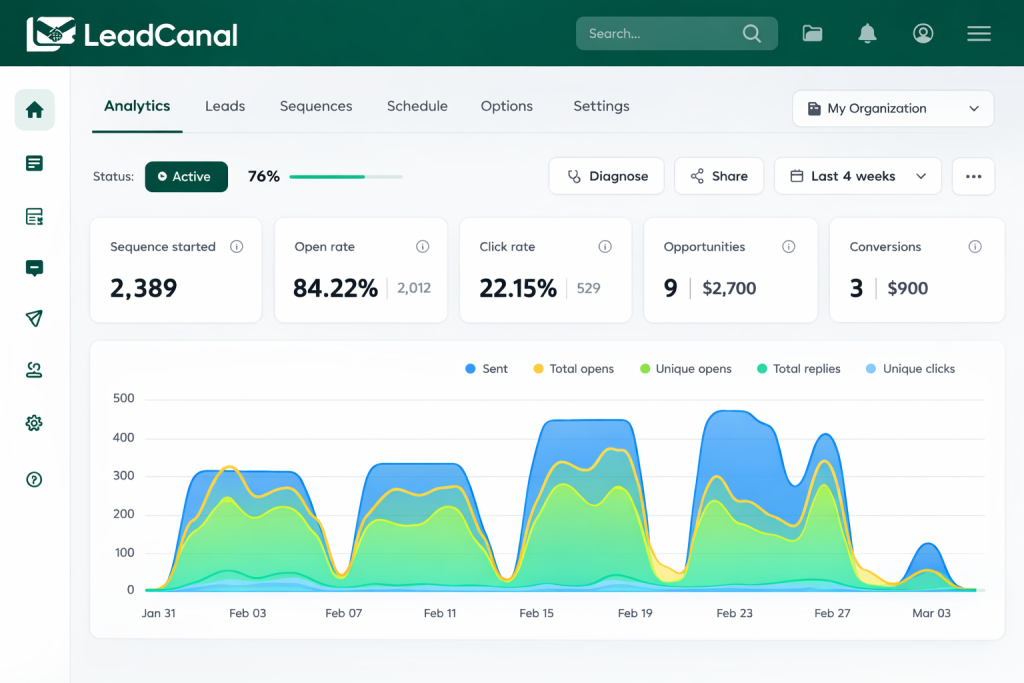
B2B outreach performance used to measure buyer engagement.
FAQs About the B2B Buyer Journey
What is the B2B buyer journey?
The B2B buyer journey is the process a business buyer or buying committee follows from recognizing a problem through researching, evaluating, purchasing, implementing, and reviewing a solution.
What are the main B2B buyer journey stages?
A practical model includes awareness, consideration, evaluation, decision, and implementation/evaluation.
Is the B2B buyer journey linear?
No. B2B buyers frequently move backward and forward between research, requirements, vendor comparison, validation, and internal consensus.
What is B2B buyer journey mapping?
B2B buyer journey mapping documents the triggers, questions, stakeholders, touchpoints, content requirements, intent signals, and actions associated with each stage of a purchase.
How is a B2B buyer journey different from a sales funnel?
The buyer journey represents the customer’s decision process. The sales funnel represents the seller’s process for managing and converting opportunities.
How is AI changing the B2B buyer journey?
AI tools help buyers research categories, compare vendors, summarize information, investigate risks, and create potential vendor shortlists before contacting a sales representative.
What content works best at each stage?
Use educational content for awareness, comparisons and guides for consideration, case studies and tools for evaluation, implementation and ROI information for decision, and onboarding or value-focused content after purchase.
How can businesses improve the B2B buyer journey?
Define the ICP, map the buying committee, answer stage-specific questions, connect related content, monitor buyer intent signals, align marketing with sales, and remove friction wherever prospects stop progressing.
Conclusion
The modern B2B buyer journey is not a neat path from awareness to a sales call. It is a self-directed, multi-stakeholder, increasingly AI-assisted decision process.
Businesses that win are easier to discover, understand, evaluate, and trust.
That requires more than publishing more content. Educational resources, comparison pages, buyer-focused tools, case studies, outreach, sales conversations, and post-purchase support should work together around the questions buyers are actually trying to answer.
Call to Action
Turn buyer research into a more predictable sales pipeline.
Explore LeadCanal’s B2B prospecting and outreach resources, test your email infrastructure with the Domain Scanner, and use targeted B2B data, cold email, LinkedIn outreach, and structured sales follow-up to reach the right buyers at the right stage of their journey.