 Skip to content

B2B Prospecting Guide in 2026: How to Find and Engage Qualified Buyers
Quick Answer
B2B prospecting in 2026 is the structured process of identifying companies that match your ideal customer profile,
finding the right decision-makers, analyzing relevant buying signals, and contacting those prospects with personalized outreach.
The most effective approach combines accurate B2B data, AI-assisted research, human review, multichannel engagement, lead qualification, and disciplined CRM follow-up.
Modern B2B prospecting is no longer about collecting the largest possible contact list.
It is about identifying the companies most likely to need your solution and approaching them with a credible reason to begin a conversation.
Salesforce defines sales prospecting as finding potential customers and reaching out to them so they can be developed from leads into genuine sales opportunities.
Before prospecting begins, businesses should define their ideal buyers, their problems, and the channels through which they are most likely to engage.
Table of Contents
- What is B2B prospecting?
- How B2B prospecting has changed in 2026
- B2B leads vs prospects vs opportunities
- Prospecting method comparison
- Pros and cons of B2B prospecting
- Step-by-step B2B prospecting process
- Practical B2B prospecting example
- Important prospecting metrics
- Common mistakes
- Frequently asked questions
- Conclusion
- Call to action
What Is B2B Prospecting?
B2B prospecting is the process of researching and contacting businesses that may benefit from your product or service.

The objective is to move suitable contacts through three stages:
- Lead: A person or company that may have potential but has not yet been evaluated.
- Prospect: A lead that appears to match defined targeting or qualification criteria.
- Opportunity: A qualified buying situation in which a relevant problem, stakeholder, and potential next step have been identified.
Prospecting may include outbound methods such as cold email, LinkedIn outreach, calling, referrals, events, and account-based outreach.
It can also include inbound prospects who have downloaded content, submitted a form, or engaged with a high-intent page.
A successful process does not treat every contact as equally valuable. It prioritizes fit, need, timing, authority, and commercial relevance.
How B2B Prospecting Has Changed in 2026
B2B prospecting in 2026 is becoming more targeted, signal-led, and AI-assisted.
AI tools can help sales teams research accounts, enrich records, summarize company information, identify potential buying signals,
draft personalized messages, and organize follow-up tasks. HubSpot,
for example, now provides prospecting features that can research target accounts, generate outreach, and monitor selected companies for buying signals.
LinkedIn Sales Navigator also continues to support persona-based searches, account lists, professional research, and AI-assisted prospect identification.
However, AI does not remove the need for human judgment. Automated research can misunderstand context, select weak signals, or produce messages that sound personalized without containing anything genuinely relevant.
The strongest 2026 prospecting process therefore uses:
- AI for research and administrative efficiency.
- Reliable data sources for contact discovery.
- Human review for accuracy and relevance.
- Buying signals for timing.
- Multiple stakeholders within important accounts.
- Personalized messaging based on real information.
- CRM workflows for consistent follow-up.
- Commercial outcomes for performance measurement.
The shift is away from broad “spray-and-pray” outreach and toward context-rich communication with carefully selected accounts.
B2B Lead vs Prospect vs Opportunity
| Stage | Definition | Evidence Available | Recommended Action |
|---|---|---|---|
| Lead | A contact or company with possible relevance | Basic contact or company information | Research and evaluate |
| Prospect | A lead matching important ICP criteria | Suitable industry, role, size or location | Begin relevant outreach |
| Engaged prospect | A prospect who has responded or shown meaningful activity | Reply, referral, meeting request or commercial question | Conduct discovery |
| Qualified opportunity | A credible buying situation | Need, stakeholder, timing and next step | Manage through the sales pipeline |
| Disqualified contact | A person or company that cannot realistically buy | Poor fit, irrelevant role or unsupported market | Remove or nurture appropriately |
The distinction matters because list size alone does not indicate pipeline quality.
A database containing thousands of names may produce little commercial value if the contacts do not match the business’s target market.
B2B Prospecting Method Comparison
| Method | Best Use | Main Advantage | Main Limitation |
|---|---|---|---|
| Cold email | Reaching selected decision-makers at scale | Direct, measurable and highly targeted | Requires accurate data and strong deliverability |
| LinkedIn outreach | Research and professional engagement | Provides role, company and activity context | Responses may be slow without established credibility |
| Cold calling | Immediate qualification and feedback | Enables real-time conversation | Requires good telephone data and capable representatives |
| Referrals | Trust-based introductions | Higher initial credibility | Difficult to scale predictably |
| Events and webinars | Relationship-building and education | Creates richer engagement | Requires planning, promotion and follow-up |
| Account-based prospecting | High-value target companies | Coordinates several stakeholders and channels | Research-intensive |
| Inbound prospecting | Engaged website visitors or content leads | Prospect has already shown interest | Limited control over which companies respond |
The right channel depends on deal value, target-market size, buyer behaviour, available data, and the sales team’s capacity.
Most B2B companies should avoid relying on only one channel. Email may introduce the business,
LinkedIn may provide research and social context, and a call may confirm whether the issue is commercially relevant.
Pros and Cons of B2B Prospecting
Advantages
- Gives the business control over its target market.
- Creates access to specific companies and job roles.
- Generates direct feedback about the offer.
- Supports new businesses without strong organic traffic.
- Helps test industries, messages, and value propositions.
- Produces measurable sales activity.
- Supports account-based and multichannel strategies.
- Can create a repeatable pipeline-building process.
Disadvantages
- Poor targeting can waste sales time.
- Incorrect data can cause bounces and missed contacts.
- Generic outreach may damage brand credibility.
- Personalized research requires time and expertise.
- Prospects may not be ready to purchase.
- Email and privacy requirements vary by location.
- Weak CRM processes can cause opportunities to be lost.
- Scaling too early may reduce message quality.
B2B prospecting works best when list quality, message relevance,
deliverability, qualification, and sales follow-up are treated as one connected system.
Step-by-Step B2B Prospecting Process
Step 1: Define Your Commercial Objective
Determine what prospecting should produce.
Possible objectives include:
- Qualified consultations.
- Product demonstrations.
- Channel partnerships.
- Enterprise sales opportunities.
- Market-validation conversations.
- Introductions to specific accounts.
- Expansion into a new industry or country.
Do not define success as merely sending emails or adding contacts.
Activity is useful only when it contributes to meaningful sales outcomes.
Step 2: Build Your Ideal Customer Profile
Your ideal customer profile describes the companies most likely to need, afford, and benefit from your service.
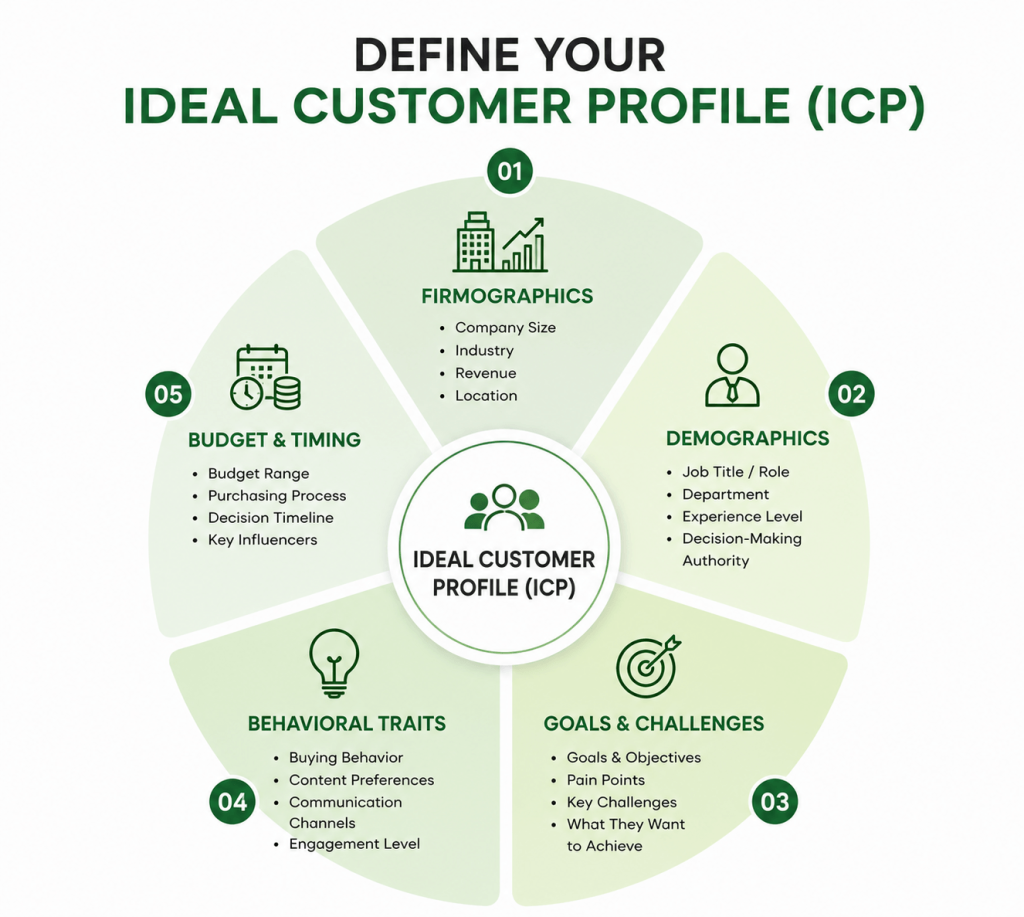
Define:
- Industry
- Location
- Company size
- Revenue
- Business model
- Relevant technology
- Common problems
- Buying triggers
- Typical contract value
- Exclusion criteria
Review your strongest existing customers where possible.
Look for recurring characteristics, business problems, and reasons they selected your solution.
Step 3: Identify the Buying Committee
B2B purchases are often influenced by several people.
Important roles may include:
- Economic buyer
- Department leader
- Technical evaluator
- End user
- Procurement representative
- Legal or compliance reviewer
- Internal champion
Do not assume that the chief executive is always the most appropriate first contact.
A department head or operational manager may understand the problem more clearly and provide access to the final decision-maker.
For high-value accounts, identify two or three relevant stakeholders rather than depending on one contact.
Step 4: Identify Useful Buying Signals
A buying signal is an observable event suggesting that a company may have a relevant need or increased readiness.
Examples include:
- Hiring for a related department.
- Entering a new market.
- Announcing funding or expansion.
- Changing leadership.
- Adopting new technology.
- Publishing a relevant strategic initiative.
- Attending a specialized event.
- Requesting a comparison, demonstration or quotation.
- Engaging with high-intent content.
A signal is not proof that the company will purchase. It is a reason to research the account more carefully and adjust the outreach message.
Step 5: Build the Prospect List
Collect the information required to evaluate and contact each account.
| Data Field | Purpose |
|---|---|
| Contact name | Identifies the person |
| Job title | Indicates role and possible influence |
| Company name | Identifies the account |
| Website | Supports company research |
| Business email | Enables professional outreach |
| LinkedIn profile | Provides professional context |
| Industry | Supports segmentation |
| Company size | Measures ICP fit |
| Location | Supports territory planning |
| Buying signal | Explains potential timing |
| Personalization note | Supports relevant messaging |
| Source | Enables data-quality review |
LeadCanal builds targeted B2B data using criteria such as industry, role, location, company size, and revenue.
Its published services also include manual research, AI-assisted discovery, LinkedIn prospecting, email verification, data enrichment, and clean outreach-ready lists.
Screenshot placement: Add the LeadCanal targeted B2B list-building visual beneath this section.
Step 6: Verify and Enrich the Data
Verification should occur before contacts enter a live campaign.
Review:
- Whether the person still works at the company.
- Whether the job title is current.
- Whether the business email is valid.
- Whether the company matches your ICP.
- Whether the account is already a customer.
- Whether the prospect has previously opted out.
- Whether required CRM fields are complete.
Data enrichment can add missing company size, revenue, industry, location, technology, or professional-profile information.
Accurate records improve segmentation, personalization, routing, and reporting.
Step 7: Prepare Outreach Infrastructure
For email prospecting, configure sending domains, professional mailboxes, DNS records, authentication, monitoring, and opt-out processes.
Google’s current sender guidance requires email authentication. Bulk senders must use SPF, DKIM, and DMARC, while the domain used for authentication must meet alignment requirements.
LeadCanal’s services include sending-domain configuration, SPF, DKIM and DMARC setup, mailbox preparation, sending rotation, reputation monitoring, and deliverability optimization.
Step 8: Write a Relevant Prospecting Message
A strong message should answer four questions:
- Why are you contacting this person?
- What relevant business issue are you addressing?
- Why might your solution be useful?
- What simple next step are you suggesting?
A practical structure is:
- Context: A real observation about the company, role, or market.
- Problem: A relevant challenge.
- Value: The outcome your company helps support.
- Proof: A credible example, capability, or resource.
- Call to action: One low-friction question.
Avoid fake personalization such as claiming to have studied a company’s internal operations when you have not.
Step 9: Use a Multichannel Cadence
Create a structured sequence rather than sending one message and abandoning the account.
A cadence may include:
- Initial email.
- LinkedIn profile research.
- Professional connection request.
- Value-focused follow-up.
- Telephone call where appropriate.
- Useful article or checklist.
- Final respectful close-out message.
Each touchpoint should add context. Repeating “Did you see my previous message?” provides little reason to reply.
Step 10: Qualify Responses
A positive response is not automatically a qualified sales opportunity.
Evaluate:
- Company fit
- Business problem
- Commercial impact
- Decision-making authority
- Internal stakeholders
- Available resources
- Timing
- Existing solution
- Desired outcome
- Agreed next step
Classify replies consistently as qualified, referral, nurture, future opportunity, not relevant, not interested, or unsubscribed.
Step 11: Record Everything in the CRM
The CRM should record:
- Contact history
- Lead source
- ICP segment
- Campaign
- Qualification status
- Objections
- Next action
- Follow-up date
- Opportunity value
- Disqualification reason
Salesforce notes that prospecting involves nurturing leads into opportunities,
making organized follow-up essential to moving prospects through the sales process.
Step 12: Measure and Improve
Track results by audience, campaign, message, channel, and representative.
Important metrics include:
| Metric | What It Indicates |
|---|---|
| Valid contact rate | Data quality |
| Delivery rate | Infrastructure performance |
| Bounce rate | Verification quality |
| Positive reply rate | Relevance and message strength |
| Meetings booked | Ability to create conversations |
| Qualified opportunity rate | Prospect quality |
| Pipeline value | Potential commercial impact |
| Sales conversion rate | Process effectiveness |
| Closed revenue | Final business outcome |
| Opt-out or complaint rate | Recipient experience |
Avoid optimizing only for email opens. Positive replies, qualified meetings, opportunities, and revenue provide more meaningful evidence.
Practical Example: Prospecting for a Cybersecurity Consultancy
Consider a cybersecurity consultancy targeting US-based SaaS companies with 50–500 employees.
Ideal Customer Profile
- SaaS businesses
- United States
- 50–500 employees
- Selling to enterprise customers
- Relevant contacts: CTO, security leader, operations director
Buying Signal
The target company is hiring an enterprise sales team and publishing content about moving into regulated markets.
This may suggest that customers will begin requesting more detailed security documentation.
Prospecting Approach
The consultancy researches the company and identifies three stakeholders:
- Chief technology officer
- Head of security
- Vice president of operations
The initial message does not claim that the company has a compliance problem.
It explains that SaaS businesses entering enterprise markets often face detailed security reviews and asks whether improving readiness is currently relevant.
A useful security-readiness checklist is included in the follow-up.
The operations leader responds and confirms that customer reviews are delaying several opportunities.
A discovery meeting is scheduled to discuss the company’s documentation, responsibilities, timelines, and target framework.
The prospect becomes an opportunity because the account fits the ICP, a genuine commercial problem has been confirmed,
relevant stakeholders are accessible, and a specific next step exists.
This example is illustrative and does not represent a claimed LeadCanal client result.
Common B2B Prospecting Mistakes
Avoid these frequent problems:
- Targeting too many industries simultaneously.
- Using outdated or unverified contact data.
- Contacting only the most senior executive.
- Treating every company event as a buying signal.
- Using AI-generated personalization without fact-checking.
- Sending the same message to every job title.
- Launching email campaigns without authentication.
- Failing to track opt-outs.
- Following up without adding value.
- Measuring volume instead of opportunity quality.
- Leaving replies unanswered for several days.
- Scaling a campaign before proving that the audience and offer are relevant.
Responsible Email Prospecting
Commercial email must follow the laws that apply to the sender, recipient, data source, and target location.
For commercial email in the United States, the FTC requires accurate sender details, non-deceptive subject lines,
a valid postal address, a clear opt-out method, and proper handling of unsubscribe requests.
Hiring an external provider does not necessarily remove the promoted company’s legal responsibility.
Rules differ between jurisdictions. Businesses should obtain suitable legal advice before targeting unfamiliar countries or markets.
Frequently Asked Questions
What is B2B prospecting in simple terms?
B2B prospecting means finding companies that may need your solution, identifying the appropriate people within those companies, and beginning a relevant sales conversation.
What makes a good B2B prospect?
A good prospect matches your ideal customer profile, has a problem your business can address, and has a realistic path to resources, authority, and action.
What is the difference between a lead and a prospect?
A lead is a potential contact that has not been fully evaluated. A prospect has been reviewed and appears to match important targeting or qualification criteria.
What are the best B2B prospecting channels?
Cold email, LinkedIn, calling, referrals, events, inbound content, and account-based outreach can all be effective. The best combination depends on the target buyer and sales process.
How is AI used in B2B prospecting?
AI can assist with account research, enrichment, summarization, signal detection, message drafting, prioritization, and follow-up administration.
Human review is still needed to verify facts and maintain relevance.
Is cold email still useful in 2026?
Cold email remains useful when the audience is carefully targeted, the contact data is accurate, the message is relevant,
the infrastructure is properly configured, and legal requirements are followed.
How many people should be contacted within one account?
For an important B2B account, identify several relevant stakeholders.
The exact number depends on deal complexity, but relying on one person creates unnecessary risk.
How often should a prospect be followed up?
There is no universal number. Use a reasonable cadence in which each follow-up adds useful information, and stop immediately when the recipient opts out.
What should B2B prospecting success be measured by?
Measure positive replies, qualified conversations, opportunities, pipeline value, conversion rates, sales-cycle progress, and revenue not contact volume alone.
How does LeadCanal support B2B prospecting?
LeadCanal helps businesses define target markets, research decision-makers, build verified B2B lists, enrich contact data,
configure email infrastructure, conduct personalized outreach, support LinkedIn prospecting, and manage campaign activity through CRM workflows.
Conclusion
B2B prospecting in 2026 requires more than a database and an automated email sequence.
The strongest approach combines a clear ideal customer profile, accurate account data, relevant buying signals, verified contact information,
AI-assisted research, human-reviewed personalization, multichannel engagement, structured qualification, and consistent CRM follow-up.
Technology can accelerate research and reduce administrative work, but it cannot replace commercial judgment.
Businesses still need to understand why a prospect may care, which stakeholders matter, and what credible next step should be proposed.
The goal is not to contact more people. It is to identify better-fit accounts, begin more relevant conversations, and convert those conversations into qualified sales opportunities.
Build a More Targeted Prospecting System with LeadCanal
LeadCanal helps businesses identify suitable companies, find relevant decision-makers, create verified outreach-ready lists,
improve contact data, configure cold email infrastructure, launch personalized campaigns, and manage prospects through structured workflows.
Contact LeadCanal to build a professional B2B prospecting system designed around your ideal customers, sales objectives, and target markets.


