Acumbamail terms of service and cold email outreach policy
On this page
- Introduction
- What Is Acumbamail Cold Email Outreach Policy?
- Why Mailing List Sources Matter
- Consent, Privacy and Responsible Data Processing
- How Email Authentication Supports Outreach
- Review DNS and Domain Configuration Before Sending
- Write Clear, Relevant and Professional Emails
- Unsubscribe Requirements and Recipient Preferences
- Plan Campaign Volume and Monitor Results
- Common Mistakes Businesses Should Avoid
- Frequently Asked Questions
- Conclusion
Acumbamail Terms of Service Cold Email Outreach Policy: Compliance Rules, Mailing List Restrictions and Deliverability.
Introduction
Cold email outreach can help businesses introduce relevant products, establish professional relationships, and generate business-to-business (B2B) opportunities. However, successful email marketing requires more than a compelling subject line and a list of potential customers. Businesses must understand the rules of their email platform, protect recipient privacy, manage contact data responsibly, and configure their sending domains correctly.
The Acumbamail terms of service and cold email outreach policy are important for businesses considering the platform for email campaigns.
Acumbamail has specific restrictions concerning external mailing lists, and marketers should understand these requirements before importing contacts or planning promotional communications.
This guide explains Acumbamail mailing list restrictions, consent and privacy considerations, unsubscribe requirements, and email authentication practices. It also explores how technical resources from LeadCanal can help businesses review their email infrastructure and prepare more reliable campaigns.
Before launching any campaign, review the current Acumbamail Terms of Use directly. Platform requirements can change, and the rules applicable to a particular campaign depend on its audience, purpose, and contact acquisition method.
What Is Acumbamail Cold Email Outreach Policy?
Acumbamail provides email marketing services, but access to an email marketing platform does not mean every cold outreach strategy is permitted. Its published terms and email-use requirements place restrictions on how users obtain and use recipient lists.
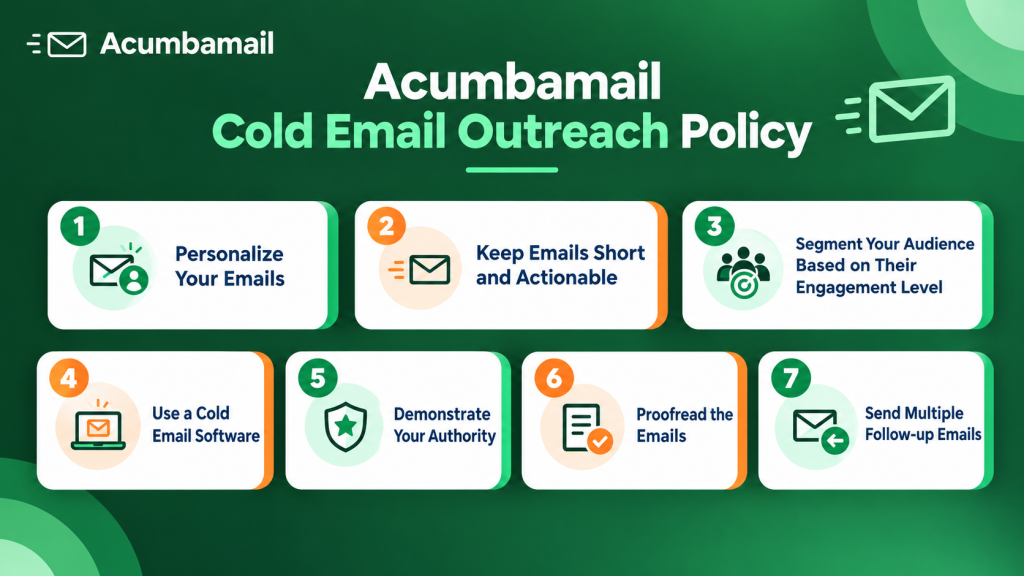
In particular, Acumbamail’s published policy prohibits purchasing, renting, or using mailing lists obtained from external suppliers, including lists whose suppliers claim that consent has been collected. The policy also addresses certain co-registration and data-sharing arrangements.
This is an important distinction for B2B marketers. A database may contain business owners, healthcare professionals, technology buyers, or other relevant contacts, but relevance alone does not establish that the database is acceptable for use through Acumbamail.
For example, businesses researching different audience acquisition methods may encounter consumer email list offerings. Finding such a resource does not override an email provider’s restrictions. Companies should not assume that a purchased or rented list can be imported simply because its contacts match their target audience.
A safer approach is to build an audience through appropriate, documented collection methods, review the platform’s current rules, and confirm that the intended communications are permitted before sending any campaign.
Why Mailing List Sources Matter
Contact acquisition is one of the most important parts of an email outreach strategy. Businesses may collect contacts through newsletter subscriptions, website forms, event registrations, customer relationships, or other channels. However, each source has different implications for privacy, permission, and acceptable use.
Before using a contact database, consider these questions:
- How was the contact information collected?
- Did recipients understand what types of communications they would receive?
- Is there a documented legal basis for processing and using the information?
- Does the email platform permit this particular contact source?
- Can recipients easily withdraw their preferences or unsubscribe?
- Are records maintained to prevent messages being sent after an opt-out?
A positive answer to one question does not automatically resolve the others. For example, a technically valid email address may still belong to someone who has not agreed to receive the proposed communication.
Businesses can use LeadCanal Email Verifier to support email address quality checks. However, verification is a technical process; it does not prove consent, establish a legal basis, or make an externally sourced list acceptable under Acumbamail’s terms.
Consent, Privacy and Responsible Data Processing
Consent and privacy requirements depend on the jurisdiction, recipient type, and purpose of the message. Some laws distinguish between individual consumers, corporate subscribers, and professional contacts. Others impose specific obligations concerning commercial email, personal data, transparency, and opt-out mechanisms.
Businesses should avoid assuming that publishing a business email address online grants unrestricted permission to use it for marketing. Public availability and marketing permission are different concepts.
Organizations should document their contact collection practices and establish clear processes for updating, correcting, and removing information. Where consent is relied upon, records should show what the recipient agreed to and when. Where another legal basis may be available, businesses should assess the relevant legal requirements rather than relying on assumptions.
Acumbamail Privacy Policy provides context about the platform’s privacy practices. Businesses should also evaluate their own obligations and, when necessary, consult qualified legal professionals.
For UK-focused campaigns, the Aubergine Legal guide to email marketing compliance offers additional context on legal considerations. It should be read alongside current legislation and official guidance rather than treated as a substitute for legal advice.
How Email Authentication Supports Outreach
Email authentication helps receiving systems evaluate whether messages are associated with authorized sending infrastructure. Three widely used standards are SPF, DKIM, and DMARC. They serve different purposes, and correctly configuring them can support domain security and message authenticity.
Authentication is not a permission mechanism. A domain can have valid authentication records while its owner still sends unwanted messages or violates a platform’s mailing list rules.
1. Review SPF records
Sender Policy Framework (SPF) identifies the servers authorized to send email for a domain. Incorrect or incomplete configuration can create authentication problems, particularly when a business uses multiple legitimate sending services.
LeadCanal SPF Checker can help review an existing SPF record. If a record needs to be prepared, the SPF Record Generator can help organize the configuration before publication.
Before making changes, identify the email services that actually send messages for your organization. Follow their technical instructions, avoid creating multiple SPF records for the same hostname, and validate the final configuration after updating DNS.
2. Configure DKIM correctly
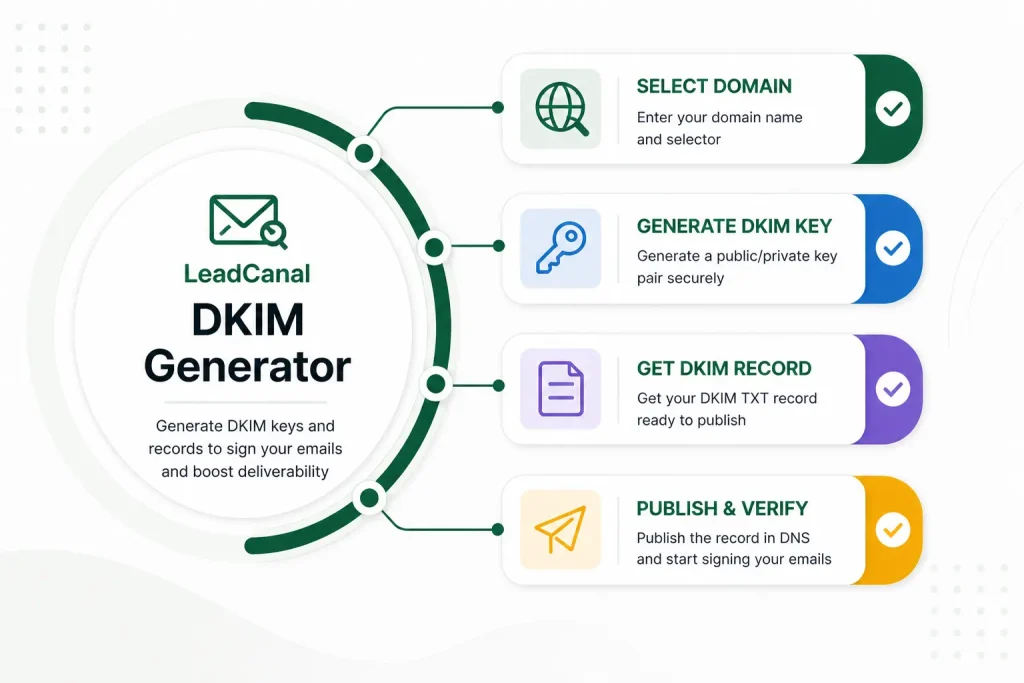
DomainKeys Identified Mail (DKIM) uses a cryptographic signature to help receiving systems verify that a message is associated with an authorized signing domain. The public key is published in DNS, while the sending system uses the corresponding private key to sign messages.
The DKIM Record Checker can help inspect a published DKIM record. The DKIM Record Generator can assist in preparing a record when setting up a signing configuration.
Always obtain the correct selector and public key from your email provider. A record copied from another domain or generated without the correct information may not work with your sending service. After publishing a record, verify the configuration and test actual messages.
3. Establish an appropriate DMARC policy
Domain-based Message Authentication, Reporting and Conformance (DMARC) builds on SPF and DKIM. It allows a domain owner to publish a policy that instructs receiving systems how to handle messages that fail authentication alignment and provides a framework for reporting.
Use DMARC Record Lookup to inspect a domain’s existing DMARC record. Before adopting a stricter policy, identify legitimate sending sources and review available authentication reports. An overly aggressive configuration introduced without preparation can affect legitimate email traffic.
Businesses should treat SPF, DKIM, and DMARC as complementary controls. None guarantees inbox placement, but maintaining accurate records is an important part of protecting a domain and supporting responsible email operations.
Review DNS and Domain Configuration Before Sending
DNS records connect domain names with information used by email and other internet services. Incorrect records can interfere with authentication, verification, and other aspects of sending infrastructure.
LeadCanal DNS Lookup can help inspect publicly available DNS information. A broader review with the Domain Scanner can support the process of identifying domain-related configuration issues.
Before sending a campaign, confirm that your domain is configured according to your email provider’s requirements. Review SPF authorization, DKIM records, and DMARC alignment, and check for outdated or conflicting entries.
Technical checks should also be part of routine maintenance. When a company changes email providers, adds a sending service, or updates its domain infrastructure, authentication records may need to be revised. Make changes carefully and test them before relying on the new configuration for important communications.
Write Clear, Relevant and Professional Emails
Even when a campaign meets technical requirements, its content can affect recipient trust and engagement. Messages should explain who is contacting the recipient, why the message is relevant, and what action—if any—the sender would like the recipient to take.
Avoid misleading subject lines, false familiarity, exaggerated promises, and language that conceals the commercial purpose of the message. Keep the content focused on a genuine business need and make it easy for recipients to understand the offer.
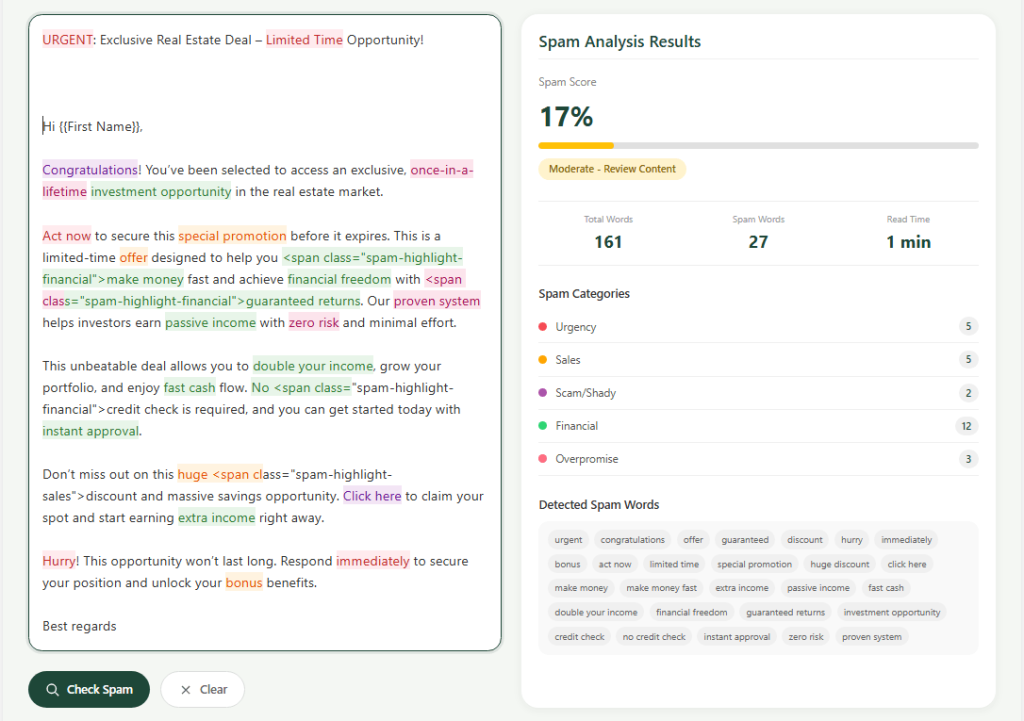
LeadCanal Email Copy Spam Checker can help review email copy for potential content-related issues. Treat the result as an aid rather than a guarantee of deliverability. Spam filtering depends on many factors, including recipient feedback, sender reputation, message characteristics, and authentication.
Businesses should also avoid sending the same generic message to every contact. Audience relevance, appropriate segmentation, and honest communication can make outreach more useful to recipients. However, better personalization does not remove the need to comply with platform rules and applicable marketing laws.
Unsubscribe Requirements and Recipient Preferences
A responsible email program gives recipients a clear way to stop receiving marketing communications. Acumbamail published terms require an effective unsubscribe mechanism for relevant promotional or commercial messages and messages based on consent. Its terms also specify requirements for processing unsubscribe requests, including a stated maximum period of three days.
Businesses should review the current policy to understand the precise requirements applicable to their campaigns. They should also maintain suppression records so that an opted-out contact is not accidentally added back to a future campaign.
Unsubscribe handling should be treated as an operational process, not simply a link placed at the bottom of an email. Teams need to make sure requests are recorded, synchronized with the appropriate systems, and respected in subsequent campaigns.
A final content review using the Email Copy Spam Checker can support quality control, but a content checker cannot confirm that opt-outs are processed correctly. That requires suitable data management and campaign procedures.
Plan Campaign Volume and Monitor Results
Businesses should plan their email activity carefully instead of increasing volume without considering audience quality, infrastructure, and recipient expectations. A sudden rise in sending volume can expose technical problems and make it harder to identify the cause of negative campaign results.
LeadCanal Cold Email Calculator can help estimate campaign quantities and support planning. Use such estimates as operational guidance, not as a way to bypass sending limits or justify contacting people through a prohibited list.
Monitor relevant indicators such as hard bounces, spam complaints, unsubscribes, and engagement. If complaints rise or authentication failures appear, pause and investigate instead of continuing to increase volume.
Before a campaign goes live, review the sending domain using the Domain Scanner and inspect published records through DNS Lookup. These checks can help identify technical issues, but they do not establish whether the contact source is allowed by Acumbamail.

Common Mistakes Businesses Should Avoid
Several mistakes can undermine an otherwise well-planned outreach program:
- Importing purchased or rented external mailing lists without checking platform restrictions.
- Assuming a publicly available address can be used for any marketing purpose.
- Treating email verification as proof of consent.
- Sending promotional messages without an effective unsubscribe process.
- Ignoring hard bounces, complaints, and recipient preferences.
- Publishing incorrect SPF, DKIM, or DMARC records.
- Using deceptive subject lines or unclear sender identities.
- Scaling sending volume without reviewing performance and technical readiness.
For technical troubleshooting, use the SPF Checker to review SPF configuration and DMARC Record Lookup to inspect DMARC policy. These resources can help identify configuration issues, but neither certifies legal compliance or permission to contact recipients.
Frequently Asked Questions
Does Acumbamail allow purchased email lists?
Acumbamail’s published terms expressly prohibit purchasing, renting, or using external mailing lists from suppliers, including lists for which a third party claims to have obtained consent. Review the latest official terms before importing contact data.
Does email verification make a campaign compliant?
No. Verification can help identify invalid or problematic addresses, but it does not prove consent, establish a legal basis, or override platform restrictions.
Do SPF, DKIM and DMARC guarantee inbox placement?
No. These standards support email authentication and domain security. Inbox placement also depends on reputation, recipient feedback, content, sending practices, and receiving-provider filtering.
Why is an unsubscribe process important?
It gives recipients a way to express their preferences and helps businesses avoid continuing unwanted communications. Organizations should process opt-outs within the required timeframe and maintain reliable suppression records.
Can a spam checker guarantee that an email will not enter the spam folder?
No. A content checker can flag possible issues, but it cannot predict every receiving system’s decision or guarantee inbox delivery.
Conclusion
Acumbamail cold email outreach requires careful attention to mailing list restrictions, consent and privacy obligations, unsubscribe handling, and email authentication. Businesses should not assume that a contact database is permitted merely because it is commercially available or contains relevant prospects.
A more responsible approach combines appropriate contact collection, clear communication, effective opt-out procedures, and correctly configured sending infrastructure. LeadCanal email and DNS tools can support technical reviews, content checks, and campaign planning as part of that broader process.
Before launching a campaign, review the latest Acumbamail terms, confirm that your contact source is permitted, and assess the laws applicable to your audience. Technical deliverability checks and legal compliance are separate responsibilities, and both deserve attention.
Editorial disclaimer: This article is for general informational purposes only and does not constitute legal advice. Consult current platform terms, official regulatory guidance, and qualified legal professionals when assessing specific campaigns.