Skip to content
Email Marketing with Purchased Lists: Risks, Rules & Better Alternatives in 2026
Quick Answer
Email marketing with purchased lists is possible in some situations, but buying a database does not automatically give you permission to use it for marketing.
Legal requirements vary by country, major email marketing platforms often prohibit purchased lists, and low-quality data can increase bounces, spam complaints, and sender-reputation problems.
For traditional newsletters and promotional email marketing, an opt-in list is usually the safer and more sustainable choice.
For B2B prospecting, a carefully researched, verified, and compliance-aware prospect database can be used differently from a mass consumer marketing list, subject to the laws and platform rules that apply to your campaign.
Table of Contents
- What Is Email Marketing with Purchased Lists?
- Are Purchased Email Lists Legal?
- Purchased Email Lists vs. B2B Prospect Lists
- Why Purchased Lists Can Hurt Email Marketing
- Pros and Cons of Purchased Email Lists
- What to Do If You Already Purchased an Email List
- Better Alternatives to Buying Generic Email Lists
- Practical B2B Example
- Real Screenshot Recommendations
- Frequently Asked Questions
- Conclusion
What Is Email Marketing with Purchased Lists?
Email marketing with purchased lists means sending commercial or promotional emails to addresses obtained from a third-party data provider rather than collected directly through your own signup forms, customers, events, or other first-party channels.
A purchased list might contain:
- Names
- Email addresses
- Company names
- Job titles
- Industries
- Locations
- Phone numbers
- Company size
- Revenue information
The problem is that not every purchased database is created the same way.
One list may contain millions of generic consumer addresses gathered from unclear sources. Another may be a carefully researched B2B prospect database containing relevant professional contacts from companies matching a defined Ideal Customer Profile.
Treating those two datasets as identical leads to bad marketing decisions.
If you are evaluating B2B data, LeadCanal guide to Compliant B2B Data Lists explains why sourcing, purpose, jurisdiction, verification, transparency, and opt-out handling matter more than simply calling a spreadsheet “compliant.”
Are Purchased Email Lists Legal?
There is no universal answer.
The legality of using purchased email data depends on factors including:
Country → recipient type → source of the data → purpose → lawful basis → message type → opt-out process
United States: CAN-SPAM
A common misconception is that CAN-SPAM requires every commercial email recipient to opt in before you contact them.
It does not.
The U.S. CAN-SPAM Act regulates unsolicited commercial email and requires, among other things, accurate sender information, non-deceptive subject lines, identification requirements where applicable, and a working method for recipients to opt out.
That does not mean every purchased list is automatically appropriate to use.
You still need to consider how the data was obtained, other privacy laws, your email platform’s rules, recipient expectations, and deliverability risk.
UK B2B Email Marketing
UK rules are more nuanced.
The Information Commissioner’s Office explains that PECR generally does not require prior consent for B2B marketing emails sent to corporate subscribers, such as limited companies. However, marketers must identify themselves and provide a valid way to opt out.
Different rules can apply to sole traders and certain partnerships. UK GDPR may also apply when you process information identifying individual business contacts.
So “B2B email is always legal without consent” is just as misleading as saying “all cold email is illegal.”
Platform Rules Are Separate from the Law
Even when a particular marketing activity may be lawful, your software provider can impose stricter rules.
Mailchimp’s current Acceptable Use Policy prohibits purchased, rented, third-party, co-registration, publicly available, and partner lists.
Klaviyo similarly states that it only supports permission-based sending and does not allow purchased or prospecting lists to be uploaded for marketing campaigns.
That distinction matters:
Legal permission does not automatically equal platform permission.
Purchased Email Lists vs. Targeted B2B Prospect Lists
This is one of the most important distinctions for modern B2B marketers.
| Factor | Generic Purchased List | Opt-In Marketing List | Targeted B2B Prospect List |
|---|---|---|---|
| Source | Third-party bulk seller | Direct signup | Targeted business research |
| Recipient expectation | Usually low | High | Depends on relevance |
| Best use | Usually limited | Newsletters and promotions | B2B prospecting/outreach |
| Targeting | Often broad | Based on subscribers | ICP and decision-maker based |
| Verification | Varies widely | Usually stronger | Should be verified |
| Platform compatibility | Often restricted | Widely accepted | Requires appropriate outreach system |
| Compliance | Depends on source/use | Usually clearer | Depends on jurisdiction/use |
| Spam risk | High if poorly sourced | Lower | Depends heavily on targeting and sending |
A targeted B2B list should not simply be a CSV containing as many addresses as possible.
It should answer:
Which companies fit our market?
Which person is relevant to our offer?
Is the business email current?
Why should this person reasonably care about our message?
LeadCanal B2B email list building resources focus on industry, job title, company size, revenue, location, decision-makers, verification, and campaign relevance rather than indiscriminate volume.
Why Purchased Lists Can Hurt Email Marketing
1. Recipients Did Not Ask to Hear From You
For conventional promotional email marketing, this is the biggest weakness.
A person who intentionally subscribes knows your brand.
Someone appearing on a purchased list may have never heard of you.
That increases the chance of:
- Ignored emails
- Unsubscribes
- Spam complaints
- Poor engagement
- Brand distrust
2. Purchased Lists Can Contain Old or Invalid Data
Email databases decay.
Employees leave companies. Domains change. Businesses close. People abandon inboxes.
A database that was accurate last year may contain a meaningful number of invalid records today.
Sending repeatedly to invalid addresses increases bounce problems and wastes campaign capacity.
A healthier workflow is:
Clean → verify → segment → suppress → send
LeadCanal Email Campaign Database guide explains how verification, deduplication, enrichment, segmentation, and suppression management can make a database more campaign-ready.
3. Spam Complaints Can Damage Sender Reputation
Mailbox providers care about recipient behavior.
Google’s current sender guidance tells senders to keep spam rates below 0.1% where possible and avoid reaching 0.3% or higher. Authentication and unsubscribe requirements also apply to qualifying bulk senders.
A list filled with people who do not recognize your brand makes those thresholds harder to maintain.
4. Purchased Lists May Contain Spam Traps
Low-quality or badly maintained databases may contain abandoned addresses, malformed contacts, or addresses associated with spam-detection systems.
That can hurt deliverability even before campaign performance becomes obviously poor.
5. Your Email Platform May Suspend the Account
Marketers sometimes ask:
“Can I upload a purchased list to Mailchimp?”
Under Mailchimp’s current policy, purchased lists are prohibited. Klaviyo also prohibits them for permission-based marketing.
Trying to disguise the origin of a list is not a clever workaround. It is a surprisingly efficient way to create a second problem while failing to solve the first.
Pros and Cons of Purchased Email Lists
Potential Pros
- Faster access to a large audience
- Can support market research
- Some B2B datasets offer detailed firmographic filters
- May help identify companies and decision-makers
- Faster than building every prospect record manually
Major Cons
- Contacts may not know your brand
- Data may be outdated
- Higher risk of irrelevant recipients
- Potential bounce and complaint problems
- Permission-based ESPs may prohibit usage
- Privacy and marketing rules vary by jurisdiction
- Generic databases usually produce weak personalization
- The same contacts may have been sold to many other marketers
The real question is therefore not:
“How many emails can I buy?”
It is:
How many relevant, accurate and appropriately sourced prospects can I identify for this specific campaign?

What to Do If You Already Purchased an Email List
Do not immediately upload 50,000 contacts into your newsletter platform and press Send. Humanity has already performed enough uncontrolled experiments.
Use a structured review instead.
Step 1: Identify the Source
Ask the provider:
- Where did the data come from?
- When was it collected?
- How frequently is it updated?
- Is it consumer or business data?
- Are sources documented?
- Are opt-outs and suppression requests maintained?
If the provider cannot explain how the data was sourced, that is a serious warning sign.
Step 2: Identify the Jurisdictions
Determine where recipients are located.
US, UK, EU, Canada, and other markets can have different email-marketing and privacy requirements.
Do not treat one legal rule as a worldwide permission slip.
Step 3: Separate Marketing Subscribers from B2B Prospects
An opt-in newsletter subscriber and a cold B2B prospect are not the same audience.
Keep them in separate databases, workflows, campaigns, and suppression systems.
Step 4: Remove Irrelevant Contacts
Filter by your ICP:
- Industry
- Company size
- Geography
- Job title
- Department
- Revenue
- Technology
- Business need
A database of 100,000 contacts is useless if only 2,000 are plausible buyers.
Step 5: Verify Email Addresses
Check addresses before outreach.
Remove obvious invalid, duplicate, and risky records.
Verification cannot make inappropriate data compliant, but it can prevent avoidable delivery problems.
Step 6: Check Your Sending Infrastructure
Before launching email outreach, verify:
- SPF
- DKIM
- DMARC
- DNS configuration
- Sending-domain health
You can use the free LeadCanal Domain Scanner to check SPF, DKIM, DMARC, and other domain records.
Step 7: Use Relevant Messaging
Do not send one generic promotion to thousands of unrelated contacts.
A strong B2B email should connect:
prospect role + company context + likely problem + relevant offer
For companies using cold outreach instead of traditional newsletter marketing, LeadCanal Cold Email Outreach service combines prospect research, verified data, infrastructure, personalized sequences, follow-ups, and campaign optimization.
Step 8: Make Opting Out Easy
Include a clear way to unsubscribe or request no further contact and maintain a suppression list.
Do not quietly add an opted-out contact back into another campaign six weeks later because someone exported the wrong spreadsheet.
Better Alternatives to Buying Generic Email Lists
Build an Opt-In Audience
For newsletters, ecommerce promotions, product updates, and content marketing, build first-party subscribers through:
- Lead magnets
- Signup forms
- Webinars
- Free tools
- Checklists
- Templates
- Original research
- Events
- Customer communities
Build a Targeted B2B Prospect Database
For outbound sales, build a database around your ICP rather than buying a generic bulk file.
For example:
Industry: B2B SaaS
Company size: 20–200 employees
Location: United States
Contacts: VP Sales, CRO, Head of Growth
Trigger: Hiring SDRs or expanding outbound
That is closer to account-based prospecting than old-fashioned bulk email blasting.
Practical Example
Imagine a software company purchases a database containing 20,000 US business contacts.
Instead of emailing everyone, the team audits the file.
Only 4,200 contacts match its target industries.
After removing irrelevant roles and companies, 3,100 remain.
Email verification and deduplication reduce the campaign-ready database further.
The team then separates:
- Founders
- Revenue leaders
- Sales directors
- Growth leaders
Each segment receives messaging based on its likely business problem rather than the same promotional template.
The result is a smaller campaign, but every remaining contact has a clearer reason to receive the message.
That is the fundamental difference between bulk list blasting and targeted B2B outreach.
Real Screenshot Recommendations
Screenshot 1: LeadCanal Domain Scanner

Domain authentication check before B2B email outreach.
Screenshot 2: Email Campaign Performance
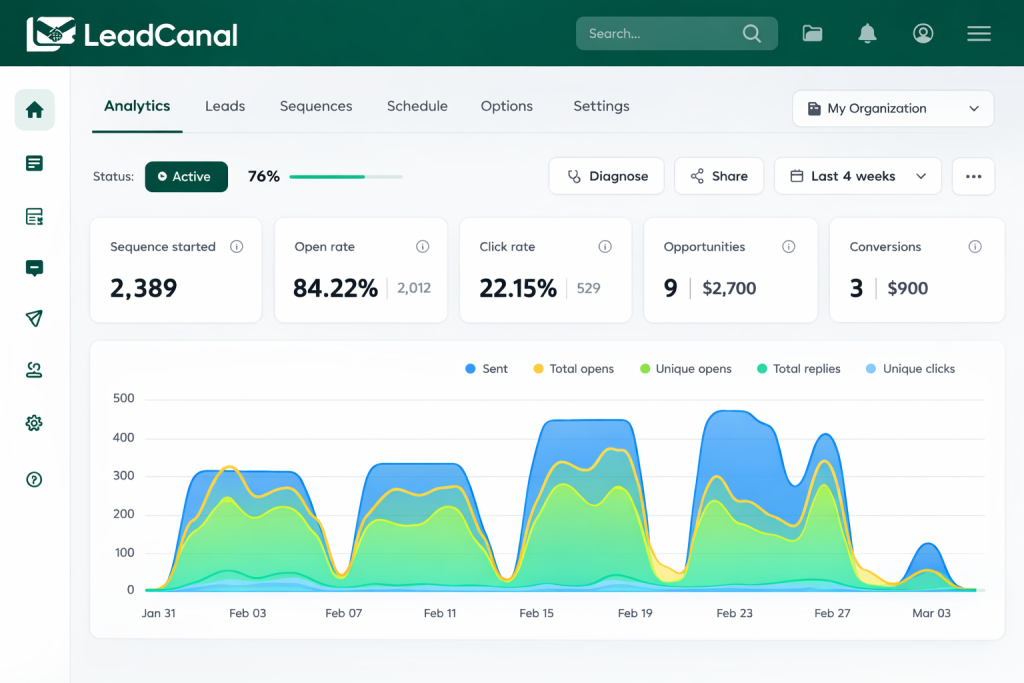
Use an anonymized real campaign dashboard showing:
- Emails sent
- Bounces
- Replies
- Positive replies
- Unsubscribes
Suggested alt text: “B2B email campaign metrics used to monitor list quality and engagement.”
Frequently Asked Questions
Is email marketing with purchased lists legal?
It depends on the jurisdiction, recipient type, data source, and intended use. For example, CAN-SPAM regulates commercial email in the United States without creating a universal prior opt-in requirement, while UK rules distinguish between corporate and individual subscribers.
Can I use a purchased email list with Mailchimp?
Mailchimp’s current terms prohibit purchased, rented, and third-party email lists.
Does Klaviyo allow purchased email lists?
No. Klaviyo states that it only supports permission-based sending and prohibits purchased and prospecting lists.
Are purchased B2B email lists the same as consumer mailing lists?
No. B2B datasets may contain professional contacts and company information for sales prospecting, while consumer lists are generally used for promotional marketing. Different legal, targeting, and platform considerations can apply.
Do purchased email lists hurt deliverability?
They can. Poor-quality lists may contain invalid addresses and uninterested recipients, leading to bounces, complaints, low engagement, and weaker sender reputation.
Can email verification make a purchased list safe?
Verification helps identify invalid or risky addresses, but it does not create consent, establish a lawful basis, or override an email provider’s terms.
What is the best alternative to buying a generic email list?
For email marketing, build an opt-in first-party audience. For B2B outbound sales, build a targeted prospect database around your Ideal Customer Profile and verify the contacts before outreach.
How can I protect my sender reputation?
Use relevant contacts, verify addresses, maintain suppression lists, authenticate your domain with SPF, DKIM, and DMARC, monitor complaints, and avoid sudden high-volume sending to unengaged recipients.
Conclusion
Email marketing with purchased lists is not simply a question of buying addresses and sending campaigns.
The real issues are data source, recipient expectation, legal requirements, platform rules, targeting, verification, deliverability, and sender reputation.
For traditional email marketing, permission-based subscriber lists remain the strongest long-term approach.
For B2B prospecting, the better alternative to a giant generic purchased database is a targeted, verified, compliance-aware prospect list built around a clear ICP and used through an appropriate outreach process.
Quality beats volume.
A smaller list containing the right companies and decision-makers is far more useful than 100,000 addresses that have no meaningful connection to your offer.
Call to Action
Stop treating B2B data as a numbers game.
LeadCanal helps businesses build targeted prospect databases, verify contact information, prepare cold email infrastructure, improve deliverability, and launch structured outreach campaigns designed around the right decision-makers.
Explore LeadCanal’s B2B data and outreach solutions and use the free Domain Scanner to check your email authentication setup before launching your next campaign.