Commercial Directors Email List for Targeted B2B Lead Generation

On this page
- Table of Contents
- What Is a Commercial Director Account Intelligence Database?
- Why Commercial Directors Matter in B2B Sales
- Commercial Director Email List vs. Account Intelligence
- Industries That May Require Commercial Director Contacts
- How to Identify and Qualify the Right Commercial Director Prospects
- What Information Should a Quality Database Include?
- Email Verification and B2B Data Enrichment
- How to Build a Commercial Director Outreach Strategy
- Account-Based Marketing and CRM Management
- Common Prospecting Mistakes to Avoid
- How to Measure Campaign Performance
- Frequently Asked Questions
- Conclusion:
Quick Answer
A Commercial Director Account Intelligence Database is a structured business resource that helps B2B sales and marketing teams research commercial decision-makers, identify suitable target companies, organize professional contact information, and prioritize potential business opportunities.
Depending on the dataset, it may include names, job titles, company details, industries, locations, business email addresses, and other relevant firmographic information.
The strongest approach goes beyond collecting contacts. It combines ideal customer profile development, account qualification, data verification, relevant messaging, and responsible outreach to help businesses identify commercial directors whose responsibilities align with their products or services.
Table of Contents
- What Is a Commercial Director Account Intelligence Database?
- Why Commercial Directors Matter in B2B Sales
- Commercial Director Email List vs. Account Intelligence
- Industries That May Require Commercial Director Contacts
- How to Identify and Qualify the Right Prospects
- What Information Should a Quality Database Include?
- Email Verification and B2B Data Enrichment
- How to Build a Commercial Director Outreach Strategy
- Account-Based Marketing and CRM Management
- Common Prospecting Mistakes
- How to Measure Campaign Performance
- Frequently Asked Questions
- Conclusion
What Is a Commercial Director Account Intelligence Database?
A Commercial Director Account Intelligence Database is a collection of business and professional information designed to support targeted prospecting.
It helps organizations understand which companies may be suitable customers, which commercial leaders could influence a purchasing decision, and how to prioritize outreach.
Commercial directors can have responsibilities involving revenue growth, business development, sales strategy, commercial partnerships, pricing, customer relationships, and market expansion. Their exact responsibilities vary by organization, industry, and job structure.
For a B2B vendor, this makes commercial directors potentially relevant prospects when an offering addresses a commercial challenge they own.
For example, a revenue operations consultancy may want to reach commercial leaders at growing businesses.
A business intelligence provider may focus on organizations looking to improve sales forecasting.
A partnership management platform may prioritize companies expanding into new markets.
In each case, the objective is to identify a relevant business need rather than contact executives simply because their job titles sound senior.
Companies looking to expand their prospecting beyond one executive role can also explore LeadCanal premium CXO decision-maker contacts when senior leadership audiences fit the campaign.
Why Commercial Directors Matter in B2B Sales
Commercial directors often connect business strategy with revenue-generating activities. Depending on the company, they may coordinate sales, business development, partnerships, customer growth, or commercial operations.
This makes them potentially valuable contacts for vendors whose solutions support those responsibilities.
1. Business Development and Revenue Growth
Commercial leaders may evaluate tools and services that help improve pipeline visibility, customer acquisition, sales productivity, or market expansion.
A vendor should connect its offer to a specific commercial objective. For example, a sales intelligence provider could explain how better account research helps teams prioritize suitable prospects.
2. Strategic Partnerships
Some commercial directors oversee partnerships, channel relationships, distribution agreements, or new market opportunities.
Businesses offering channel management, partner enablement, or market research services may therefore consider these professionals as part of their target audience.
3. Sales and Marketing Alignment
Commercial performance often depends on collaboration between sales, marketing, operations, and customer-facing teams.
Solutions that improve lead qualification, campaign measurement, or customer data quality may be relevant when they address a clearly identified business problem.
LeadCanal B2B SaaS companies email list can also support broader account research when the intended prospects include software businesses and their relevant decision-makers.
Commercial Director Email List vs. Account Intelligence
A commercial director email list and an account intelligence database are related, but they serve different purposes.
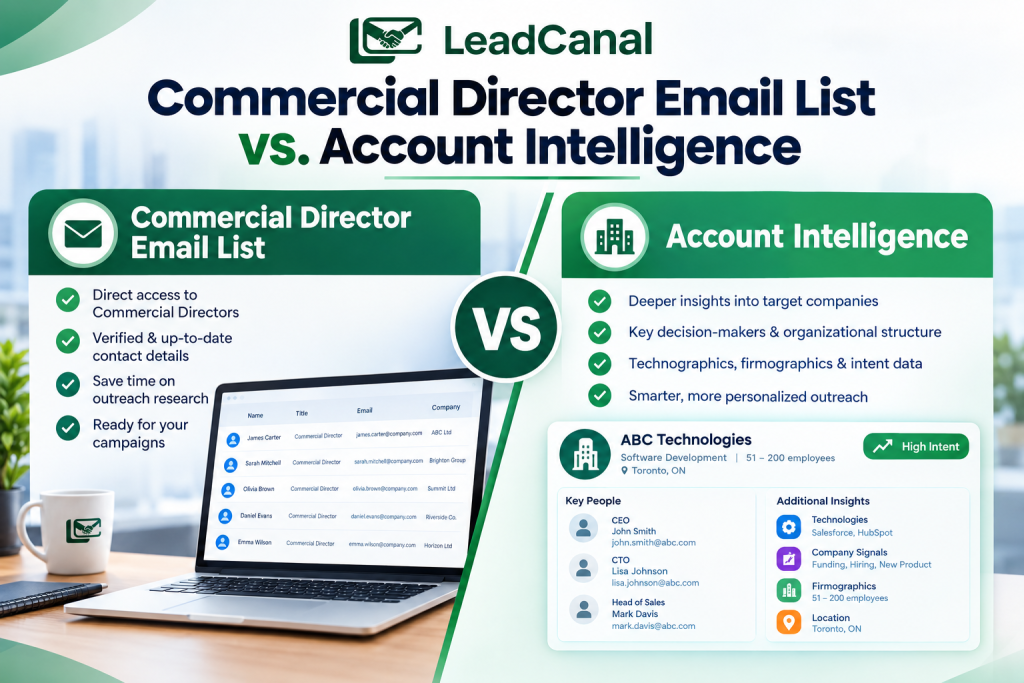
An email list primarily organizes contact records. Account intelligence adds context that helps a sales team understand the company, assess the prospect’s relevance, and decide whether outreach makes sense.
A basic record might contain a contact’s name, job title, company, and business email address. A more useful account profile may also include the organization’s industry, location, company size, business model, commercial priorities, relevant public signals, and the date the information was last checked.
This additional context can help sales representatives answer three important questions:
- Does the company match our ideal customer profile?
- Is this commercial director likely to be involved in the problem we solve?
- What relevant business reason justifies contacting this person?
Businesses seeking a wider range of company-level prospects can review LeadCanal B2B companies email list.
The key principle is simple: contact information supports outreach, but account intelligence supports better prospect selection.
Industries That May Require Commercial Director Contacts
The most relevant industries depend on the product, service, geographic market, and commercial problem being addressed.
The following sectors offer potential targeting opportunities, but industry membership alone does not establish buying intent.
Technology and SaaS
Software companies may employ commercial directors to oversee sales strategy, channel partnerships, revenue growth, and market expansion.
Vendors offering sales enablement, business intelligence, customer relationship management, or data services may investigate these organizations when their solutions match the company’s needs.
Financial Services
Banks, financial technology businesses, payment providers, and other financial services companies may have commercial leadership involved in customer acquisition, partnerships, and revenue development.
For campaigns specifically targeting this sector, LeadCanal finance and banking email list provides a related industry-focused resource.
Manufacturing and Distribution
Manufacturers and distributors may have commercial leaders responsible for channel relationships, pricing, customer accounts, and regional expansion.
A supplier or service provider should assess whether its offering addresses a real operational or commercial requirement before including an account in a campaign.
Logistics and Supply Chain
Logistics providers and supply chain businesses may employ commercial leaders who oversee customer acquisition, service partnerships, and business development.
Companies serving this market can investigate LeadCanal supply chain email list as a related resource for industry-focused prospect research.
Business Intelligence and Data Services
Commercial leaders may be relevant buyers for solutions that translate business information into better forecasting, reporting, and commercial planning.
LeadCanal Business Intelligence Users Email List is another resource to consider when building campaigns around analytics-related audiences.
How to Identify and Qualify the Right Commercial Director Prospects
A strong prospecting process starts with the customer rather than a large database.
Step 1: Define Your Ideal Customer Profile
Identify the organizations most likely to benefit from your offering.
Consider industry, company size, geography, business model, sales complexity, and the commercial problem your product solves.
For example, a consultancy specializing in enterprise sales transformation may prioritize established B2B organizations with multi-person sales teams. A local service provider may focus on smaller companies in a defined region.
Step 2: Define Relevant Job Titles
Commercial responsibilities can appear under different titles, including Commercial Director, Chief Commercial Officer, Director of Business Development, Sales Director, Revenue Director, or Partnerships Director.
These titles should not automatically be treated as equivalent. Review the actual responsibilities and organizational structure to determine whether a contact is suitable.
For campaigns that involve multiple executive roles, LeadCanal C-suite executives email list may help with broader executive-level prospect research.
Step 3: Research Company-Level Signals
Look for reliable public information that indicates business relevance. Examples include expansion announcements, new product launches, partnership initiatives, changes in commercial leadership, or stated growth priorities.
Use these signals to guide research, not to assume that a company is ready to purchase.
Record the source and date of important observations so sales representatives can distinguish recent evidence from outdated information.
Step 4: Prioritize Accounts
Create a simple qualification model based on company fit, relevance of the role, evidence of a matching business need, and the quality of available contact information.
Your team can assign different weights to these criteria based on previous sales experience.
A qualification score should guide research priorities; it should not be presented as proof of buying intent.
Step 5: Validate the Buying Group
A commercial director may influence a decision without being its only approver. Some purchases require input from finance, IT, procurement, operations, or executive leadership.
Identify the smallest relevant group of stakeholders instead of sending the same message to everyone in the organization.
What Information Should a Quality Database Include?
The fields required depend on the campaign, but a useful commercial director database should make it easy to identify the prospect, understand the account, and assess data quality.
| Data field | Why it matters |
| Contact name | Helps identify the intended professional |
| Current job title | Supports role-based targeting |
| Company name | Connects the person to an account |
| Company website | Helps validate the organization |
| Industry | Supports audience segmentation |
| Location | Helps organize geographic targeting |
| Business email | Provides a possible professional contact channel |
| Company size | Helps assess account fit |
| Relevant business context | Supports meaningful personalization |
| Verification status | Records the outcome of data-quality checks |
| Source and last-checked date | Supports review and maintenance |
Not every campaign needs every field. Collect information that has a clear purpose, and avoid unnecessary personal data.
Businesses that need to research technology-oriented accounts may also find LeadCanal IT decision-maker email list relevant when technical stakeholders form part of the buying group.
Email Verification and B2B Data Enrichment
Contact data changes over time. Employees move between organizations, email domains change, and business records become incomplete or outdated.
That is why data quality should be treated as an ongoing process rather than a one-time task.
Verify Email Addresses Before Outreach
Email verification can help identify certain address-quality issues before a campaign begins. It may reduce avoidable problems caused by invalid or risky addresses, depending on the verification method and the recipient’s mail environment.
LeadCanal Email Verifier can be incorporated into a pre-campaign data-quality workflow.
Verification has limits: it cannot guarantee inbox placement, prove that a person still holds a particular role, or establish permission to send a marketing message.
Validate Addresses During Lead Capture
If a business collects contacts through registration forms, demo requests, or other digital channels, it may benefit from checking email addresses when they enter the system.
LeadCanal email verification API is relevant to workflows that need automated validation during lead capture.
Enrich Incomplete Business Records
An existing CRM may contain a company name and website but lack a current job title, business email, or other useful information.
LeadCanal data appending services can be considered when a business needs to fill missing fields in an existing dataset.
For contact records specifically missing email information, email appending services may also be relevant.
Clean Existing Databases
Duplicate entries, outdated company names, inconsistent formatting, and old contact details can make segmentation and reporting difficult.
LeadCanal data cleansing and enrichment services can support the process of reviewing and improving existing records.
A sensible workflow is to research the account, enrich only the necessary fields, verify the available information, review compliance requirements, and then decide whether the contact belongs in a campaign.
How to Build a Commercial Director Outreach Strategy
Once the right accounts and contacts have been identified, outreach should focus on relevance rather than volume.
Here you can see the sample list. If you want to download these samples with dentists’ emails, please contact us or get a quote.

Segment by Commercial Objective
Separate prospects according to the problem your product solves. One segment might focus on sales efficiency, another on partnership development, and another on commercial reporting.
Different segments should receive different messages because their responsibilities and priorities may vary.
Personalize the Message
Reference a relevant, verified business detail and explain why your offering may be useful.
For example, a message to a commercial leader at a growing distributor might introduce a solution for improving account visibility or partner coordination, if that challenge is genuinely relevant.
Avoid unsupported assumptions about the company’s internal systems, revenue problems, or purchasing plans.
Use a Clear Call to Action
Ask for a proportionate next step, such as permission to share a short resource or an invitation to discuss a relevant business challenge.
Avoid exaggerated promises, misleading subject lines, or messages that conceal the sender’s identity.
Respect Outreach Requirements
Before sending, assess the laws and rules applicable to the recipient, location, data source, and communication channel. Apply appropriate consent or lawful-basis requirements, identify the sender clearly, and respect opt-outs and suppression requests.
LeadCanal cold email outreach resource can provide additional context for planning a structured B2B communication process.
For broader guidance, review the compliant B2B data lists and sourcing guide.
Account-Based Marketing and CRM Management
Account-based marketing (ABM) focuses sales and marketing efforts on selected organizations rather than treating every contact as an independent lead.
Commercial director prospecting can fit this approach when the business has a clearly defined target-account list.
Organize Contacts by Account
Store relevant commercial leaders and other stakeholders under the same company record. This makes it easier to coordinate communication, track engagement, and reduce duplicate outreach.
Maintain a Clear Record of Evidence
Record where the contact information came from, when it was checked, and whether the technology or business signal is confirmed, reported, inferred, or unverified.
This distinction helps teams avoid turning assumptions into facts during sales conversations.
Keep CRM Information Current
Businesses that target organizations using particular CRM systems can review LeadCanal Salesforce CRM users email list for a related audience. CRM-related technology targeting should remain separate from claims about a company’s commercial buying intent.
Align Sales and Marketing
Marketing can develop segment-specific content while sales teams use account research to guide conversations. Both teams should share qualification criteria, maintain suppression records, and agree on what counts as a meaningful response or opportunity.
Common Prospecting Mistakes to Avoid
- Targeting job titles without checking responsibilities. Two people with similar titles may own very different functions. Review the role before sending an offer.
- Prioritizing database size over relevance. A large list may contain companies outside your market or contacts who cannot benefit from your solution.
- Using outdated information. Old titles, inactive email addresses, and incorrect company associations can damage campaign quality.
- Confusing email verification with buyer qualification. A valid email address does not establish purchasing authority or interest.
- Sending generic messages. Commercial directors have different priorities across industries and company sizes. Personalization should reflect a real, relevant business context.
- Ignoring data provenance. Without source information and dates, it is difficult to evaluate accuracy or resolve conflicting records.
- Overlooking privacy and marketing rules. Data quality alone does not make every contact record or outreach method permissible.
- Failing to maintain CRM hygiene. Duplicate contacts and unrecorded opt-outs can lead to inconsistent communication and unreliable reporting.
Avoiding these mistakes helps create a more disciplined, evidence-based prospecting process.
How to Measure Campaign Performance
A well-organized campaign should be measured by business relevance and outcomes, not merely by the number of contacts collected.
Useful metrics include:
- Number of target accounts that match the ideal customer profile
- Percentage of records with complete, relevant company information
- Email verification outcomes
- Bounce rate and other delivery indicators
- Positive replies and qualified conversations
- Meetings held with suitable prospects
- Opportunities created and pipeline contribution
- Opt-outs, complaints, and suppression compliance
- Time spent researching and qualifying each account
Compare results across audience segments and messaging approaches. Use the findings to improve account selection, update records, and refine the value proposition.
Email open rates should be interpreted cautiously because privacy features and automated systems can affect their reliability. Positive responses, qualified meetings, and opportunity progression are generally more meaningful indicators of commercial relevance.
Frequently Asked Questions
What is a Commercial Director Account Intelligence Database?
It is a structured resource that combines professional contact information with company-level context to help B2B teams research commercial decision-makers and qualify potential accounts.
What is the difference between a commercial director and a sales director?
A commercial director may oversee broader commercial responsibilities such as sales, partnerships, pricing, customer growth, and market strategy. A sales director is often more focused on sales performance and sales-team management. Actual responsibilities vary by organization.
Which industries should businesses target?
Potential sectors include technology, SaaS, financial services, manufacturing, distribution, logistics, and business services. The right audience depends on the product, target market, and customer problem being addressed.
What should a commercial director email list contain?
Useful fields may include the contact’s name, current job title, company, website, industry, location, professional email address, verification status, and source information. Additional fields should be included only when they serve a clear purpose.
Does email verification guarantee successful outreach?
No. Verification can help assess address quality, but it cannot guarantee inbox placement, confirm purchasing intent, or establish consent or another lawful basis for marketing.
How can businesses improve commercial director lead generation?
Start with an ideal customer profile, identify relevant accounts and roles, assess data quality, personalize the outreach, and measure qualified responses. Update records regularly and respect applicable marketing requirements.
Conclusion:
Commercial director prospecting is most useful when it connects the right professional to the right company and a relevant business need.
A Commercial Director Account Intelligence Database can support this process by organizing contact information, company characteristics, commercial context, and data-quality indicators in one structured workflow.
The objective is not simply to collect more email addresses. It is to identify suitable accounts, understand the responsibilities of commercial decision-makers, maintain accurate information, and communicate a clear value proposition.
By combining account qualification, contact research, email verification, data enrichment, CRM management, and personalized outreach, B2B teams can develop a more organized and measurable prospecting strategy.
LeadCanal offers related resources for executive contacts, industry-specific prospecting, email verification, data appending, data cleansing, and outreach planning.
Businesses should select the resources that match their actual campaign objectives and independently evaluate data quality, sourcing, and applicable compliance requirements before using contact information.
A focused, well-maintained prospect database provides a stronger foundation for strategic B2B growth than an unqualified collection of contacts.