Engineering Professionals Email List | Targeted B2B Contacts
On this page
- What Is an Engineering Professionals Email List?
- Quick Answer
- Why Engineering Contacts Matter for B2B Lead Generation
- Engineering Professionals vs. Engineering Decision-Makers
- Engineering Disciplines You Can Target
- Mechanical Engineering Professionals
- Civil and Structural Engineering Contacts
- Electrical and Electronics Engineering Contacts
- Software, Systems and Computer Engineering
- Industrial, Manufacturing and Process Engineers
- Engineering Managers and Directors
- What Information Should an Engineering Database Include?
- Engineering Contacts by Industry
- Engineering Companies by Size
- Engineering Professionals by Location
- Engineering Software and Technology Users
- How to Build a Targeted Engineering Contact Database
- Data Cleansing and Enrichment for Engineering Leads
- Why Email Verification Matters for Engineering Contacts
- Engineering Email Lists for B2B Marketing
- Engineering Contacts for Sales Outreach
- Engineering Leads for Account-Based Marketing
- Engineering Data for CRM Enrichment
- Email Validation Before Engineering Outreach
- Real-Time Validation for Engineering Lead Forms
- Common Engineering Email List Mistakes
- Responsible B2B Data Practices
- Sample Engineering Professionals Email List
- How to Segment Engineering Professionals
- Frequently Asked Questions
- Editorial Policy
- Content Transparency
- About the Author
- Conclusion
Introduction
Engineering is one of the broadest professional categories in the B2B market. Mechanical engineers, civil engineers, electrical engineers, software engineers, industrial engineers, design engineers, project engineers, engineering managers, and technical directors can all have very different responsibilities and purchasing influence.
For businesses selling technical products, engineering software, industrial equipment, automation solutions, consulting services, recruitment services, or specialized B2B products, reaching the right engineering professional matters more than simply reaching a large number of contacts.
An Engineering Professionals Email List can help businesses organize professional contacts according to engineering discipline, job title, company, location, industry, seniority, and other business attributes. Competitor databases commonly segment engineering contacts by specialty, job role, company size, geography, and technology-related criteria.
The key is to build a database around the actual sales objective. A company selling CAD software may need design engineers and engineering managers, while an industrial automation supplier may need controls engineers, plant managers, operations leaders, and manufacturing engineers.
Before launching campaigns, businesses can also review B2B email verification techniques to understand how contact quality can fit into a broader prospecting workflow.
What Is an Engineering Professionals Email List?
Quick Answer
An Engineering Professionals Email List is a structured B2B database containing professional contacts who work in engineering-related functions.
Depending on the source and campaign requirements, a database may contain:
- Full name
- Professional email address
- Job title
- Engineering discipline
- Department
- Seniority
- Company name
- Company website
- Industry
- Location
- Employee size
- Revenue range
- Business phone
- Technology information
- Professional profile information
The exact fields available depend on the data source and methodology.
A useful engineering database should do more than answer “Who is an engineer?” It should help sales and marketing teams understand what type of engineer the contact is, what company they work for, what department they belong to, and whether their professional role is relevant to the product being promoted.
Businesses that want to evaluate individual addresses before outreach can use an email verification tool as part of their data-quality workflow.
Why Engineering Contacts Matter for B2B Lead Generation
Engineering departments influence purchasing decisions across many industries.
Engineering professionals may evaluate or use:
- CAD and design software
- Engineering simulation tools
- Manufacturing equipment
- Industrial automation
- Robotics
- Testing equipment
- Components
- Sensors
- Engineering consulting
- Technical services
- Cloud platforms
- Cybersecurity solutions
- Data and analytics platforms
- Project management software
- Recruitment services
However, not every engineer is automatically a buyer.
A technical user may recommend a product, an engineering manager may evaluate it, procurement may negotiate the commercial terms, and an executive may approve the final budget.
This means engineering prospecting should consider both technical relevance and buying influence.
For companies that need real-time checking within forms, applications, or data workflows, a real-time email verification API can also be relevant to maintaining cleaner contact information.
Engineering Professionals vs. Engineering Decision-Makers
One of the most important distinctions in an engineering database is the difference between a professional user and a decision-maker.
Technical User
This person works directly with the technology, equipment, component, or process.
Technical Evaluator
This professional may test whether a solution meets technical requirements.
Recommender
This individual may influence which products or suppliers are considered.
Engineering Manager
This person may control departmental requirements, projects, teams, or budgets.
Engineering Director
A director may oversee larger engineering operations and participate in strategic purchasing decisions.
Executive
Senior leadership may approve major technology, equipment, or service investments.
A B2B campaign can therefore include multiple contacts from the same account rather than relying on one generic engineering contact.
Engineering Disciplines You Can Target
Engineering includes numerous specialties, and segmentation by discipline can make prospecting more relevant.
Common categories include:
- Mechanical Engineering
- Civil Engineering
- Electrical Engineering
- Software Engineering
- Industrial Engineering
- Chemical Engineering
- Aerospace Engineering
- Structural Engineering
- Electronics Engineering
- Automotive Engineering
- Environmental Engineering
- Biomedical Engineering
- Manufacturing Engineering
- Automation Engineering
- Robotics Engineering
- Systems Engineering
- Process Engineering
- Design Engineering
- Project Engineering
- Marine Engineering
Competitor engineering databases similarly organize contacts across multiple specialties rather than treating engineering as one uniform audience.
For example, a robotics supplier may prioritize automation and industrial engineers, while a construction software company may focus on civil and structural engineering professionals.
Mechanical Engineering Professionals
Mechanical engineers work across product design, manufacturing, machinery, equipment, automotive applications, industrial systems, and other technical environments.
Potential target roles include:
- Mechanical Engineer
- Senior Mechanical Engineer
- Mechanical Design Engineer
- Manufacturing Engineer
- Product Engineer
- Mechanical Engineering Manager
- Engineering Director
- Design Engineering Manager
Companies selling machinery, components, CAD software, simulation tools, industrial automation, testing systems, and manufacturing services may find this audience relevant.
The campaign should still be narrowed by industry and company type because a mechanical engineer in automotive manufacturing may have very different requirements from a mechanical engineer in consumer-product development.
Civil and Structural Engineering Contacts
Civil and structural engineering professionals can work on construction, infrastructure, transportation, commercial buildings, industrial facilities, bridges, utilities, and other projects.
Relevant job titles can include:
- Civil Engineer
- Structural Engineer
- Senior Structural Engineer
- Civil Engineering Manager
- Project Engineer
- Structural Engineering Director
- Design Engineer
- Technical Director
Businesses selling engineering software, construction technology, surveying solutions, structural-analysis platforms, materials, equipment, or consulting services may develop specialized audiences around these roles.
A geographic filter can be particularly useful for businesses operating only in selected construction or infrastructure markets.
Electrical and Electronics Engineering Contacts
Electrical and electronics engineering covers areas such as power systems, electronics, embedded systems, industrial controls, electrical infrastructure, and product development.
Potential contacts include:
- Electrical Engineer
- Electronics Engineer
- Electrical Design Engineer
- Controls Engineer
- Instrumentation Engineer
- Electrical Engineering Manager
- Automation Engineer
- Technical Director
Industrial suppliers and technology companies can use these job functions to create more focused prospect segments.
For example, an industrial controls vendor may want automation and controls professionals rather than every engineer working within a manufacturing organization.
Software, Systems and Computer Engineering
Software and systems-related engineering roles represent another major B2B audience.
Potential titles include:
- Software Engineer
- Systems Engineer
- DevOps Engineer
- Cloud Engineer
- Data Engineer
- Computer Engineer
- Systems Architect
- Software Engineering Manager
- Director of Engineering
- VP of Engineering
This audience can be relevant for software vendors, cloud providers, cybersecurity companies, developer platforms, infrastructure providers, technical recruitment firms, and other technology businesses.
Because software engineering overlaps with IT and product development, companies should define whether they need individual contributors, engineering leadership, technical architects, or technology decision-makers.
Businesses targeting technical and IT leadership can also explore IT decision-maker contacts when engineering and technology purchasing overlap.
Industrial, Manufacturing and Process Engineers
Industrial and manufacturing engineers are closely connected with productivity, production systems, quality, automation, process improvement, and operational efficiency.
Potential roles include:
- Industrial Engineer
- Manufacturing Engineer
- Process Engineer
- Quality Engineer
- Production Engineer
- Automation Engineer
- Plant Engineer
- Operations Engineer
- Engineering Manager
This audience may be relevant to businesses selling:
- Factory automation
- Robotics
- Production equipment
- Industrial software
- Quality systems
- Sensors
- Process-control technology
- Manufacturing analytics
Campaigns can become more precise by combining engineering job titles with manufacturing industries and company-size filters.
Engineering Managers and Directors
Engineering leadership can be particularly relevant when a product requires departmental approval or significant technical investment.
Potential leadership titles include:
- Engineering Manager
- Senior Engineering Manager
- Engineering Director
- Director of Engineering
- VP Engineering
- Chief Engineering Officer
- Technical Director
- R&D Director
- Product Engineering Manager
- Engineering Operations Manager
Competitor databases explicitly include engineering directors, engineering managers, project managers, technical leads, product engineering managers, R&D managers, and other related roles.
These contacts can be combined with individual engineering professionals to create account-level stakeholder maps.
What Information Should an Engineering Database Include?
A practical database can be divided into several layers.
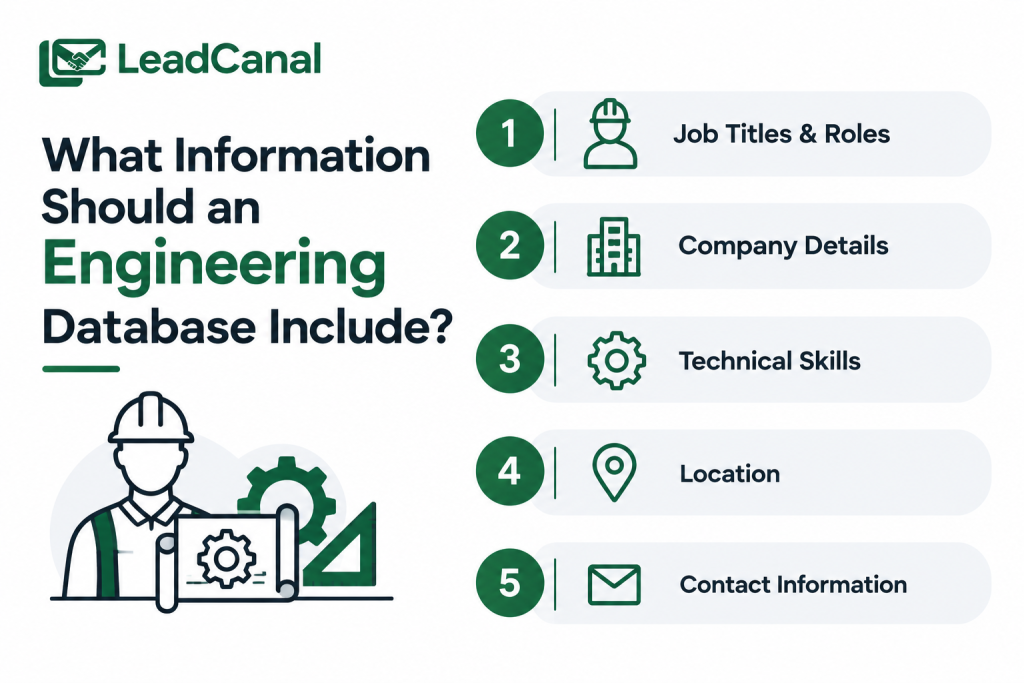
Contact Information
- Name
- Professional email
- Job title
- Seniority
- Department
- Business phone
Company Information
- Company name
- Website
- Industry
- Company size
- Revenue range
- Location
Engineering Information
- Discipline
- Technical specialty
- Engineering function
- Department
- Seniority
- Management responsibility
Technology Information
- Software environment
- Engineering platforms
- Manufacturing technology
- Automation environment
- Relevant technology signals
UpLead, for example, describes engineering contact records using fields such as discipline, seniority, company size, industry, location and technologies used.
Businesses with incomplete company records can also consider data appending services when additional business information is needed.
Engineering Contacts by Industry
Engineering professionals exist across nearly every major business sector.
Possible industry segments include:
- Manufacturing
- Automotive
- Aerospace
- Construction
- Energy
- Oil and Gas
- Chemicals
- Electronics
- Telecommunications
- Technology
- Healthcare
- Medical Devices
- Transportation
- Marine
- Consumer Products
- Industrial Equipment
- Renewable Energy
Industry segmentation is important because the same engineering title can represent completely different commercial requirements.
For example, an electrical engineer in renewable energy may have different technology requirements from an electrical engineer working in electronics manufacturing.
Engineering Companies by Size
Company size can help refine an engineering prospecting campaign.
Possible segments include:
- Small engineering firms
- Startups
- Mid-market companies
- Large enterprises
- Multinational organizations
A small engineering consultancy may have a compact decision-making structure where the principal engineer participates directly in purchasing.
A large manufacturer may have separate engineering, procurement, IT, operations, and finance stakeholders.
Therefore, company size should be used together with job title and industry rather than as a standalone targeting criterion.
Engineering Professionals by Location
Geographic segmentation can help businesses focus on markets they can actually serve.
Possible filters include:
- Country
- State
- Province
- City
- Metropolitan area
- Sales territory
- Region
Potential search segments include:
- Engineering Professionals Email List USA
- US Engineers Email Database
- UK Engineering Professionals
- Canadian Engineering Contacts
- Australian Engineering Database
- Global Engineering Professionals
- Engineering Contacts by State
- Engineering Companies by City
Competitor pages also promote country-specific and regional engineering databases, demonstrating that geography is a common segmentation layer.
A company selling region-specific engineering services should prioritize the geographic markets it can realistically support.
Engineering Software and Technology Users
Technology-based segmentation can be valuable for software vendors and digital solution providers.
Potential categories include:
- CAD
- CAM
- CAE
- PLM
- ERP
- Engineering simulation
- Product lifecycle management
- Manufacturing software
- Automation platforms
- Robotics
- Industrial IoT
- Engineering analytics
- Cloud engineering tools
Technographic data can help identify companies using technologies related to the solution being marketed. UpLead specifically highlights technology information alongside engineering discipline and company data.
However, a technology signal should be treated as a targeting indicator rather than proof that a company is currently planning to purchase a new solution.
How to Build a Targeted Engineering Contact Database
A strong engineering database starts with the ideal customer profile.
Step 1: Define the Product Use Case
Ask what engineering problem the product solves.
Step 2: Select the Relevant Industry
Identify the industries where that problem occurs.
Step 3: Choose Engineering Disciplines
Determine which engineering specialties interact with the product.
Step 4: Define Job Titles
Create a title group rather than relying on one exact title.
Step 5: Add Seniority
Separate individual contributors from managers, directors, and executives.
Step 6: Add Company Filters
Use location, company size, industry, and other relevant firmographic fields.
Step 7: Enrich Missing Information
Complete incomplete company or professional records where appropriate.
Step 8: Verify Contact Information
Check email quality before using contacts in active outreach.
For broader B2B database development, businesses can also review B2B lead generation resources for related prospecting workflows.
Data Cleansing and Enrichment for Engineering Leads
Engineering databases can become outdated for several reasons.
Professionals change jobs, receive promotions, move between departments, companies change websites, and businesses merge or restructure.
Data cleansing may involve:
- Removing duplicates
- Standardizing company names
- Correcting formatting
- Reviewing outdated records
- Updating job titles
- Checking company domains
- Removing irrelevant contacts
Enrichment can add missing information such as:
- Company size
- Industry
- Location
- Department
- Engineering specialty
- Technology information
- Seniority
A structured data cleansing and enrichment process can therefore support ongoing CRM and prospect-database maintenance.
Why Email Verification Matters for Engineering Contacts
A database can contain relevant professionals while still having outdated or problematic email addresses.
Potential causes include:
- Job changes
- Company changes
- Domain changes
- Typographical errors
- Inactive mailboxes
- Disposable addresses
- Role changes
Email verification can help businesses identify potentially problematic addresses before they are included in an active campaign.
The goal is not to guarantee responses. The goal is to improve the quality of the email data being used.
Businesses that want to understand pre-send verification methods can review how to verify an email without sending.
Engineering Email Lists for B2B Marketing
Different B2B companies can use engineering audiences for different purposes.
Industrial Suppliers
Target engineers involved in equipment selection and technical evaluation.
Software Companies
Reach engineering teams that may use CAD, PLM, simulation, analytics, or other platforms.
Manufacturers
Connect with engineering and operations professionals.
Recruitment Agencies
Build audiences around specific engineering disciplines and seniority levels.
Consulting Firms
Identify engineering leaders and companies matching specific project requirements.
Technology Vendors
Combine engineering job titles with company industry and technology indicators.
A focused email campaign database can help separate these audiences so each campaign has a clear purpose.
Engineering Contacts for Sales Outreach
The same engineering database should not receive one generic message.
Consider a CAD software campaign.
An individual design engineer may care about:
- Workflow
- Modeling
- Collaboration
- Compatibility
- Productivity
An engineering manager may care about:
- Team adoption
- Licensing
- Standardization
- Project delivery
- Cost
An engineering director may care about:
- Department-wide efficiency
- Integration
- Strategic technology investment
- Long-term operational requirements
This makes role-specific messaging more relevant than simply inserting the recipient’s first name into a generic email.
For teams building outbound campaigns, a structured cold email outreach process can connect audience segmentation with messaging and follow-up.
Engineering Leads for Account-Based Marketing
Account-based marketing can be useful when selling complex technical solutions.
Instead of contacting one engineer, a sales team can map several stakeholders within the same organization.
For example:
Target Company
- Engineering Director
- Mechanical Engineering Manager
- Senior Design Engineer
- IT Manager
- Procurement Manager
- Operations Director
Each stakeholder can have a different role in the evaluation and purchasing process.
This creates a more complete account picture and can reduce dependence on one individual contact.
Companies that need broader targeted B2B contacts can combine engineering-specific targeting with company-level prospecting.
Engineering Data for CRM Enrichment
Many sales teams already have engineering companies in their CRM but lack complete contact coverage.
For example, an existing account may contain:
- Company name
- Website
- Industry
- Location
but no current:
- Engineering Director
- Design Engineer
- Technical Manager
- Professional email
- Engineering department information
CRM enrichment can help identify gaps and improve account coverage.
The goal should be to maintain useful, relevant records rather than simply increasing the number of contacts stored in the CRM.
Email Validation Before Engineering Outreach
Before launching an engineering campaign, marketers can review their contact records for potentially invalid or risky email addresses.
This is especially useful when a database contains records collected or updated at different times.
An email validation workflow can be incorporated before contacts are moved into an active email campaign.
Verification is only one part of campaign preparation. Businesses should also review segmentation, messaging, suppression requirements, duplicates, and applicable communication rules.
Real-Time Validation for Engineering Lead Forms
Engineering companies may collect contact information through:
- Demo requests
- Product registrations
- Webinar forms
- Technical downloads
- Quote requests
- Contact forms
- Software trials
Real-time validation can help identify potentially problematic addresses at the point where they enter a database.
For businesses building applications or forms that require this functionality, LeadCanal email verification API provides a relevant reference point for integrating verification into a workflow.
Common Engineering Email List Mistakes
Using “Engineer” as the Only Filter
Engineering is too broad to represent one buyer persona.
Ignoring Industry
The same engineering title can exist across unrelated industries.
Targeting Only Individual Engineers
Managers, directors, procurement professionals, and executives may also participate in buying decisions.
Ignoring Seniority
A junior technical user and an engineering director may have very different responsibilities.
Buying Based Only on Record Count
More records do not automatically mean more relevant prospects.
Skipping Data Maintenance
Professional information changes over time.
Sending One Message to Everyone
Mechanical engineers, software engineers, and engineering directors should not automatically receive identical messaging.
Failing to Verify Email Addresses
Outdated or problematic email records can reduce the quality of a campaign.
Responsible B2B Data Practices
Engineering prospecting should be approached with attention to applicable privacy and marketing requirements.
Requirements can differ according to jurisdiction, communication method, recipient type, data source, and business relationship.
A responsible B2B process can include:
- Documenting data sources
- Using relevant professional information
- Maintaining suppression records
- Respecting opt-out requests
- Reviewing applicable regulations
- Avoiding unnecessary personal information
- Keeping CRM records appropriately maintained
- Using clear sender identification
Businesses researching this topic can review LeadCanal compliant B2B data practices as part of their internal planning.
Sample Engineering Professionals Email List
The following table is fictional and illustrative only. The names, companies, and email addresses below are examples created to demonstrate a possible database structure.
A production database could contain additional fields such as professional email, business phone, company website, seniority, employee size, revenue range, technology indicators, engineering specialty, and verification status.
Here you can see the sample list. If you want to download these samples with dentists’ emails, please contact us or get a quote.

How to Segment Engineering Professionals
A useful engineering database can be divided into multiple campaign groups.
By Discipline
Mechanical, civil, electrical, software, chemical, industrial, aerospace, structural, and other specialties.
By Seniority
Entry-level, mid-level, senior, manager, director, VP, and executive.
By Industry
Manufacturing, construction, aerospace, automotive, energy, technology, healthcare, and other sectors.
By Company Size
Small business, mid-market, enterprise, and multinational.
By Geography
Country, state, province, city, or sales territory.
By Technology
CAD, PLM, ERP, automation, robotics, analytics, and other relevant technologies.
This layered approach makes it easier to create separate campaigns instead of treating the entire engineering profession as one audience.
Frequently Asked Questions
What is an Engineering Professionals Email List?
It is a B2B database containing professional contacts working in engineering-related disciplines and functions, potentially segmented by job title, specialty, industry, location, seniority, and company characteristics.
What engineering disciplines can be targeted?
Common segments include mechanical, civil, electrical, software, industrial, chemical, aerospace, structural, environmental, biomedical, manufacturing, automation, and systems engineering.
Can engineering managers be included?
Yes. Engineering managers, directors, technical leaders, R&D managers, and other leadership roles can be targeted separately from individual engineers.
Who uses engineering contact databases?
Potential users include industrial suppliers, software companies, manufacturers, recruitment firms, engineering consultants, technology vendors, equipment companies, and B2B service providers.
Can engineers be segmented by industry?
Yes. Industry segmentation can separate engineering contacts working in manufacturing, construction, automotive, aerospace, energy, healthcare, technology, and other sectors.
Can engineering contacts be filtered by location?
Yes. Geographic segmentation can include countries, states, provinces, cities, regions, or sales territories where suitable data is available.
Why should engineering contacts be segmented by discipline?
A mechanical engineer, civil engineer, software engineer, and electrical engineer can have completely different responsibilities and technology requirements. Discipline-level targeting can therefore make campaign messaging more relevant.
Should companies target engineers or engineering managers?
The answer depends on the product and buying process. Engineers may be technical users or evaluators, while managers and directors may have broader budget or purchasing responsibilities. Complex B2B sales can involve several stakeholder types.
Why is email verification important?
Email verification can help identify potentially problematic addresses before outreach and can support broader contact-data hygiene.
Is a large engineering email database automatically better?
No. Relevance, data quality, segmentation, freshness, job-title accuracy, and fit with the ideal customer profile are important considerations.
Can engineering contacts be used for account-based marketing?
Yes. Businesses can map several relevant stakeholders within the same target organization rather than relying on a single engineering contact.
Editorial Policy
This article is intended to provide educational information about engineering prospecting, B2B contact databases, segmentation, email verification, CRM enrichment, and professional outreach.
The sample database in this article is fictional and should not be interpreted as real contact data.
Claims made by individual database providers about their own contact counts, accuracy, verification, deliverability, or database performance are provider-specific and should not automatically be treated as universal industry benchmarks.
Content Transparency
The article incorporates themes found across engineering-data providers, including engineering specialties, job titles, seniority, industry, company size, geographic segmentation, technology information, and technical decision-makers. Competitor pages currently emphasize these types of filters in their engineering databases.
The content adds a more practical B2B perspective by connecting those fields with ideal-customer-profile development, technical influence, buying roles, CRM enrichment, email verification, and account-based prospecting.
About the Author
This article is writing by M.Shahzad designed for B2B marketers, sales teams, engineering software providers, industrial suppliers, manufacturers, recruiters, consultants, technology vendors, and businesses that need to understand engineering-focused prospecting.
For additional B2B data and lead-generation resources, readers can explore LeadCanal and its related resources.
Conclusion
An Engineering Professionals Email List can support targeted B2B prospecting when it is built around relevance rather than database size alone.
Engineering is a broad professional category that includes mechanical, civil, electrical, software, industrial, chemical, aerospace, structural, manufacturing, automation, and many other disciplines. Each group can have different technical responsibilities, purchasing requirements, and business priorities.
A more structured approach begins by defining the product use case, identifying the relevant industries, selecting engineering disciplines, mapping job titles, applying seniority and company filters, and then validating the professional contact information.
For complex B2B products, it can also be useful to map multiple stakeholders within an account. An engineer may evaluate the technical solution, an engineering manager may influence adoption, procurement may handle commercial negotiations, and an executive may approve the investment.
That is why the strongest engineering prospecting strategy is not simply about finding more engineers.
It is about finding the right engineering professionals in the right companies with the right technical relevance and buying context.
Businesses can combine engineering specialization, firmographic segmentation, technology signals, data enrichment, email verification, and personalized outreach to create a more structured prospecting workflow.
The final objective is straightforward: identify relevant engineering organizations, connect with appropriate technical professionals, understand their role in the buying process, and communicate with a message that matches their professional needs.