Primary Care Physicians Email List for Targeted Healthcare B2B Marketing
On this page
- Quick Answer: What Is a Primary Care Physician Contact Intelligence Database?
- Table of Contents
- 1. Why Primary Care Physician Targeting Matters
- 2. Primary Care Physicians Email List vs. Contact Intelligence Database
- 3. Understand the Primary Care Audience
- 4. Segment by Practice Type
- 5. Use Geographic and Regional Targeting
- 6. Choose the Right Contact Fields
- 7. Build an Ideal Customer Profile
- 8. Improve Data Quality Through Cleansing and Enrichment
- 9. Complete Missing Contact Information Carefully
- 10. Verify Business Email Addresses
- 11. Use Real-Time Email Validation Where Appropriate
- 12. Create Campaign Segments
- 13. Personalize Healthcare B2B Communications
- 14. Organize Contact Data in Your CRM
- 15. Measure Campaign Performance
- 16. Responsible Data Sourcing and Healthcare Outreach
- 17. Avoid Common Database Selection Mistakes
- 18. Practical Implementation Checklist
- Frequently Asked Questions
- Editorial Policy
- Transparency
- About LeadCanal
- Conclusion
Introduction
Primary care physicians are an important audience for businesses that provide medical technology, healthcare software, diagnostic equipment, clinical education, practice-management solutions and other professional services. However, reaching relevant healthcare professionals requires more than collecting a large number of email addresses.
A successful healthcare B2B strategy starts by understanding the audience: which professionals a company needs to reach, what types of practices they work in, which geographic markets matter and how the proposed solution fits their professional needs.
A Primary Care Physician Contact Intelligence Database brings these considerations together by organizing physician contact information with relevant professional and practice attributes. Depending on the source, records may include names, business contact details, specialty, practice location, organization and other professional information.
Competitors such as DataCaptive and LakeB2B emphasize specialty-based targeting, geographic segmentation and physician contact fields, while UpLead highlights physician contacts alongside NPI and practice information. These examples show that buyers are evaluating more than email addresses alone.
For businesses planning healthcare campaigns, the objective should be to identify relevant professional audiences, maintain accurate data and communicate responsibly.
Businesses exploring broader B2B prospecting can begin with LeadCanal business contact resources and then define a more focused healthcare audience according to their campaign objectives.
Quick Answer: What Is a Primary Care Physician Contact Intelligence Database?
A Primary Care Physician Contact Intelligence Database is an organized set of professional contact records and relevant practice information used to identify primary care physicians for appropriate business research, professional engagement and B2B outreach.
Depending on the source and available fields, it may include:
- Physician name and professional title
- Business email address
- Business telephone number
- Medical specialty or professional classification
- Practice or organization name
- City, state, region or postal code
- Practice website and address
- Professional identifiers, where available
- Source and last-reviewed date
- Contact verification status
The most useful database is not necessarily the largest one. It is the one whose information, coverage and permitted use align with the business’s specific audience requirements.
Table of Contents
- Why Primary Care Physician Targeting Matters
- Primary Care Physicians Email List vs. Contact Intelligence Database
- Understanding the Primary Care Audience
- Segmenting by Practice Type
- Geographic and Regional Targeting
- Choosing the Right Contact Fields
- Building an Ideal Customer Profile
- Data Quality and Enrichment
- Completing Missing Contact Information
- Email Verification
- Real-Time Email Validation
- Campaign Segmentation
- Healthcare B2B Personalization
- CRM Organization
- Measuring Campaign Performance
- Responsible Data Sourcing
- Common Mistakes
- Practical Implementation Checklist
- Frequently Asked Questions
- Conclusion
1. Why Primary Care Physician Targeting Matters
Primary care professionals work in a variety of clinical and organizational environments. A business that offers practice-management software may have different prospects from a company supplying diagnostic technology or professional training.

Broad healthcare targeting can make it difficult to distinguish between organizations that fit a particular offer and those that do not.
A more focused approach can help businesses:
- Identify relevant professional audiences.
- Separate suitable practice types.
- Organize prospects by geographic market.
- Prepare more specific business communications.
- Reduce unnecessary research.
- Evaluate the quality of contact records before use.
For example, a healthcare software company may prioritize independent practices and medical groups, while a company providing enterprise integration services may focus on larger healthcare organizations.
The objective is to match the audience to the solution rather than approach every healthcare professional with the same message.
2. Primary Care Physicians Email List vs. Contact Intelligence Database
A primary care physicians email list primarily describes a collection of email contacts. A contact intelligence database places greater emphasis on the context surrounding each record.
| Data Element | Why It Matters |
| Physician name | Identifies the professional |
| Business email | Provides a potential communication channel |
| Specialty | Helps qualify professional relevance |
| Practice type | Distinguishes different care settings |
| Organization | Connects a physician to a practice or group |
| Geography | Supports regional targeting |
| Professional identifier | May help distinguish records with similar names |
| Source information | Supports record review and provenance |
| Last-reviewed date | Helps assess freshness |
| Verification status | Tracks email-check results |
These fields are not guaranteed to be available in every dataset. Businesses should request a sample and inspect the actual field coverage before making a decision.
3. Understand the Primary Care Audience
Primary care is not a single uniform audience. Depending on the dataset’s definitions, it may include family medicine physicians, general practitioners and physicians providing primary care through internal medicine or other practice settings.
The precise classification matters because different vendors may group professional categories differently.
Before sourcing data, document the audience you want to reach. Specify whether you need family medicine, general practice, internal medicine or a broader group of primary care professionals.
Also distinguish clinical professionals from administrative and purchasing stakeholders. A physician may use a product without controlling the organization’s purchasing process.
For campaigns aimed at healthcare technology leadership, LeadCanal CISO contact resource may be relevant when the product addresses cybersecurity teams rather than individual clinicians.
4. Segment by Practice Type
The setting in which a physician works can influence the type of business solution that is relevant.
Potential practice categories include:
- Independent medical practices
- Group practices
- Community clinics
- Multispecialty practices
- Hospital-affiliated practices
- Ambulatory care settings
- Healthcare networks
- Academic or teaching institutions
A small independent practice may have different purchasing authority and operational needs from a large healthcare network.
For example, a scheduling platform might target practice managers and owners, while an enterprise data integration provider may focus on IT and operations teams within larger organizations.
Treat practice-type information as a qualification signal, not proof that a particular organization is actively looking to purchase.
5. Use Geographic and Regional Targeting
Geographic segmentation helps businesses focus on the markets they can serve.
Useful filters may include:
- Country
- State or province
- City
- County or district
- Postal code
- Regional sales territory
- Practice address
A medical technology distributor operating in selected states may not need nationwide coverage. A company offering remote software services may have a broader geographic scope.
Target NXT’s healthcare positioning, for example, describes targeting by geography and practice setting, illustrating how a broad physician audience can be narrowed to a specific market.
Define geographic requirements before building the list. This can prevent unnecessary records from entering the research and qualification process.
6. Choose the Right Contact Fields
The right fields depend on the campaign.
A useful record might contain:
| Field | Application |
| Physician name | Professional identification |
| Practice name | Account-level research |
| Business email | Potential business communication |
| Business phone | Appropriate professional follow-up |
| Specialty | Audience qualification |
| Practice type | Segment selection |
| City and state | Territory management |
| Website | Source cross-checking |
| Professional identifier | Identity matching where available |
| Record source | Provenance tracking |
| Last-reviewed date | Data freshness review |
Avoid purchasing or collecting fields that have no clear purpose. More data does not automatically mean better targeting.
For broader company-level prospecting, LeadCanal verified B2B company contact resource can provide context for distinguishing organization-level records from individual professional contacts.
7. Build an Ideal Customer Profile
An Ideal Customer Profile (ICP) defines the type of organization or professional audience most likely to benefit from a product or service.
For a healthcare business, an ICP could specify:
- The clinical or operational problem being addressed
- The type of practice that experiences the problem
- The relevant geography
- The organization size or complexity
- The professional role involved
- The buying or evaluation process
- The business requirements that indicate a suitable fit
For example, a company selling appointment-management software might focus on independent practices with administrative workflows that match its product capabilities.
A provider of enterprise healthcare integration services may instead focus on larger organizations with complex systems.
When a campaign involves senior business stakeholders rather than individual clinicians, LeadCanal C-suite executive contact resource can help illustrate role-based audience planning.
8. Improve Data Quality Through Cleansing and Enrichment
Contact records can become outdated when professionals move practices, organizations change names or email domains are retired.
A data-quality process should review:
- Duplicate contacts
- Incomplete business details
- Inconsistent organization names
- Outdated websites
- Conflicting practice affiliations
- Missing source information
- Records that require further review
LeadCanal data cleansing and enrichment services are relevant to the broader process of improving contact-data completeness and consistency.
Do not automatically treat an old record as accurate simply because its email address still appears in a database. The professional identity, practice affiliation and intended audience should also be reviewed.
9. Complete Missing Contact Information Carefully
A record may identify a medical practice but lack a relevant business contact or current email address.
For example:
- Practice name: Available
- Website: Available
- Location: Available
- Relevant professional contact: Requires research
- Business email: Not yet confirmed
Research the official practice website and other appropriate sources before filling the gap. Avoid guessing personal email addresses or assuming that a general inbox belongs to a particular physician.
Where appropriate, LeadCanal data appending services may be considered as part of a broader contact-data completion workflow.
Any appended information should be assessed for accuracy, provenance, relevance and permitted use before it is activated in a campaign.
10. Verify Business Email Addresses
Email verification helps assess whether an address appears technically usable. It does not guarantee that the recipient is the intended person, wants to receive a message or will engage with it.
Before outreach, consider:
- Reviewing the source of the address.
- Checking for obvious formatting errors.
- Evaluating email verification results.
- Confirming that the contact remains relevant.
- Removing or suppressing addresses that should not be contacted.
- Recording when the record was reviewed.
LeadCanal Email Verifier is a relevant resource to evaluate as part of this process.
Verification should be one component of data quality, not a substitute for appropriate data sourcing or communication practices.
11. Use Real-Time Email Validation Where Appropriate
Businesses that collect professional enquiries through websites or applications can consider validating email addresses when they are submitted.
A basic workflow may look like this:
Form submission → validation check → review result → CRM record creation.
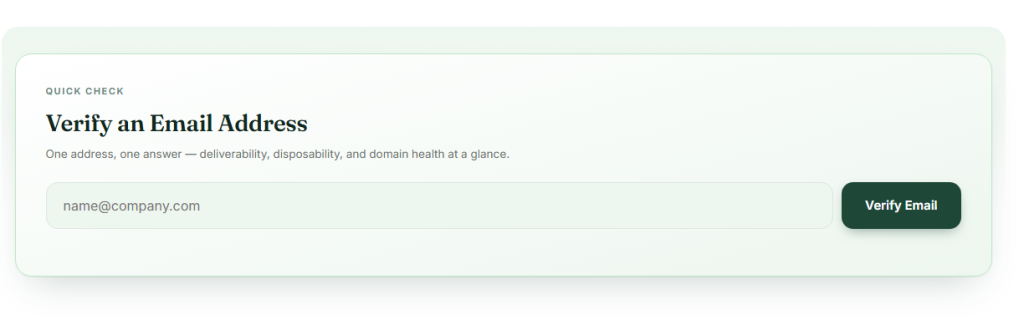
This can help identify obvious data-entry problems before they enter a sales or marketing system.
LeadCanal email verification API is relevant for businesses considering automated validation in their applications or lead-capture workflows.
Implement validation in a way that handles uncertain results appropriately and avoids rejecting legitimate users without a suitable fallback.
12. Create Campaign Segments
A single database can support different business objectives, but the audience should be divided according to the purpose of each campaign.
Potential segments include:
- Independent practices
- Group practices
- Primary care professionals by region
- Practice owners and administrators
- Clinical technology audiences
- Healthcare operations teams
- Medical education audiences
Use the smallest number of segments needed to create meaningful differences in messaging and qualification.
For campaign organization, LeadCanal’s email campaign database resource provides a related reference for thinking about audience structure, data hygiene and segmentation.
Do not combine different contact types into one marketing audience without reviewing their communication preferences and the rules governing the intended use.
13. Personalize Healthcare B2B Communications
Healthcare professionals have limited time, so business messages should be clear, relevant and respectful.
A good message explains why the offer may matter to the recipient’s professional environment.
For example, a company offering practice-management software might discuss administrative workflow challenges rather than using a generic product pitch.
Effective communication generally includes:
- A clear introduction
- A relevant business context
- A concise explanation of value
- Accurate claims
- A low-pressure next step
- Appropriate sender identification and opt-out information where required
Avoid claims about clinical effectiveness, patient outcomes or regulatory compliance unless those claims are properly substantiated.
For businesses developing a broader outbound process, LeadCanal’s cold email outreach resources can provide additional context for structuring professional outreach.
14. Organize Contact Data in Your CRM
A CRM can help teams track research, qualification, communication history and follow-up.
Useful fields include:
- Contact name
- Organization
- Practice type
- Geography
- Specialty or professional category
- Source
- Last-reviewed date
- Verification status
- Campaign assignment
- Contact preferences
- Follow-up status
Keep data fields consistent so that teams can compare records and report results reliably.
For organizations that already maintain large business contact databases, LeadCanal’s data appending services may also be relevant when evaluating how to fill justified gaps in existing records.
Avoid creating duplicate records when a physician is associated with multiple facilities. Where possible, distinguish the individual professional from each relevant organization or practice relationship.
15. Measure Campaign Performance
The success of a healthcare B2B campaign should not be measured by contact volume alone.
Useful metrics include:
| Metric | What It Helps Measure |
| Qualified contacts | Relevance to the intended audience |
| Data completeness | Whether required fields are available |
| Verification outcomes | Email quality issues needing review |
| Bounce rate | Delivery problems |
| Positive responses | Relevance of the message |
| Meetings or enquiries | Progress toward the business goal |
| Unsubscribes and complaints | Whether targeting or messaging needs review |
| Opportunities created | Contribution to the sales process |
Compare results across different segments and acquisition sources.
If one segment generates relevant enquiries while another produces frequent complaints or irrelevant responses, investigate the source data and the message before increasing campaign volume.
16. Responsible Data Sourcing and Healthcare Outreach
Healthcare professional contact data should be handled with care.
A physician’s professional email address is not the same thing as patient health information. However, professional contact records can still contain personal information, and the rules governing collection and marketing use vary by jurisdiction and communication method.
Businesses should:
- Document where contact data came from.
- Review the permitted purpose of the data.
- Collect only the fields needed for the workflow.
- Respect opt-out and suppression requests.
- Protect stored records.
- Avoid misleading sender identities.
- Review applicable privacy and marketing requirements.
- Avoid including patient information in ordinary marketing databases.
Do not assume that a vendor’s claim of compliance means every use of its data is automatically lawful.
For a wider discussion of business contact-data practices, consult LeadCanal’s compliant B2B data sourcing guidance.
17. Avoid Common Database Selection Mistakes
Choosing by record count alone
A large database may still contain contacts that do not match your required audience.
Ignoring practice type
Independent practices and large healthcare systems may have very different purchasing processes.
Assuming every physician is a buyer
A clinician may use a product without having authority to purchase it.
Skipping sample review
A sample can help reveal missing fields, duplicate records and mismatched professional information.
Treating email verification as a guarantee
Verification does not prove consent, interest or message engagement.
Using identical messages for every segment
Different professional audiences may need different information.
Ignoring data-source limitations
A contact may be current in one field but outdated in another. Review the whole record rather than relying on a single verification label.
Overlooking compliance requirements
Data sourcing, storage and outreach should be evaluated according to the applicable rules and intended purpose.
18. Practical Implementation Checklist
Before activating a primary care physician prospecting workflow, review the following:
- Define the product or service being promoted.
- Specify the primary care audience and professional categories.
- Identify relevant practice types.
- Choose the geographic markets.
- Define the required contact and professional fields.
- Confirm data-source provenance.
- Review sample records.
- Remove duplicates and correct incomplete information.
- Assess business email verification results.
- Organize the qualified records in a CRM.
- Prepare segment-specific communication.
- Review applicable marketing and privacy requirements.
- Track responses, complaints and business outcomes.
- Schedule periodic data-quality reviews.
This checklist helps make the process repeatable and gives teams a consistent basis for evaluating data before use.
Frequently Asked Questions
What is a primary care physician contact intelligence database?
It is an organized collection of professional contact records and related practice information designed to help businesses identify relevant primary care physician audiences for appropriate professional engagement.
What is included in a primary care physicians email list?
Depending on the source, records may include a physician’s name, business email, phone number, specialty, practice name, location, website and selected professional identifiers. Field availability and quality vary by provider.
How can primary care physicians be segmented?
Common criteria include professional category, practice type, geography, organization, role and other relevant business attributes where reliable information is available.
Who may use primary care physician contact data?
Potential users include medical technology companies, healthcare software providers, medical equipment suppliers, professional education organizations, diagnostic service providers and other businesses with relevant healthcare offerings.
Does email verification guarantee that a physician will receive or respond to a message?
No. Verification helps assess address usability, but it cannot guarantee inbox placement, consent, interest or engagement.
Should primary care physician contacts automatically be added to a marketing subscriber list?
No. A professional contact database and a subscriber list are different. Review the intended purpose, applicable rules and the recipient’s communication preferences before sending marketing emails.
What should businesses check before choosing a physician database provider?
Review the sample records, data fields, source information, freshness, duplicate handling, verification methodology, geographic coverage and contractual terms. Do not rely solely on headline record counts or unsupported performance claims.
How often should physician contact data be reviewed?
Review frequency depends on the campaign, source and business requirements. Establish a consistent schedule and reassess records before important campaigns or when data-quality issues appear.
Editorial Policy
This article is intended for educational and B2B marketing-planning purposes. It does not provide medical advice and does not establish the legality of any specific contact-data source or marketing campaign.
Third-party statements about verification, accuracy, coverage and compliance are not treated as independently confirmed facts. Businesses should assess providers using documentation, sample records and their own legal and operational requirements.
Transparency
The competitor review identified recurring themes across primary care physician data providers:
- Specialty and professional-category segmentation
- Practice and organization information
- Geographic targeting
- Email and telephone contact fields
- Verification and data maintenance
- Sample records and database evaluation
DataCaptive emphasizes primary care audience segmentation and contact fields, LakeB2B highlights practice and geographic targeting, and UpLead describes physician records with professional identifiers and practice data. These are summaries of publicly presented vendor positioning, not independent endorsements or verification of vendor claims.
About LeadCanal
LeadCanal provides B2B data and email-verification resources for businesses working on contact-data management and outreach workflows.
Businesses can explore LeadCanal’s email verification resources when developing a process for assessing business email quality.
The appropriate workflow depends on the audience, the data source, the intended use and the requirements that apply to the target market.
Conclusion
A useful primary care physician database should do more than provide a collection of email addresses. It should help a business define the audience, evaluate professional relevance, organize practice information and maintain a responsible approach to communication.
Start with the solution you offer and the professional audience that is most likely to benefit from it. Define practice types, geographic criteria and required fields before evaluating a database. Then review sample records, assess data quality, verify addresses where appropriate and organize qualified information in a CRM.
The Primary Care Physician Contact Intelligence Database approach positions contact data as part of a broader workflow: audience definition, research, segmentation, data quality and responsible outreach.
By prioritizing relevance and transparency over raw contact volume, businesses can build a more structured foundation for healthcare B2B prospecting and long-term professional engagement.