Skip to content

How Can Recruitment Agencies Find Companies That Are Ready to Hire?
Quick Answer:
Lead generation for recruitment agencies is the process of identifying companies with current or upcoming hiring needs, finding the decision-makers responsible for recruitment, and converting those businesses into qualified staffing clients.
The strongest approach combines hiring-intent signals, a clearly defined ideal client profile, targeted prospect lists, cold email, LinkedIn outreach, reverse marketing, referrals, SEO, and consistent sales follow-up.
The key is to target companies with a reason to hire, not simply build a large database of random employers.
Useful signals can include active vacancies, rapid hiring, company expansion, new funding, leadership changes, new locations, or repeated difficulty filling specialised roles.
Specialised recruitment lead-generation platforms similarly distinguish useful recruitment leads from generic company records by focusing on hiring companies, relevant decision-makers, and active or emerging demand.
LeadCanal can support recruitment agencies through targeted B2B prospect research, verified email-list building, LinkedIn prospecting, cold email infrastructure, and multichannel outreach.
Table of Contents
- What Is Lead Generation for Recruitment Agencies?
- Recruitment Leads vs Candidate Leads
- Who Should Recruitment Agencies Target?
- 10 Recruitment Lead Generation Strategies
- How to Use Hiring Signals
- Inbound vs Outbound Recruitment Lead Generation
- Step-by-Step Recruitment Agency Lead Generation Process
- Common Mistakes
- Practical Example
- How LeadCanal Can Help
- FAQs
What Is Lead Generation for Recruitment Agencies?
Recruitment agency lead generation means finding businesses that may pay an agency to source, screen, or place employees.

That distinction is important.
A staffing business generally works with two different audiences:
- candidates looking for jobs; and
- employers looking for talent.
For business development, the second audience matters.
A recruitment lead might be:
- a SaaS company hiring software engineers;
- a hospital expanding its nursing workforce;
- a warehouse hiring seasonal staff;
- a manufacturer looking for skilled technicians;
- an accounting firm hiring tax professionals;
- a construction company needing project managers; or
- an enterprise searching for senior executives.
A useful lead therefore needs more than a company name.
Ideally, the agency knows:
Who is hiring?
What are they hiring for?
Who owns the hiring decision?
Does the requirement fit our recruitment niche?
Is there a reason to contact them now?
This is where targeted staffing agency lead generation becomes different from buying a generic business list.
Recruitment Leads vs Candidate Leads: What Is the Difference?
| Recruitment Client Lead | Candidate Lead |
|---|---|
| A company that may buy staffing services | A person seeking employment |
| Generates agency revenue | Fills client vacancies |
| Target may be HR or hiring manager | Target is job seeker |
| Found through business prospecting | Found through candidate sourcing |
| Goal is a job order/client agreement | Goal is placement |
| Part of business development | Part of recruitment delivery |
For this article, lead generation means client acquisition for recruitment agencies, not candidate sourcing.
Specialised staffing-industry guidance uses a similarly narrow definition: a recruitment lead is a hiring organisation with a relevant requirement and a reachable decision-maker rather than simply a job applicant or a company on a database.
Who Should Recruitment Agencies Target?
The right decision-maker varies according to company size and hiring structure.
Common prospects include:
- HR Directors
- Heads of Talent Acquisition
- Talent Acquisition Managers
- Recruitment Managers
- HR Managers
- People Directors
- Hiring Managers
- Operations Directors
- Department Heads
- Founders
- CEOs
- COOs
But targeting based only on job title is not enough.
Build an Ideal Client Profile
A specialised IT recruitment agency might use:
| ICP Factor | Example |
|---|---|
| Industry | B2B SaaS |
| Location | United States |
| Employees | 50–500 |
| Hiring type | Technical |
| Target roles | Software Engineers |
| Decision-maker | Head of Talent |
| Hiring signal | 5+ active technical roles |
| Agency specialisation | Technology recruitment |
This is significantly more precise than sending:
“We provide recruitment services. Do you have any vacancies?”
10 Effective Lead Generation Strategies for Recruitment Agencies
1. Target Companies Showing Active Hiring Intent
One of the biggest advantages recruitment agencies have is that their prospects often publish signals before purchasing staffing help.
Monitor:
- newly posted vacancies;
- multiple vacancies in one department;
- roles remaining open for long periods;
- repeated reposting;
- sudden workforce expansion;
- new offices;
- funding announcements;
- new leadership;
- geographical expansion; and
- seasonal hiring.
Current specialist recruitment-lead systems specifically use hiring activity and growth information to surface companies more likely to need staffing support.
A company hiring ten cybersecurity professionals is usually a more meaningful prospect for a cybersecurity recruiter than a random company with no visible hiring activity.
2. Build a Verified Recruitment Prospect List
After identifying target organisations, find relevant decision-makers.
Your database might include:
- company name;
- industry;
- website;
- location;
- employee size;
- hiring activity;
- decision-maker;
- job title;
- LinkedIn profile;
- verified business email;
- telephone number where appropriate;
- current vacancies;
- hiring trigger; and
- prospect status.
LeadCanal’s email-list-building service allows B2B prospect research based on industry, location, company size, job title, and custom criteria, with contact verification before lists are used for outreach.
3. Use Cold Email to Reach Hiring Decision-Makers
Cold email can help recruitment firms contact hiring managers before a competitor receives the same vacancy.
Avoid generic emails such as:
Hi, we are a leading recruitment agency. Can we help with your recruitment?
Instead, connect the message to something relevant.
For example:
I noticed your team is currently hiring several senior data engineers. We specialise in data and AI recruitment and maintain an active network of candidates in this market. Would it be useful if I shared a brief view of current candidate availability?
The purpose of the first message is to start a relevant conversation, not explain your entire recruitment company.
LeadCanal cold-email service combines targeted prospect data, personalised sequences, follow-ups, and deliverability-focused infrastructure for B2B outreach.
4. Use LinkedIn Prospecting Around Hiring Signals
LinkedIn is particularly relevant to recruitment because the platform contains:
- employers;
- hiring managers;
- HR professionals;
- talent leaders;
- employees;
- company growth information; and
- hiring activity.
A recruitment agency can use LinkedIn to identify the company first and then locate the person most likely to own the hiring problem.
LeadCanal LinkedIn prospecting service researches company profiles, employee information, job titles, industries,
hiring patterns, growth indicators, and decision-makers to build targeted prospect datasets.
A simple workflow might be:
Hiring signal → Company research → Decision-maker → Email → LinkedIn touchpoint → Follow-up
5. Use Reverse Marketing With Strong Candidates
Reverse marketing starts with the candidate rather than the vacancy.
Suppose your recruitment firm represents an experienced logistics director with:
- 12 years of experience;
- warehouse automation expertise;
- multi-site management experience; and
- relevant industry knowledge.
Instead of waiting for a matching job order, identify businesses likely to value that profile.
Then approach selected employers with an anonymised candidate summary.
For example:
We are currently representing a senior logistics leader who has managed multi-site operations and warehouse automation projects. I noticed your organisation is expanding its distribution footprint. Would a short confidential profile be useful?
The approach works best when the candidate genuinely matches the target company’s likely requirements. It should not become a generic CV blast.
6. Choose a Recruitment Niche
Broad positioning makes outreach harder.
Compare:
“We recruit for companies.”
with:
“We place cybersecurity professionals with U.S. SaaS and financial-services companies.”
The second instantly answers:
- whom you help;
- what talent you provide; and
- where you specialise.
Possible recruitment niches include:
- healthcare staffing;
- IT recruitment;
- cybersecurity recruitment;
- finance and accounting;
- engineering;
- manufacturing;
- construction;
- logistics;
- executive search;
- legal recruitment; and
- temporary staffing.
Niche positioning also makes SEO and content creation more focused.
7. Create Content for Hiring Managers
Most recruitment blogs are heavily candidate-focused:
- how to write a resume;
- interview tips;
- how to find a job.
That content may attract candidates but not necessarily staffing clients.
For client lead generation, create employer-focused content such as:
- How to Hire Cybersecurity Talent
- Software Engineer Salary Guide
- Permanent vs Contract Staffing
- How Much Does a Recruitment Agency Cost?
- How to Reduce Time-to-Hire
- Recruitment Agency vs Internal Recruiter
- How to Hire During Rapid Growth
- Executive Search Process Explained
- Skills Shortage Report for Your Niche
These pages allow the agency to demonstrate market expertise while targeting questions employers actually ask.
8. Use SEO for High-Intent Recruitment Searches
Target keywords around employer intent rather than just traffic.
Examples include:
- IT recruitment agency;
- healthcare staffing company;
- engineering recruiters;
- staffing agency for manufacturers;
- executive search firm;
- temporary staffing agency;
- recruitment agency for startups;
- staffing services for warehouses;
- recruitment agency for SaaS companies; and
- specialised recruitment services.
For your broader content cluster, semantic terms can include:
- lead generation for recruitment agencies;
- recruitment lead generation;
- staffing agency lead generation;
- leads for staffing agencies;
- recruitment agency client acquisition;
- recruitment sales leads;
- staffing leads;
- hiring manager leads;
- recruitment prospecting; and
- recruitment business development.
9. Turn Past Clients and Candidates Into Referral Sources
Recruitment agencies already sit inside valuable professional networks.
Potential referrals can come from:
- previous hiring managers;
- former clients;
- placed candidates;
- candidates who become managers;
- HR consultants;
- payroll companies;
- training providers;
- HR software businesses; and
- industry associations.
A placed candidate who later becomes a department head may eventually become a buyer.
Maintain relationships after placement instead of ending communication once the invoice is paid.
10. Use a Multi-Channel Follow-Up System
Recruitment deals do not always happen after one message.
A business may say:
“We do all hiring internally.”
Three months later, it may suddenly have 20 vacancies.
Record:
- previous conversations;
- current supplier;
- hiring activity;
- future requirements;
- follow-up date;
- objections;
- niche;
- decision-maker;
- next action.
A basic sequence could be:
Day 1: Personalised email
Day 4: LinkedIn research/connection
Day 7: Relevant follow-up
Day 14: Share useful market insight
Day 30+: Revisit if a new hiring signal appears
The goal is not constant messaging. It is to remain organised enough to contact an account when the situation changes.
What Hiring Signals Should Recruitment Agencies Monitor?
This is one of the strongest opportunities for differentiating recruitment prospecting from ordinary B2B lead generation.
High-Value Signals
Multiple New Job Openings
Several vacancies may indicate rapid hiring.
Repeated Vacancies
A repeatedly advertised role may suggest difficulty filling it.
Funding
Growth capital can precede team expansion, although funding alone does not guarantee a staffing requirement.
New Office or Market
Expansion can create local hiring needs.
New HR or Talent Leadership
A new leader may reassess suppliers and recruitment processes.
Rapid Employee Growth
Increasing headcount can signal future recruitment demand.
Specialist Vacancy
A difficult-to-source technical role may create an opportunity for a niche recruiter.
LeadCanal LinkedIn research specifically includes company expansion, hiring patterns, growth indicators, decision-maker information, and other firmographic signals that can support this kind of prospect selection.
Inbound vs Outbound Lead Generation for Recruitment Agencies
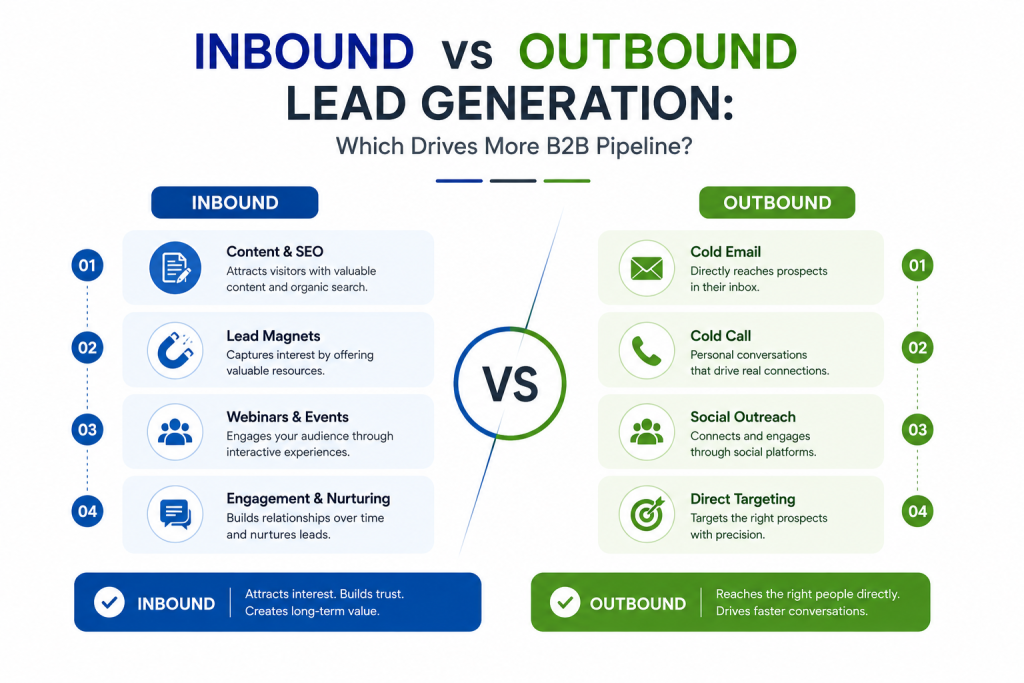
Which Is Better?
Recruitment agencies generally benefit from combining both.
Inbound channels capture employers already researching recruiters.
Outbound allows an agency to identify a company immediately after a relevant hiring signal even before the employer searches for outside recruitment support.
Step-by-Step Recruitment Agency Lead Generation Process
Step 1: Choose Your Recruitment Niche
Define the industries and roles you recruit.
Step 2: Define Your Ideal Client
Specify location, industry, employee count, hiring volume, and relevant company characteristics.
Step 3: Define Hiring Signals
Choose the events that make an account more valuable.
Step 4: Find Target Companies
Build a structured company list.
Step 5: Identify Decision-Makers
Find HR, Talent Acquisition, relevant hiring managers, founders, or operational leaders.
Step 6: Verify Contact Data
Remove invalid and unsuitable records before outreach.
Step 7: Score Prospects
For example:
| Signal | Score |
|---|---|
| Relevant active vacancy | +3 |
| Multiple vacancies | +3 |
| Ideal industry | +2 |
| Correct company size | +2 |
| Recent expansion | +2 |
| Decision-maker identified | +2 |
| No relevant hiring | -3 |
High-scoring accounts receive priority.
Step 8: Start Personalised Outreach
Reference a legitimate need or relevant hiring context.
Step 9: Track Sales Outcomes
Measure:
- positive replies;
- discovery calls;
- qualified companies;
- signed terms;
- job orders;
- vacancies received;
- placements; and
- revenue.
Step 10: Scale What Produces Job Orders
Do not optimise only for email opens or LinkedIn connections.
The real goal is:
Qualified company → Conversation → Signed client → Job order → Placement
Common Recruitment Lead Generation Mistakes
Targeting Every Company That Is Hiring
A vacancy does not automatically make the company suitable for your agency.
Contacting the Wrong Person
The HR contact is not always the actual hiring owner.
Pitching Before Researching
A generic recruitment pitch is easy to ignore.
Buying Old Recruitment Leads
Hiring requirements can change quickly, so prospect data should be reviewed and updated.
Focusing Only on Candidates
An excellent candidate database does not automatically create client demand.
Ignoring Deliverability
Poor sender infrastructure can prevent otherwise relevant recruitment outreach from reaching decision-makers. LeadCanal offers domain authentication, verification, deliverability monitoring, and related outreach infrastructure alongside prospect-data services.
Practical Example: Lead Generation for an IT Recruitment Agency
Imagine a U.S. recruitment agency specialising in cybersecurity roles.
Its ICP is:
Industry: SaaS and financial services
Employees: 100–1,000
Location: United States
Roles: Security engineers, SOC analysts, security leadership
Decision-makers: Talent Acquisition + cybersecurity leadership
Instead of creating a database of 10,000 technology companies, the agency identifies organisations showing signals such as:
- active cybersecurity vacancies;
- several security roles posted simultaneously;
- rapid technical hiring;
- expansion; or
- difficult roles remaining open.
The agency then:
- identifies the relevant decision-maker;
- verifies contact information;
- researches the vacancy;
- sends a short role-specific message;
- follows through LinkedIn;
- shares relevant salary or talent-market insight;
- offers a candidate-market discussion.
That produces a much more focused recruitment agency client acquisition strategy than mass outreach to unrelated businesses.
How Can LeadCanal Help Recruitment Agencies Generate More Leads?
LeadCanal provides targeted B2B contact research, verified email-list building, LinkedIn prospecting, cold email outreach, data enrichment, and deliverability-focused infrastructure.
Its prospect research can be filtered using industry, location, company size, job title, hiring trends, growth indicators, and other business characteristics.
For a recruitment or staffing company, this can support:
- identifying target employers;
- researching hiring companies;
- locating decision-makers;
- monitoring hiring and growth signals;
- building verified contact lists;
- segmenting prospects by recruitment niche;
- launching cold email campaigns;
- LinkedIn prospecting;
- data enrichment;
- email verification; and
- maintaining outbound infrastructure.
Rather than asking recruiters to spend large amounts of time manually researching companies, a structured prospecting system can help the sales team focus more attention on suitable hiring accounts.
Build a More Targeted Recruitment Pipeline With LeadCanal
If your recruitment agency wants to reach hiring managers and growing companies more systematically, LeadCanal can help build targeted prospect data and multichannel outreach systems around your staffing niche and ideal client profile.

Frequently Asked Questions About Lead Generation for Recruitment Agencies
What is lead generation for recruitment agencies?
Lead generation for recruitment agencies is the process of identifying companies that may need external recruitment support, locating relevant hiring decision-makers, and converting those prospects into sales conversations, signed clients, and job orders.
How do recruitment agencies generate leads?
Recruitment agencies can use hiring-intent research, job-board monitoring, cold email, LinkedIn prospecting, referrals, SEO, content marketing, cold calling, networking, candidate reverse marketing, and strategic partnerships.
What are the best leads for staffing agencies?
The strongest staffing lead is usually a company that fits the agency’s niche, has a relevant hiring requirement or credible future hiring signal, and has an identifiable decision-maker who may use external recruitment support.
How can a recruitment agency find companies that are hiring?
Agencies can monitor job boards, company career pages, LinkedIn hiring activity, public company announcements, expansion signals, and other business intelligence. Specialist recruitment lead-generation systems also use hiring and growth signals to identify potential staffing clients.
Does cold email work for recruitment agencies?
Cold email can support recruitment business development when the target company is relevant, the decision-maker is appropriate, the message is personalised, contact data is reliable, and the sending infrastructure is properly managed.
Is LinkedIn good for recruitment lead generation?
LinkedIn can be useful because it provides information about companies, professional roles, hiring activity, employee growth, and decision-makers. LeadCanal uses LinkedIn company and professional research as part of its prospecting services.
What is reverse marketing in recruitment?
Reverse marketing involves starting with a suitable candidate and proactively approaching selected companies that may value that candidate’s skills, rather than waiting for a client vacancy first.
How do staffing agencies get new clients?
Staffing agencies can win clients through referrals, specialised positioning, hiring-trigger prospecting, targeted cold outreach, LinkedIn, employer-focused SEO content, partnerships, networking, and systematic sales follow-up.
What is recruitment agency client acquisition?
Recruitment agency client acquisition covers the complete process of finding potential employers, qualifying their hiring needs, establishing a relationship, agreeing commercial terms, receiving a job order, and converting the relationship into revenue-producing placements.
How can LeadCanal help a staffing agency?
LeadCanal can support staffing firms with targeted employer research, decision-maker identification, custom B2B lists, email verification, LinkedIn prospecting, cold-email systems, and outreach infrastructure