 Skip to content
How Can Consultants Generate More Qualified Leads?
Quick Answer:
Lead generation for consultants is the process of identifying businesses or decision-makers that have a problem a consultant can solve and converting them into qualified sales conversations.
The most effective consulting lead generation strategy combines a clearly defined ideal client profile, authority-building content, referrals,
targeted cold email, LinkedIn outreach, SEO, strategic partnerships, webinars, and consistent follow-up.
Consulting buyers often research possible solutions before speaking with a provider, which makes expertise and relevance especially important.
Apollo’s 2026 consulting lead generation guidance similarly emphasizes thought leadership,
targeted outbound, account-based approaches, and buyer-trigger data rather than relying on one acquisition channel alone.
For consultants who want to build a more structured outbound system, LeadCanal supports prospect research, verified B2B data, cold email outreach, LinkedIn prospecting, and email deliverability.
Table of Contents
- What Is Lead Generation for Consultants?
- Why Is Consulting Lead Generation Different?
- Who Should Consultants Target?
- 10 Effective Lead Generation Strategies for Consultants
- Inbound vs Outbound Lead Generation
- Step-by-Step Consulting Lead Generation Process
- Common Mistakes Consultants Should Avoid
- Practical Lead Generation Example
- How LeadCanal Can Help Consultants
- Frequently Asked Questions
What Is Lead Generation for Consultants?
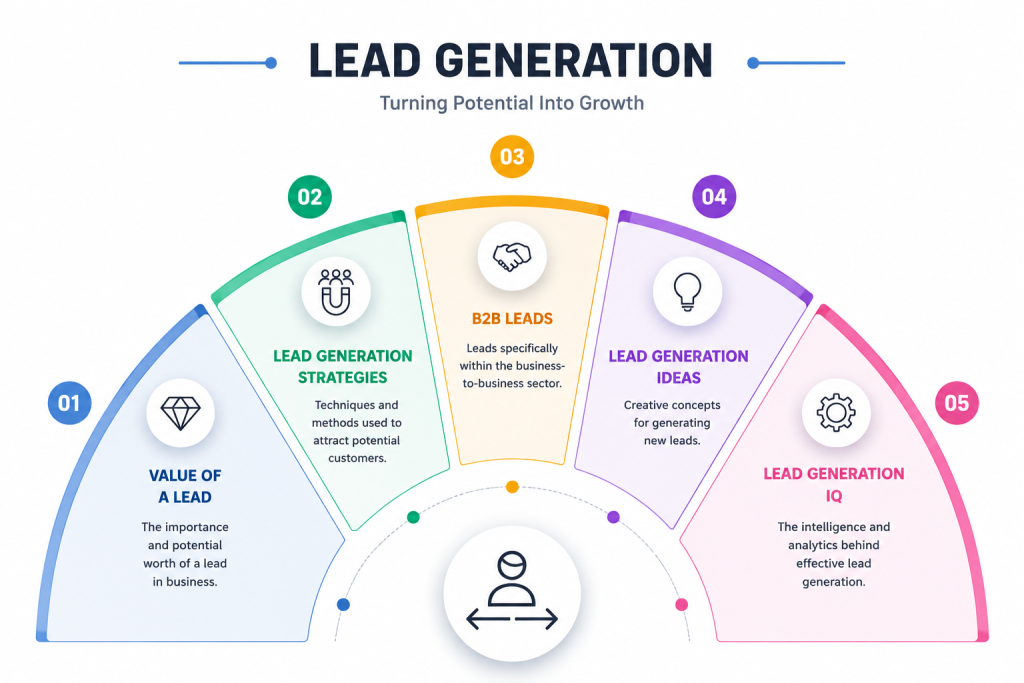
Lead generation for consultants means attracting or identifying potential clients who have a business problem, need expert guidance, and are financially and operationally capable of hiring a consultant.
The objective is not simply to generate as many contacts as possible.
A consultant needs qualified consulting leads.
For example, a cybersecurity consultant may want to reach:
- CTOs
- CISOs
- IT Directors
- Compliance leaders
- Operations executives
A management consultant may target:
- CEOs
- Founders
- COOs
- Heads of Strategy
- Business-unit leaders
An HR consultant might instead focus on:
- HR Directors
- Chief People Officers
- Talent leaders
- Founders at growing companies
The right audience depends on the consultant’s expertise, target industry, company size, geography, service value, and the specific problem being solved.
This makes precise B2B prospecting for consultants more valuable than building a huge generic contact list.
LeadCanal B2B list-building approach uses factors such as job title, company size, industry, location, and business characteristics to create more targeted prospect datasets.
Why Is Lead Generation Different for Consultants?
Consulting is usually an expertise-led sale.
A prospect is not only asking:
“What does this service cost?”
They are also asking:
- Does this consultant understand our problem?
- Have they worked with businesses like ours?
- Can they explain the problem clearly?
- Do they have a credible process?
- What will change after we hire them?
- Can we trust their recommendations?
- Is the potential value worth the consulting fee?
That is why consultants should avoid relying entirely on promotional content.
Educational content, practical frameworks, case studies, diagnostic tools, insights, and clear explanations allow a consultant to demonstrate expertise before the sales meeting.
Apollo’s current guidance for consulting firms notes that modern B2B buyers frequently research independently and recommends a mix of expertise-led inbound activity with targeted outbound prospecting.
Who Should Consultants Target for Lead Generation?
Start with an Ideal Client Profile (ICP).
A useful consulting ICP may include:
| Targeting Factor | Example |
|---|---|
| Industry | SaaS |
| Company size | 50–500 employees |
| Geography | United States |
| Revenue | $5M–$100M |
| Decision-maker | COO |
| Problem | Operational inefficiency |
| Trigger | Rapid team expansion |
| Service | Operations consulting |
| Engagement value | High-ticket project |
Avoid defining your audience as:
“Any company that could use consulting.”
That makes both marketing and outbound messaging too broad.
Instead, define:
Who has the problem?
How serious is the problem?
Who owns the problem?
What event makes solving it urgent?
These questions create the foundation for better consulting lead generation.
10 Effective Lead Generation Strategies for Consultants
1. Create a Narrow Ideal Client Profile
Successful consulting prospecting begins with focus.
Define:
- target industries;
- company size;
- geographic market;
- seniority;
- relevant job titles;
- business model;
- current challenges; and
- buying triggers.
A growth consultant targeting SaaS companies should not use the same messaging as one targeting manufacturing companies.
The narrower your ICP becomes, the easier it is to create useful content and personalised outreach.
2. Use Targeted Cold Email Outreach
Cold email allows consultants to directly reach relevant decision-makers rather than waiting for them to discover a website.
A strong consulting email should demonstrate relevance quickly.
Instead of:
Hi, we provide business consulting services and would love to work with you.
Use:
I noticed your team recently expanded into three new markets. We help B2B SaaS companies standardise their sales process during rapid expansion.
The second message provides context.
LeadCanal’s cold email outreach service focuses on targeted prospecting using filters such as industry, company size, location and job title, combined with personalised messaging and structured follow-up.
3. Build Authority Through Problem-Based Content
Consultants should create content around problems prospects are actively trying to solve.
For example, an operations consultant might publish:
- How to reduce operational bottlenecks
- Operations audit checklist
- When should a company redesign its processes?
- How to identify workflow inefficiencies
- Operational KPIs every COO should track
- Scaling operations from 50 to 200 employees
A cybersecurity consultant could cover:
- cybersecurity readiness assessments;
- vendor-risk frameworks;
- compliance gaps;
- security policies; and
- incident-response planning.
This is stronger than publishing generic posts such as:
“Why Consulting Is Important.”
The goal is to let the prospective client experience some of your thinking before contacting you.
4. Generate Consulting Leads Through LinkedIn
LinkedIn can support both authority building and direct prospecting.
Consultants can use it to:
- identify decision-makers;
- publish insights;
- comment on relevant industry discussions;
- connect with target accounts;
- share case studies;
- distribute frameworks;
- follow client-company developments; and
- start personalised conversations.
LeadCanal’s LinkedIn outreach service targets professionals using criteria including industry, job title, company size, location and activity while supporting personalised connection and messaging campaigns
5. Turn Existing Clients Into Referral Sources
Referrals are particularly valuable in consulting because credibility plays a major role in the buying decision.
After delivering measurable value, ask satisfied clients whether they know:
- another founder facing the same problem;
- another department that needs support;
- a partner company;
- a portfolio company;
- another executive within their network.
Do not simply say:
“Please refer someone.”
Make the request specific.
For example:
“If you know another B2B software company currently restructuring its sales operation, an introduction would be appreciated.”
Specificity makes it easier for clients to identify a suitable referral.
6. Use SEO to Capture High-Intent Consulting Searches
SEO can attract prospective clients who are already looking for answers.
Instead of targeting only broad keywords such as:
business consultant
create content around more specific searches:
- lead generation for consultants;
- consulting lead generation;
- how to get consulting clients;
- B2B lead generation for consultants;
- lead generation for consulting firms;
- management consulting lead generation;
- consulting client acquisition;
- how consultants find clients;
- consulting marketing strategies; and
- how to generate consulting leads.
Service-focused long-tail keywords can also work well:
HR consultant for SaaS companies
or:
sales consultant for manufacturing companies
These searches often reveal more context than broad head terms.
7. Use Account-Based Marketing for High-Value Consulting Clients
Some consulting engagements may justify much deeper research.
Instead of targeting 5,000 random companies, identify perhaps 50–200 high-value accounts.
For each account, research:
- current leadership;
- hiring patterns;
- expansion activity;
- funding;
- organisational changes;
- strategic priorities;
- technology changes;
- public challenges; and
- likely consulting needs.
Then create outreach based on the actual account.
This is account-based lead generation for consultants.
Apollo’s current consulting lead generation guidance also recommends account-based and trigger-driven approaches for consulting firms pursuing higher-value clients.
8. Build Strategic Referral Partnerships
Consultants can also generate leads through businesses serving the same client without directly competing.
Examples include:
Management consultant + accounting firm
HR consultant + recruitment agency
Cybersecurity consultant + managed IT provider
Marketing consultant + web-development agency
Operations consultant + ERP implementation company
Each partner can introduce relevant clients when a problem extends beyond their own service.
This can create a recurring lead source instead of relying only on individual referrals.
9. Run Educational Webinars and Workshops
Consulting buyers often need to understand the problem before committing to an engagement.
A short educational webinar can demonstrate expertise around one specific issue.
Examples:
- How to audit your sales process
- Five compliance gaps growing businesses overlook
- How to prepare your company for international expansion
- How to diagnose operational bottlenecks
- What to fix before implementing a CRM
Do not turn the entire event into a sales presentation.
Teach something useful, then give qualified attendees a logical next step such as an assessment, consultation, audit, or strategy session.
10. Create a Simple Lead Magnet or Diagnostic Tool
Consultants often possess frameworks that can be turned into lead-generation assets.
Examples:
- readiness assessment;
- self-audit;
- scorecard;
- calculator;
- checklist;
- benchmark;
- maturity model;
- planning template.
For instance, a consultant might create:
“10-Point Sales Process Audit”
A visitor answers 10 questions and identifies potential weaknesses in their existing sales process.
The consultant receives a more relevant enquiry because the prospect has already engaged with the problem.
Inbound vs Outbound Lead Generation for Consultants
Which Is Better for Consultants?
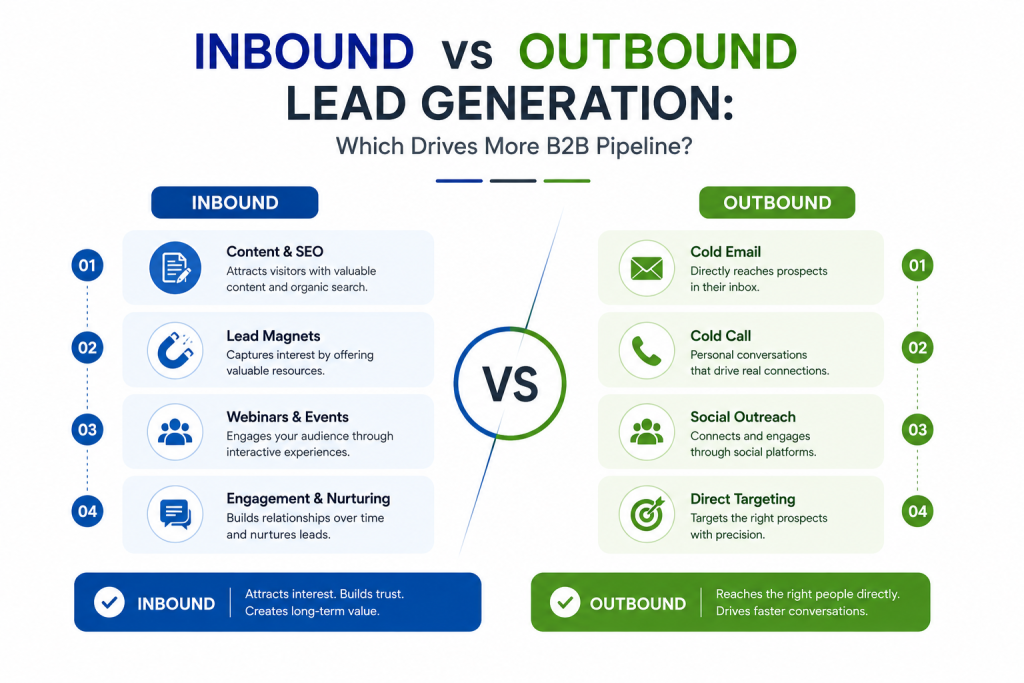
The strongest consulting lead generation system usually combines both.
Inbound marketing builds authority and captures existing demand.
Outbound prospecting allows consultants to reach businesses that match the ideal client profile even if those businesses have not yet searched for a consultant.
For a consulting business, these channels should support one another rather than operate separately.
Step-by-Step Lead Generation Process for Consultants
Step 1: Define Your Consulting Offer
Be clear about the problem you solve.
Avoid:
Business Consulting
Prefer:
We help B2B SaaS companies redesign sales operations when they scale beyond 50 employees.
Step 2: Define Your Ideal Client
Choose industries, company sizes, locations and decision-makers.
Step 3: Identify Buying Triggers
Look for events such as:
- new funding;
- rapid hiring;
- leadership changes;
- expansion;
- new regulations;
- declining performance;
- mergers;
- technology migrations.
Step 4: Build a Targeted Prospect List
Research companies and relevant decision-makers.
LeadCanal builds B2B datasets using company and professional filters designed for targeted outreach.
Step 5: Verify Prospect Data
Do not build campaigns around outdated or invalid contact information.
Email verification and list hygiene help reduce avoidable delivery problems.
Step 6: Create Problem-Specific Messaging
Explain:
- Why this prospect?
- Why this problem?
- Why now?
Do not start with a long description of your consultancy.
Step 7: Combine Email and LinkedIn
Create multiple reasonable opportunities for a prospect to notice and respond to your message.
Step 8: Track Qualified Outcomes
Focus on:
- positive replies;
- discovery calls;
- qualified leads;
- proposals;
- opportunities;
- closed clients; and
- revenue.
Do not measure success only by email opens or LinkedIn connections.
Common Consulting Lead Generation Mistakes
Targeting Everyone
Broad targeting creates generic messages.
Selling Too Early
Consulting buyers often need to understand the problem and trust the consultant before discussing an engagement.
Generic Content
Publishing basic information that is already available everywhere gives prospects little reason to remember your consultancy.
No Proof
Use relevant case studies, anonymised examples, frameworks and documented processes where possible.
Ignoring Email Deliverability
A strong consulting offer cannot generate replies if outbound emails consistently fail to reach the inbox.
LeadCanal’s email deliverability guidance covers domain authentication, sender reputation, list quality and responsible sending practices.
Practical Example: Lead Generation for an Operations Consultant
Suppose an operations consultant helps growing logistics companies reduce workflow inefficiencies.
Instead of targeting every business, they define:
Industry: Logistics
Company size: 100–500 employees
Location: United States
Decision-maker: COO / VP Operations
Trigger: Rapid expansion
Problem: Operational bottlenecks
The consultant creates:
- an operations audit checklist;
- an article on scaling logistics operations;
- a case study;
- a targeted list of logistics companies;
- COO-specific cold email messaging;
- LinkedIn content around operational efficiency; and
- a short diagnostic call.
Inbound prospects may discover the consultant through the content.
Outbound prospects may discover the consultant through targeted email or LinkedIn.
Both paths ultimately lead to the same objective: a qualified consulting conversation.
How Can LeadCanal Help Consultants Generate Leads?
LeadCanal helps businesses and service providers create targeted B2B lead generation systems using verified prospect data, cold email outreach,
email infrastructure, deliverability optimisation and LinkedIn prospecting.
For consultants, that can include:
- defining prospect filters;
- researching target companies;
- identifying decision-makers;
- building targeted contact lists;
- verifying business emails;
- launching personalised cold email campaigns;
- LinkedIn outreach;
- structured follow-ups; and
- improving email deliverability.
Rather than relying entirely on referrals or waiting for inbound enquiries, consultants can use a structured outbound system to reach companies that more closely match their ideal-client criteria.
Build a More Consistent Consulting Pipeline With LeadCanal
Your expertise may solve an important business problem, but potential clients still need to discover you.
LeadCanal can help consultants build targeted prospect lists, reach relevant decision-makers, and develop structured cold email and LinkedIn outreach campaigns
designed to create qualified business conversations.

Frequently Asked Questions About Lead Generation for Consultants
What is lead generation for consultants?
Lead generation for consultants is the process of identifying or attracting potential clients who need a consultant’s expertise and moving them toward a qualified sales conversation, assessment, proposal, or consulting engagement.
How do consultants generate leads?
Consultants can generate leads through referrals, SEO, thought-leadership content, cold email, LinkedIn outreach, partnerships, account-based marketing, webinars, networking and diagnostic resources.
What is the best lead generation strategy for consultants?
There is no single strategy that works for every consultancy. A strong approach generally combines authority-building inbound marketing with targeted outbound prospecting based on a clearly defined ideal client profile.
How can consultants get clients without paid advertising?
Consultants can use SEO, LinkedIn content, referrals, partnerships, cold email, webinars, networking, case studies and targeted prospecting instead of relying solely on paid advertising.
Does cold email work for consultants?
Cold email can help consultants reach relevant business decision-makers when targeting, messaging, list quality and email infrastructure are handled properly.
LeadCanal provides targeted cold email outreach built around company and decision-maker criteria.
Is LinkedIn good for consulting lead generation?
LinkedIn can support prospect identification, credibility, content distribution and direct outreach because consultants can target professionals according to roles, industries, locations and companies. LeadCanal also uses these targeting factors in its LinkedIn outreach campaigns.
What is a qualified consulting lead?
A qualified consulting lead is a potential client that matches the consultant’s target profile, has a relevant problem, has reasonable authority or access to a decision-maker, and has realistic potential to purchase the consulting service.
How can consultants improve lead quality?
Consultants can improve lead quality by narrowing their ICP, targeting specific problems, using buyer triggers, researching decision-makers and measuring opportunities rather than focusing only on contact volume.
Should consultants use inbound or outbound lead generation?
Most consultants can benefit from both. Inbound creates authority and captures existing demand, while outbound helps consultants proactively reach suitable companies and decision-makers.
How can LeadCanal help consulting firms?
LeadCanal supports consulting firms with targeted B2B data, email list building, cold email outreach, LinkedIn prospecting, email infrastructure and deliverability-focused systems designed to support consistent lead generation.


