
Finding a research opportunity in high school can feel confusing, especially when you do not already know a professor, lab manager, or mentor. That is why many students search for a cold email template for research high school opportunities. A cold email is a short, professional message sent to someone who does not know you yet, usually asking about research mentorship, lab volunteering, or a summer research opportunity.
Cold emailing can work, but only when the email is specific, respectful, and easy to reply to. University research offices often recommend emailing faculty directly because it lets students show a shared interest in the professor’s work and explain why they would be a good fit for research. UNC’s Office for Undergraduate Research, for example, says an email should highlight shared research interest and be concise and targeted.
This guide explains how high school students can write better cold emails, what to include, what to avoid, and how to follow up without sounding pushy.
Why High School Students Cold Email Professors
High school students usually cold email for one of four reasons:
- They want to volunteer in a university lab.
- They want a summer research internship.
- They want mentorship for an independent research project.
- They want advice about a field like physics, biology, psychology, computer science, economics, or engineering.
The goal is not to pretend you are already an expert. The goal is to show that you are curious, responsible, and willing to learn. Princeton’s undergraduate research blog explains that strong cold emails are not mainly about proving how impressive you are; they are about showing that you have done your homework, understand the professor’s work, and can explain why you are interested.
Who Should You Email?
Start with people whose work genuinely matches your interests. For example, if you are interested in physics, do not email every professor in the physics department with the same message. Look for faculty pages, lab websites, recent papers, and student research groups.
Good people to email include:
Professors with active research labs
Assistant professors or early-career researchers
Postdoctoral researchers
Graduate students listed on lab websites
Lab managers or research coordinators
Program administrators for high school outreach
A common mistake is emailing only the department chair or the most famous professor. They may be too busy. A lab manager, postdoc, or graduate student may sometimes be closer to day-to-day research operations. Still, keep the message respectful and personalized.
What Makes a Good Cold Email?
A good research cold email has five parts:
1. A clear subject line
UNC recommends a short, clear subject line instead of vague subjects like “Hi” or “Research.” Examples include “High School Student Interested in Physics Research” or “Research Inquiry: Quantum Materials Lab.”
2. A professional greeting
Use “Dear Dr. [Last Name]” or “Dear Professor [Last Name].” UNC also recommends using a formal title and avoiding vague greetings like “To whom it may concern.”
3. A short introduction
Say your name, grade, school, and research interest. Keep this to one or two sentences.
4. A personalized reason for emailing
Mention one paper, project, lab page, talk, or research topic that caught your attention. UT Austin’s Experiential Learning guidance says students should mention specific aspects of the professor’s research and answer “Why them? Why you?”
5. A simple ask
Ask whether they are open to a brief conversation, research mentorship, lab volunteering, or advice about possible opportunities. Do not demand a position.
Copy-Ready Cold Email Template for Research High School Students
Subject: High School Student Interested in [Research Area] Research
Dear Dr. [Last Name],
My name is [Your Name], and I am a [grade level] student at [School Name] interested in [specific research area]. I recently read about your work on [specific project, paper, or lab topic], and I was especially interested in [one specific detail or question].
I am hoping to learn more about research in this field and would be grateful for the opportunity to assist with basic tasks, volunteer in your lab, or speak briefly about possible ways a motivated high school student could get involved. My relevant background includes [coursework, coding skill, science fair project, lab class, math level, data analysis, or writing experience].
I can commit approximately [number] hours per week during [time period], and I am happy to send a resume or any additional information. Thank you for your time and consideration.
Best regards,
[Your Name]
[Email]
[Phone optional]
[LinkedIn/portfolio optional]
Example: Physics Research Cold Email for a High School Student
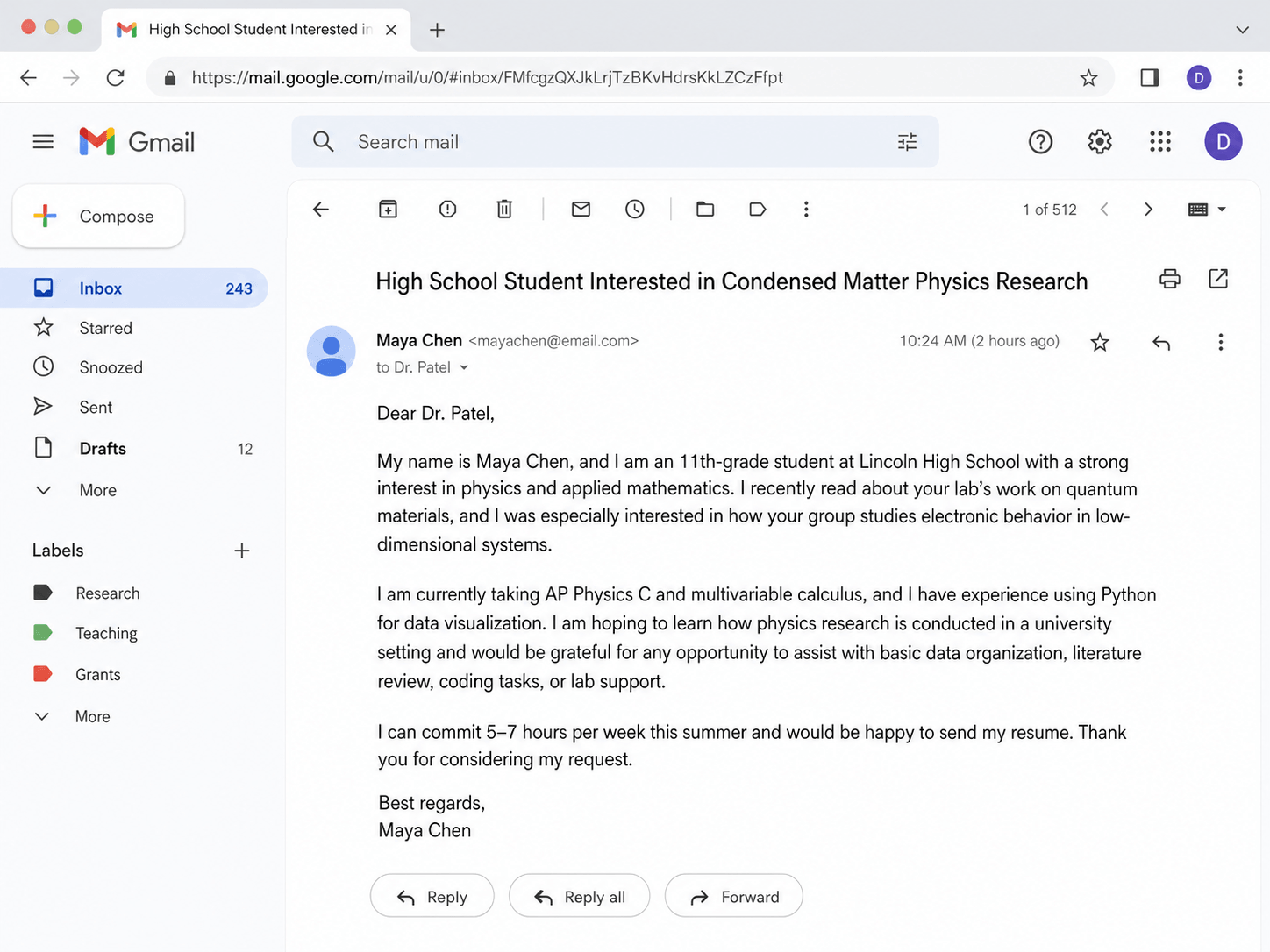
Subject: High School Student Interested in Condensed Matter Physics Research
Dear Dr. Patel,
My name is Maya Chen, and I am an 11th-grade student at Lincoln High School with a strong interest in physics and applied mathematics. i recently read about your lab’s work on quantum materials,
and I was especially interested in how your group studies electronic behaviour in low-dimensional systems.
I am currently taking AP Physics C and multivariable calculus, and I also have experience using Python for data visualization. Through this opportunity, I hope to learn how physics research is conducted in a university setting. I would be grateful for the chance to assist with basic data organization, literature review, coding tasks, or lab support.
This summer, I can commit 5–7 hours per week. I would also be happy to send my resume if helpful.
Thank you for considering my request.
Best regards,
Maya Chen
Subject Lines You Can Use
High School Student Interested in [Research Topic]
Research Inquiry from High School Student
Summer Research Opportunity in [Lab Name]
Interested in Volunteering with [Research Group Name]
Question About Research Mentorship in [Field]
High School Student Seeking Research Experience in [Topic]
What Not to Do
- Do not send the same email to 50 professors without personalization.
- Do not write a full life story.
- Do not attach too many files in the first email.
- Do not say “I am passionate” without proving it through a specific interest.
- Do not ask for a recommendation letter before building a relationship.
- Do not follow up every day.
Cornell’s career guidance recommends researching the professor first, connecting your experience to their work, keeping the email brief, and attaching or offering a resume instead of writing a long cover letter inside the email.
Should You Attach a Resume?
You can attach a one-page resume as a PDF, but the email should still make sense without it. UT Austin notes that students do not always need to attach a resume in the first email, but they should have it ready if the professor asks.
For a high school research resume, include:
- Relevant coursework
- Science fair or independent projects
- Programming skills
- Lab or technical skills
- Awards
- Volunteer work
- Availability
- Teacher or mentor references, if appropriate
Follow-Up Email Template
Wait about one week before following up. UT Austin recommends waiting one week before sending a polite follow-up, while Cornell suggests one or two follow-ups at most.
Subject: Follow-Up: High School Student Interested in [Research Area]
Dear Dr. [Last Name],
I hope you are doing well i wanted to briefly follow up on my email from last week about possible research opportunities or mentorship related to [topic].
I understand you are very busy, and I appreciate your time. If your lab is not currently taking students, I would also be grateful for any suggestion of another researcher, program, or resource I should look into.
Thank you again.
Best regards,
[Your Name]
If They Say No
A “no” is not a failure. Professors may lack funding, time, lab safety clearance, or university approval to host high school students. Princeton’s research blog notes that timing and resources affect whether labs can take students, and some labs may prioritize current undergraduates or students at later stages.
Send a polite reply:
Dear Dr. [Last Name],
Thank you for letting me know. I appreciate your time and completely understand. If you know of any programs, labs, or resources that may be a better fit for a high school student interested in [topic], I would be grateful for your suggestions.
Best regards,
[Your Name]
Where to Find Research Opportunities for Students
Students can find research opportunities by checking official university lab pages, government internship portals, and searchable research databases instead of relying only on random social media posts. Start with updated databases like Pathways to Science, which lists STEM research programs, internships, REUs, scholarships, and funded opportunities, and then search official programs from places like NASA, NIH, NSF, and the U.S. Department of Energy. NASA offers student internship and STEM opportunity pages, NIH runs research training programs including summer research options, NSF lists undergraduate research opportunities through REU programs, and DOE offers student internships and laboratory research programs. These sources are better because they are updated regularly and usually lead to official application pages. (Pathways to Science)
You can also add these auto-updating search links to your article:
High school research opportunities for students
Summer research programs for high school students
Student research internships near me
Research opportunities for high school students site:.edu
STEM research internships for students site:.gov
Physics research opportunities for high school students
Biology research opportunities for high school students
Psychology research opportunities for high school students
Computer science research opportunities for high school students
University lab volunteer opportunities for high school students
How Many Professors Should You Email?
Quality matters more than volume. Instead of sending 100 generic emails, build a targeted list of 15–30 researchers. For each person, record:
- Name
- University or lab
- Research topic
- Personalization note
- Date emailed
- Follow-up date
- Response
- Next step
This is where an outreach tool like LeadCanal can help students or counsellors organize cold email campaigns without losing track of who was contacted, what was personalized, and when to follow up.
Best Time to Send Cold Emails
Weekday mornings are usually better than late nights or weekends. Avoid exam periods, major holidays, and university breaks when possible. For summer research, start early, often in winter or early spring—because many labs and formal programs plan months ahead.
Final Checklist Before Sending
Before sending your cold email, ask:
- Is the subject line clear?
- Did I use the correct name and title?
- Did I mention a specific research interest?
- Is the email under 200 words?
- Did I make one clear request?
- Did I proofread it?
- Did I include my availability?
A cold email is not about begging for a position. It is about starting a professional conversation. The best emails are short, personal, and respectful of the professor’s time.