 Skip to content

Real estate cold email marketing is one of the most practical ways to reach property owners, motivated sellers, landlords, investors, expired listing owners, FSBO leads, and potential clients without spending heavily on ads. Instead of waiting for people to find your website, cold email allows you to start a direct conversation with the right person at the right time.
But there is one important point: real estate cold email is not about blasting thousands of random messages. That approach usually leads to spam complaints, poor deliverability, and wasted data.
A successful campaign is built on clean lists, proper domain setup, personalized messaging, legal compliance, and consistent follow-up.
LeadCanal helps real estate professionals create a smarter outreach system by focusing on targeted communication instead of random mass emailing
What Is Real Estate Cold Email Marketing?
Real estate cold email marketing is the process of sending targeted emails to people who may have a real estate need but have not contacted you first. These people may include homeowners,
absentee owners, landlords, property investors, expired listing owners, probate property contacts, commercial property owners, or buyers looking for investment opportunities.
The goal is not to force a sale in the first email. The goal is to open a conversation.
For example, a real estate investor may email an absentee owner and ask whether they would consider selling a property. A realtor may email an expired listing owner and offer a better selling strategy.
A property management company may email landlords and offer help with tenant placement or rental management.
Cold email is useful because it is cheaper than many paid advertising channels, easier to scale than manual calling, and more trackable than offline marketing.
However, it must be done carefully because email providers now pay close attention to sender reputation, authentication, spam complaints, and user engagement.
Define Your Real Estate Cold Email Goal
Before writing any email, decide what you want from the campaign. Many beginners make the mistake of targeting everyone. That creates weak messaging.
Your goal should be specific.
For example:
You want motivated seller leads.
- You want listing appointments.
- You want buyers for investment properties.
- You want landlords for property management services.
- You want real estate investors for joint venture deals.
- You want commercial property owners for leasing opportunities.
Each goal needs a different message a homeowner thinking about selling needs a simple, low-pressure email. A landlord needs a message focused on saving time or improving rental income.
A real estate investor wants numbers, opportunity and speed. The clearer your goal is, the easier it becomes to write emails that get replies.
Choose the Right Target Audience
Real estate cold email marketing depends heavily on targeting. A poor list will ruin even the best email copy. Instead of collecting random email addresses build a focused list based on your campaign goal.
If you are looking for motivated sellers, you may target absentee owners, tired landlords, vacant property owners, inherited properties, pre-foreclosure leads, or owners with high equity.
If you are a realtor, you may target expired listings, FSBO sellers, homeowners in a farming area, or past prospects who never converted.
For property management, your audience may be small landlords, out-of-state owners, or owners of multiple rental units for commercial real estate, your audience may include business owners,
building owners, tenants, or investors. Good targeting makes your email feel relevant bad targeting makes your email look like spam.
Build and Verify Your Email List
After choosing your audience, collect accurate data. A real estate cold email list usually includes name, email address, property address, city, state, property type, ownership status, and any useful property detail.
But collecting data is not enough. You must verify it.
High bounce rates can damage your sender reputation. If too many emails bounce, email providers may treat your domain as suspicious. That is why list cleaning and email verification are essential before launching any campaign.
Remove invalid emails, duplicate contacts, role-based addresses where possible, and contacts who have already opted out. Keep your list updated because property ownership and email data can change over time.
This is one area where many competitor articles are weak. They talk about sending volume, but they do not explain that list quality is more important than list size.
Set Up Your Sending Domain Correctly
Deliverability is the foundation of real estate cold email marketing. If your emails land in spam, your campaign will fail even if your message is excellent.
Use a professional domain and set up email authentication properly. Google’s sender guidelines require authentication methods such as SPF or DKIM for all senders, while bulk senders need SPF, DKIM, and DMARC. These records help prove that your emails are legitimate and reduce the chance of rejection or spam placement.
Avoid sending cold emails from your main business email if you are testing new campaigns. Many businesses use separate outreach domains to protect their primary domain reputation.
However, those domains should still look professional and connected to your brand.
Also avoid sudden high-volume sending. A new inbox that sends hundreds of emails on day one looks unnatural. Start slowly, monitor performance, and increase gradually.
Understand Legal Compliance Before Sending
Cold email is not a free-for-all. You must follow the rules that apply in your market.
In the United States, the FTC’s CAN-SPAM guidance says commercial emails should not use false header information, should not use deceptive subject lines, should identify the message properly,
include a valid physical postal address, and provide a clear way to opt out. Opt-out requests must also be honoured.
If you target the UK or Europe, rules can be stricter. The UK Information Commissioner’s Office explains that direct marketing by electronic mail is regulated under PECR,
and consent or specific exceptions may be required depending on the type of recipient. The ICO also states that marketing emails must identify the sender and provide a way to opt out.
This is important because real estate professionals often target homeowners, and homeowners are individuals, not just business contacts. Always keep your outreach transparent, respectful, and compliant.
Write a Simple and Personalized Cold Email
The best real estate cold emails are short. Your first message should not explain your entire business history. It should create interest and invite a reply.
A strong cold email usually has five parts:
- A clear subject line.
- A personal opening.
- A reason for contacting them.
- A simple value statement.
- One clear question.
Example:
Subject: Quick question about your property on Maple Street
Hi Sarah,
I noticed your property on Maple Street and wanted to ask if you would ever consider selling it. I work with local buyers looking for homes in that area and wanted to see if a simple offer would be useful for you.
Would you be open to a quick conversation?
This email works because it is short, specific, and not pushy. It mentions the property, explains the reason, and asks one direct question.
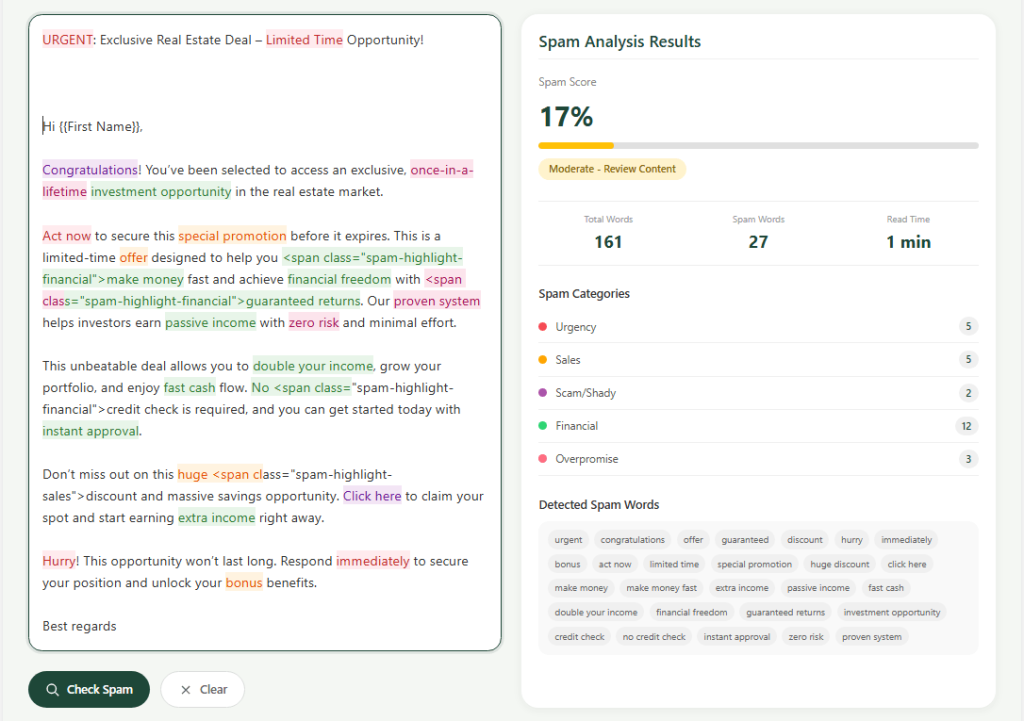
Avoid spammy phrases like “guaranteed cash offer,” “act now,” “limited time,” or “risk-free deal.” These sound aggressive and can reduce trust.
Before sending, use an email copy spam checker tool to review your email copy for spam words, weak subject lines, and formatting issues
Use Better Subject Lines
Subject lines decide whether your email gets attention. For real estate cold email outreach, the best subject lines are usually simple and property-specific.
Examples:
- Quick question about 123 Main Street
- Are you still open to selling?
- Question about your rental property
- Your property in Dallas
- Following up about 123 Main Street
- Still considering your options?
Do not trick people. A deceptive subject line may get opens, but it damages trust and can create compliance issues. The FTC specifically warns against deceptive subject lines in commercial email.
The goal is not just to get opens. The goal is to get honest replies.
Create a Follow-Up Sequence
Most replies do not come from the first email. A good real estate cold email campaign needs follow-ups.
A simple sequence can look like this:
Email 1: Ask if they are open to selling or discussing the property.
>Email 2: Mention why you reached out and restate the question.
>Email 3: Offer a helpful reason, such as a quick valuation or local market insight.
>Email 4: Send a polite closing email asking if you should stop reaching out.
Keep follow-ups short. Do not send daily emails. Space them out over several days. The tone should stay respectful.
A good final email may say:
Hi Sarah,
I do not want to keep bothering you. Should I close your file, or would it still make sense to talk about the property?
This gives the person control and often gets a response.
Track the Right Metrics
Many real estate marketers focus only on open rates, but open rates are not always fully reliable because privacy features can affect tracking. Campaign Monitor notes that a good email open rate can vary by industry,
often around 17–28%, so it is better to compare your results with your own campaign history and industry context.
Track these metrics instead:
- Bounce rate
- Reply rate
- Positive reply rate
- Spam complaint rate
- Booked calls
- Appointments
- Deals closed
- Revenue per campaign
For real estate cold email marketing, the most important number is not how many people opened the email. The most important number is how many real conversations and qualified leads you generated.
Improve Deliverability Over Time
Email deliverability is not a one-time setup. You must maintain it.
Keep bounce rates low by cleaning your list. Remove people who unsubscribe. Do not keep emailing contacts who never engage after several attempts. Avoid sending identical copy to thousands of people.
Use natural personalization, but do not overuse fake personalization.
Google’s guidelines also show that authenticated messages are less likely to be rejected or marked as spam, which makes technical setup important for long-term success.
Good deliverability comes from three things: clean data, proper technical setup, and respectful sending behaviour.
Use Templates, But Do Not Sound Like a Template
Templates save time, but they should not make your email robotic. The biggest mistake in real estate cold email campaigns is using the same generic message for every property owner.
Bad example:
Hi, I am a real estate professional. I want to buy your property. Contact me today for a no-obligation cash offer.
Better example:
Hi James,
I came across your property on Oak Avenue and wanted to ask if you have ever thought about selling it. I work with buyers who are looking for homes in that neighbourhood.
Would you be open to hearing what they might offer?
The second version feels more human. It is specific, calm, and easy to answer
Turn Replies Into Conversations
Getting a reply is only the beginning. Many people will respond with questions like:
- Who are you?
- How did you get my information?
- What are you offering?
- Is this serious?
- What is my property worth?
Prepare reply scripts before launching. Be transparent. Tell them who you are, why you reached out, and what the next step is. If someone is not interested, respect that and remove them from future outreach.
If someone is interested, move quickly. Ask basic qualifying questions, book a call, or send the lead to your acquisitions or sales team.
Cold email should not replace real relationship-building. It should start the relationship.
Common Real Estate Cold Email Mistakes
The biggest mistakes are sending to unverified lists, using misleading subject lines, sending too much volume too fast, ignoring opt-outs, writing long emails, sounding too salesy and failing to follow up.
Another major mistake is using only one campaign for every lead type. Expired listings, absentee owners, landlords, buyers, and investors all have different motivations. Your messaging should match the audience.
Also, do not copy competitors word-for-word. Competitor content may give ideas, but your campaign should be built around your own market, service, and customer pain points.
Conclusion
Real estate cold email marketing can be a powerful lead generation strategy when done correctly. It helps real estate agents, investors, wholesalers, property managers, and commercial brokers reach targeted prospects directly. But success does not come from sending the most emails. It comes from sending the right message to the right person with the right setup.
Start with a clear goal. Build a focused list. Verify your data. Set up SPF, DKIM, and DMARC. Stay compliant with email marketing rules. Write short, personal emails. Follow up respectfully. Track replies and booked appointments instead of chasing vanity metrics.
When done with strategy and care, cold email becomes more than a marketing tactic. It becomes a repeatable system for starting real estate conversations, building trust, and generating qualified property leads.


