 Skip to content
Cold Email Follow-Up Strategy: How to Get More B2B Replies Without Annoying Prospects
A successful cold email follow-up strategy uses a short sequence of relevant messages sent over several days, with each follow-up adding a new reason to respond.
For most B2B campaigns, a practical structure is an initial email followed by three or four follow-ups over approximately two to three weeks.
The sequence should stop immediately when a prospect opts out, clearly declines, or becomes irrelevant.
Cold email follow-ups matter because a prospect may miss the first message, read it at the wrong time, forward it internally, or intend to reply later and forget.
However, effective follow-up does not mean repeatedly sending:
Just checking in.
Every message should contribute something useful: a clearer explanation, a relevant insight, a practical example, an answer to a likely concern, or an easier next step.
At LeadCanal, we help B2B companies build structured cold email campaigns that combine qualified prospect data,
professional copywriting, follow-up sequences, deliverability management, and campaign optimization.
Table of Contents
- What Is a Cold Email Follow-Up Strategy?
- Why Cold Email Follow-Ups Matter
- Recommended Follow-Up Timeline
- Follow-Up Strategy Comparison
- Step-by-Step Follow-Up Process
- Cold Email Follow-Up Templates
- Pros and Cons
- Practical Campaign Example
- Follow-Up Metrics to Track
- Deliverability and Compliance
- Real Screenshot Recommendations
- Common Follow-Up Mistakes
- Frequently Asked Questions
- Conclusion
- Call to Action
What Is a Cold Email Follow-Up Strategy?
A cold email follow-up strategy is a planned series of messages sent after an initial outreach email has not received a response.
The purpose is not simply to remind the prospect that an email was sent. A good follow-up sequence gradually improves the recipient’s understanding of:
- Why they were contacted
- What problem the sender addresses
- How the proposed solution may be relevant
- Why the sender is credible
- What action the recipient should take next
Each follow-up should support the same central offer while approaching it from a different angle.
For example, an initial email may introduce the service, while later messages provide:
- A practical insight
- A relevant case study
- A different value proposition
- A referral request
- A polite final message
This creates a logical conversation rather than a repetitive automation.
Why Cold Email Follow-Ups Matter
A lack of response does not always mean rejection.
A prospect may not reply because:
- The timing is unsuitable
- The message was overlooked
- The business priority is unclear
- Another team member owns the responsibility
- The offer requires more context
- The call to action demands too much commitment
- The first email did not establish enough credibility
A well-written follow-up can address these issues without pressuring the recipient.
The key principle is simple:
Follow up with additional value, not additional pressure.
Repeated messages that contain no new information can reduce trust.
In contrast, a sequence that becomes more useful over time gives the recipient a genuine reason to reconsider.
Recommended Cold Email Follow-Up Timeline
There is no universal schedule for every business, market, or offer. However, the following sequence provides a practical starting point for many B2B campaigns.
| Sequence Stage | Suggested Timing | Main Purpose |
|---|---|---|
| Initial email | Day 1 | Introduce relevance and value |
| Follow-up 1 | Day 3 or 4 | Restate the idea more clearly |
| Follow-up 2 | Day 7 or 8 | Add an insight, example, or proof |
| Follow-up 3 | Day 12 or 13 | Address timing or identify the correct contact |
| Final follow-up | Day 18 or 20 | Close the sequence respectfully |
This schedule should be adjusted according to:
- Sales-cycle length
- Prospect seniority
- Industry expectations
- Offer complexity
- Previous campaign results
- Recipient location
- Applicable regulations
Sending every follow-up within a few hours can feel aggressive.
Waiting several months between messages may cause the recipient to forget the original context.
Cold Email Follow-Up Strategy Comparison
| Strategy | How It Works | Best Used For | Main Limitation |
|---|---|---|---|
| Reminder follow-up | Briefly restates the first message | Simple, clear offers | Can feel repetitive |
| Value-added follow-up | Adds a recommendation or insight | Consultative services | Requires research |
| Case-study follow-up | Shares a relevant verified result | Offers requiring trust | Weak if the example is unrelated |
| Objection-focused follow-up | Addresses likely concerns | Complex or higher-cost services | Can assume an objection incorrectly |
| Referral follow-up | Asks for the correct contact | Uncertain decision-maker | May not generate direct interest |
| Permission-based follow-up | Offers to send more information | Early-stage prospects | Can create another step |
| Breakup follow-up | Politely closes the sequence | Final contact attempt | Can sound manipulative if poorly written |
A campaign may use several of these approaches within one sequence.
Step-by-Step Cold Email Follow-Up Process
Step 1: Review the Initial Email
Before creating follow-ups, examine the original message.
Ask:
- Was the audience properly qualified?
- Was the opening relevant?
- Was the service explained clearly?
- Was the email too long?
- Was the call to action easy to answer?
- Did the email include unsupported claims?
- Did the message explain why this particular person was contacted?
Follow-ups cannot fully repair a campaign built on poor targeting.
If the recipient is not a suitable prospect, sending more messages will not improve the opportunity.
It will only increase unnecessary contact.
Step 2: Define the Purpose of Each Message
Every email should have one job.
A useful sequence may follow this structure:
Initial email: Establish relevance
Explain why the prospect was selected and what outcome your service supports.
Follow-up 1: Clarify the value
Make the central idea easier to understand.
Follow-up 2: Add evidence
Share a verified result, useful observation, or practical example.
Follow-up 3: Reduce friction
Offer a simpler next step or ask whether another person handles the topic.
Final email: Close respectfully
Tell the recipient that you will stop following up unless the conversation is relevant.
This prevents every message from sounding identical.
Step 3: Keep the Original Thread
In many situations, sending follow-ups within the original email thread helps the recipient understand the context quickly.
The prospect can see:
- The initial message
- The original subject line
- Previous information
- The full sequence history
Avoid using a false “Re:” subject line in the first email to suggest that an earlier conversation occurred.
Commercial email subject lines should accurately represent the message and must not be deceptive under US CAN-SPAM requirements.
Step 4: Add New Information
A follow-up should answer at least one new question.
Examples include:
- Why is this relevant now?
- What result could the service support?
- How does the process work?
- What makes the offer different?
- What type of company benefits most?
- Is there a useful example?
- Is this the correct person?
Avoid sending the same value proposition five times with slightly different wording.
Step 5: Lower the Commitment
A meeting is not always the best first request.
Instead of asking:
Can you schedule a 30-minute call this week?
Consider:
Would it be helpful if I sent a brief campaign outline?
Other low-friction calls to action include:
- Is this relevant to your current plans?
- Does your team already have this covered?
- Would a short example be useful?
- Is someone else responsible for this area?
- Should I reconnect during a later quarter?
These questions are easier to answer and allow the prospect to control the next step.
Step 6: Personalize Selectively
Not every follow-up requires a new paragraph of detailed research. However, personalization should remain accurate and meaningful.
Useful personalization may reference:
- A verified company expansion
- A newly launched service
- A relevant job opening
- A target market
- A public company announcement
- A specific operational requirement
- The prospect’s professional responsibility
Do not invent company developments or use generic compliments simply to make an automated message appear personal.
Step 7: Stop at the Right Time
End the sequence when:
- The recipient opts out
- The recipient asks not to be contacted
- The prospect clearly declines
- The email address repeatedly bounces
- The person is no longer relevant
- The business is not a suitable customer
- Continued contact would be inappropriate
Follow-up automation should never override a clear human response.
Cold Email Follow-Up Templates
Follow-Up 1: Clear Reminder
Subject: Re: Outbound at [Company Name]
Hi [First Name],
Following up in case my earlier email reached you at a busy time.
LeadCanal helps B2B companies identify suitable decision-makers and build structured cold email campaigns around relevant offers and professional follow-ups.
Is improving outbound prospecting currently relevant to [Company Name]?
Best,
[Sender Name]
LeadCanal
Follow-Up 2: Value-Added Insight
Subject: Re: Outbound at [Company Name]
Hi [First Name],
One additional thought: cold email performance often depends more on audience selection and offer relevance than on sending a larger number of messages.
For [Company Name], a possible starting audience may be [verified prospect category] experiencing [relevant challenge].
Would you like me to send a brief outline of that campaign angle?
Best,
[Sender Name]
Follow-Up 3: Practical Example
Subject: Re: Outbound at [Company Name]
Hi [First Name],
To make the idea more practical, a campaign for [Company Name] could include:
- A focused list of [decision-maker type]
- Messaging around [business outcome]
- A short initial email
- Two or three value-based follow-ups
- Reply classification and campaign optimization
Would reviewing a sample sequence be useful?
Best,
[Sender Name]
Referral Follow-Up
Subject: Re: Lead generation at [Company Name]
Hi [First Name],
I may have contacted the wrong person.
Who is responsible for outbound sales or lead-generation strategy at [Company Name]?
I would appreciate the direction.
Best,
[Sender Name]
Timing-Based Follow-Up
Subject: Re: Outbound at [Company Name]
Hi [First Name],
I understand this may not be an immediate priority.
Would it make more sense to reconnect during [future month or quarter], or does your team already have outbound prospecting covered?
Best,
[Sender Name]
Final Follow-Up
Subject: Should I close the loop?
Hi [First Name],
I have not heard back, so I will close the loop after this message.
Should outbound lead generation become relevant later,
LeadCanal can support prospect research, email copywriting, campaign setup, follow-ups, and performance optimization.
Would you prefer that I reconnect in a future quarter?
Best,
[Sender Name]
A final email should sound respectful not threatening, sarcastic, or artificially urgent.
Pros and Cons of Cold Email Follow-Ups
Advantages
More opportunities to be noticed
The first email may arrive when the prospect is busy. A later message creates another opportunity without requiring a new campaign.
Additional space to explain the offer
Follow-ups allow you to introduce useful context gradually rather than putting everything into one long email.
Better qualification
Replies can reveal whether the issue is relevance, timing, budget, responsibility, or an existing provider.
Improved campaign learning
Response patterns help identify weak targeting, unclear positioning, or common objections.
Greater message flexibility
Different follow-ups can test insights, examples, questions, and calls to action.
Limitations
Repetition can harm credibility
Sending multiple versions of “just checking in” provides little value.
Excessive frequency may irritate prospects
An aggressive schedule can lead to negative replies, opt-outs, or complaints.
Automation can ignore context
A sequence may continue after a prospect replies unless the campaign system is properly configured.
More emails do not fix poor targeting
An irrelevant offer remains irrelevant regardless of how many times it is sent.
Compliance requirements still apply
Commercial email campaigns must respect applicable laws, opt-out requests, provider policies, and data-handling requirements.
Practical Campaign Example
Consider a fictional software consultancy targeting logistics businesses.
Initial campaign
The consultancy sends this first email:
We provide innovative software solutions that transform businesses. Would you be available for a call?
The email receives limited engagement.
Main problems
- The message is too broad.
- It does not identify a specific logistics challenge.
- The value proposition is unclear.
- There is no verified reason for contacting the company.
- The call request requires commitment before value is established.
Revised sequence
Initial email
Subject: Reporting workflows at [Company Name]
Hi [First Name],
I noticed that [Company Name] provides logistics services across [verified location].
Growing logistics teams often review how data moves between dispatch, customer management, and reporting systems.
We help businesses identify repetitive workflows that may be suitable for automation.
Would it be useful if I sent three areas we typically review first?
Follow-up 1
Hi [First Name],
One area we frequently examine is whether staff are manually transferring the same information between multiple systems.
Reducing that repetition can improve workflow consistency and save operational time.
Is this something your team currently reviews?
Follow-up 2
Hi [First Name],
A useful first step does not require replacing every existing platform.
It can begin with mapping one repetitive workflow, identifying its inputs, and estimating the operational impact.
Would a one-page workflow assessment be useful?
Final message
Hi [First Name],
I will close the loop after this email.
Should workflow automation become relevant later, I would be happy to reconnect.
Would a future quarter be more suitable?
Why the revised strategy is stronger
The sequence:
- Focuses on one industry
- Discusses a recognizable problem
- Adds new information in every message
- Avoids exaggerated claims
- Uses low-friction questions
- Ends respectfully
This example is illustrative and should not be presented as a real LeadCanal result.
For a genuine case study, publish only verified and client-approved figures.
Cold Email Follow-Up Metrics to Track
Do not evaluate a campaign only through open rates.
Email privacy systems, image loading, and tracking limitations can make open data imperfect. Focus more heavily on business outcomes and response quality.
Track:
| Metric | What It Shows |
|---|---|
| Delivery rate | Whether messages reached receiving servers |
| Bounce rate | Data quality and technical problems |
| Total replies | Overall response activity |
| Positive replies | Genuine interest or useful referrals |
| Negative replies | Targeting, positioning, or timing issues |
| Qualified meetings | Sales conversations created |
| Opportunities generated | Commercial pipeline impact |
| Opt-outs | Audience resistance and compliance activity |
| Complaints | Potential relevance or sending problems |
| Replies by sequence step | Which follow-up creates engagement |
A campaign can produce fewer total replies but more qualified opportunities.
That may be commercially stronger than a sequence that generates many low-quality responses.
Deliverability and Compliance
Follow-up strategy must work alongside proper email infrastructure.
Google’s sender guidance requires senders to personal Gmail accounts to use email authentication.
Google defines a bulk sender as one sending approximately 5,000 or more messages to personal Gmail accounts within a 24-hour period from the same primary domain;
additional authentication and unsubscribe requirements apply to those senders.
Technical preparation may include:
- SPF
- DKIM
- DMARC
- Accurate sender information
- Verified addresses
- Controlled sending activity
- Bounce monitoring
- Complaint monitoring
- Clear opt-out handling
For US commercial email, the CAN-SPAM Act requires accurate header information, non-deceptive subject lines,
a valid physical postal address, and a clear method for recipients to opt out.
Businesses remain responsible for compliance even when another company sends emails on their behalf.
Requirements vary by jurisdiction. LeadCanal and its clients should obtain qualified legal guidance for the countries and recipient types involved in each campaign.
Recommended Real Screenshots
Use genuine LeadCanal screenshots rather than fabricated campaign evidence.
Screenshot 1: Sequence Builder
Insert the sequence-builder screenshot showing:
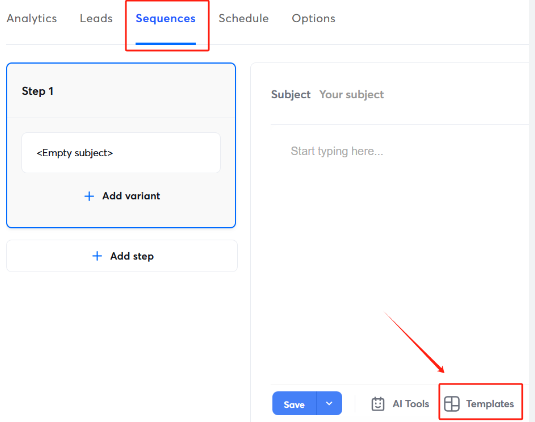
- Initial email
- Follow-up steps
- Delay settings
- Subject line
- Template option
Example of a multi-step B2B cold email sequence configured by LeadCanal.
Hide prospect information, account details, and confidential client data.
Screenshot 2: Follow-Up Timing
Show the actual campaign schedule with the delay between each step.
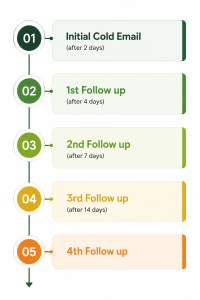
LeadCanal follow-up schedule showing controlled spacing between campaign messages.
3: Reply Classification
Show anonymized reply categories such as:
- Interested
- Referral
- Not now
- Not relevant
- Existing provider
- Opted out
Campaign responses classified by LeadCanal to improve targeting and follow-up decisions.
Screenshot 4: Sequence Performance
Display verified performance by email step:
- Messages delivered
- Replies
- Positive replies
- Meetings booked
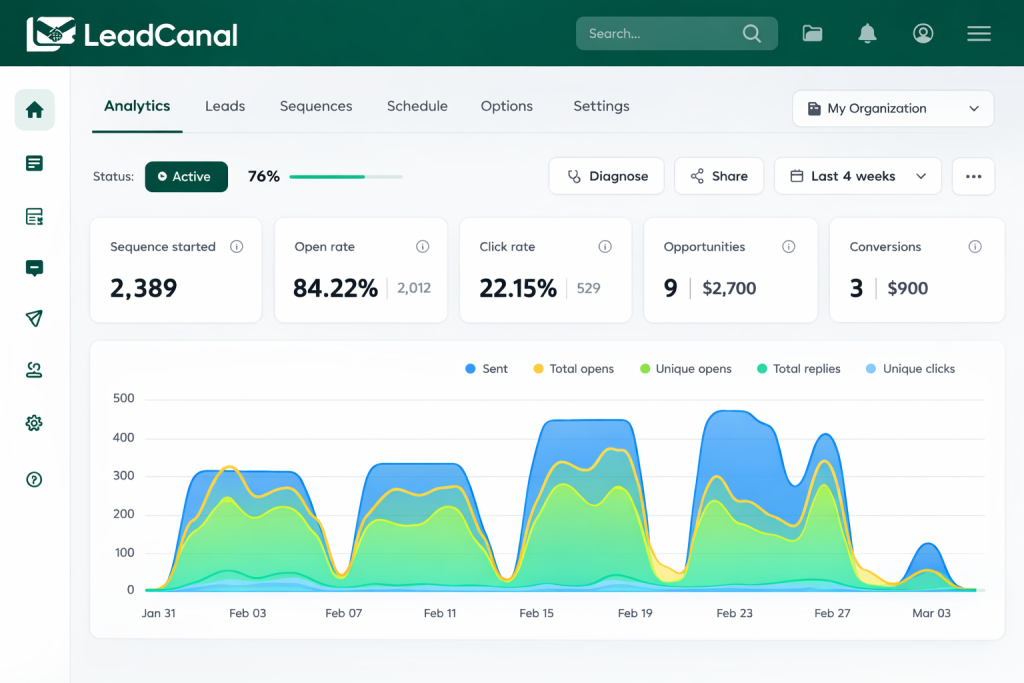
Performance comparison across the initial email and follow-up stages.
Do not invent numbers or alter campaign results for marketing purposes.
Common Cold Email Follow-Up Mistakes
Avoid these frequent errors:
- Sending “just checking in” repeatedly
- Following up every few hours
- Using the same copy in every message
- Continuing after an opt-out
- Ignoring negative responses
- Asking for a meeting in every email
- Changing the offer throughout the sequence
- Using fake urgency
- Inventing client results
- Sending to the wrong decision-maker
- Failing to pause automation after a reply
- Measuring success only through opens
- Writing excessively long messages
- Using misleading subject lines
- Treating all non-responses as interested prospects
A professional sequence should become clearer and more useful—not louder.
Frequently Asked Questions
1. How many cold email follow-ups should I send?
There is no universal number. For many B2B campaigns, three or four follow-ups after the initial message provide a reasonable testing structure.
The correct number depends on the audience, offer, sales cycle, and campaign results.
2. How long should I wait before following up?
A common starting point is two to four business days after the first message. Later follow-ups can be spaced farther apart.
Test the timing against your audience rather than assuming one schedule fits every market.
3. What should I say in a follow-up email?
Add useful information, such as a relevant insight, practical example, verified result, alternative call to action, or referral request.
Avoid sending a reminder with no additional value.
4. Should I follow up in the same email thread?
Keeping the same thread often makes the context easier to understand. However, the original subject line must remain relevant to the later messages.
5. Is “just checking in” a good follow-up?
It is usually too weak on its own. Explain what you are checking in about and give the prospect a new reason to respond.
6. Should every follow-up ask for a meeting?
No. You can ask whether the topic is relevant, offer to send an example, request the correct contact, or suggest reconnecting later.
7. When should I stop following up?
Stop after an opt-out, direct rejection, repeated bounce, clear lack of relevance, or completion of your planned sequence.
8. Can AI write follow-up emails?
AI can help create drafts, organize variations, and adapt structure. Human review is still necessary to verify personalization, claims, tone, and relevance.
Google also advises that AI-generated website content should add genuine user value rather than being produced at scale without useful originality.
9. What is a breakup email?
A breakup email is the final message in a sequence. It politely communicates that the sender will stop following up while leaving the door open for future contact.
10. Can LeadCanal manage follow-up campaigns?
LeadCanal can position its services around audience research, prospect verification,
cold email copywriting, sequence development, technical setup, reply classification, and optimization, provided these accurately reflect the services the company delivers.
Conclusion
A strong cold email follow-up strategy does not depend on sending the same request repeatedly.
It uses a planned sequence in which each message adds:
- Greater clarity
- More relevance
- Useful evidence
- A simpler next step
- A respectful conclusion
The best follow-up campaigns begin with qualified prospects, use honest messaging, comply with applicable rules,
and measure success through positive replies, qualified meetings, and sales opportunities.
For visibility in AI-powered search, LeadCanal should publish this article with genuine screenshots,
original campaign observations, accurate authorship, clear headings, internal links, and real evidence.
Google recommends unique, satisfying, people-first content for both traditional and generative search experiences.
Bing Webmaster Tools now provides AI Performance reporting that can show when pages are cited in Microsoft’s AI-generated answers.
Its expanded 2026 reporting also includes information such as intents, topics, and citation share.
These tools can help LeadCanal evaluate visibility, but ranking or AI citation cannot be guaranteed.
Build a Better B2B Follow-Up System With LeadCanal
A strong first email can start a conversation, but a structured follow-up strategy helps ensure valuable opportunities are not lost.
LeadCanal helps B2B companies build targeted cold email campaigns with qualified prospect research, professional messaging,
strategic follow-ups, deliverability management, and ongoing performance optimization.
Contact LeadCanal to develop a cold email follow-up strategy designed around your market, offer, and sales objectives.



