Skip to content
How Can Commercial Cleaning Companies Generate More Qualified B2B Leads?
Quick Answer:
B2B lead generation for cleaning services is the process of identifying businesses, facilities, property managers, and other commercial buyers that may need recurring janitorial,
office, industrial, medical, or specialty cleaning services and turning them into qualified sales opportunities.
The strongest approach combines precise local targeting, commercial cleaning SEO, Google Business Profile optimisation,
cold email, LinkedIn prospecting, referral partnerships, account-based outreach, contract-renewal tracking, and consistent follow-up.
Instead of marketing to everyone in a city, cleaning companies should focus on businesses that match their service capacity, location, cleaning frequency, facility type, and contract value.
Decision-makers often include facility managers, property managers, office managers, procurement professionals, and operations leaders.
Current commercial-cleaning lead generation providers also target these roles because they are frequently involved in vendor selection and facility management.
LeadCanal can support this process with targeted B2B contact data, prospect research, cold email systems, LinkedIn outreach, and email deliverability infrastructure.
Table of Contents
- What Is B2B Lead Generation for Cleaning Services?
- Why Commercial Cleaning Lead Generation Is Different
- Who Should Cleaning Companies Target?
- 10 B2B Lead Generation Strategies for Cleaning Services
- Inbound vs Outbound Lead Generation
- Step-by-Step Commercial Cleaning Lead Generation Process
- Common Mistakes to Avoid
- Practical Commercial Cleaning Example
- How LeadCanal Can Help
- Frequently Asked Questions
What Is B2B Lead Generation for Cleaning Services?
B2B cleaning lead generation means finding organisations that need professional cleaning services and converting them into enquiries, walkthroughs, quote requests, tenders, or recurring cleaning contracts.
This differs from residential cleaning lead generation.
A residential cleaner may target individual homeowners.
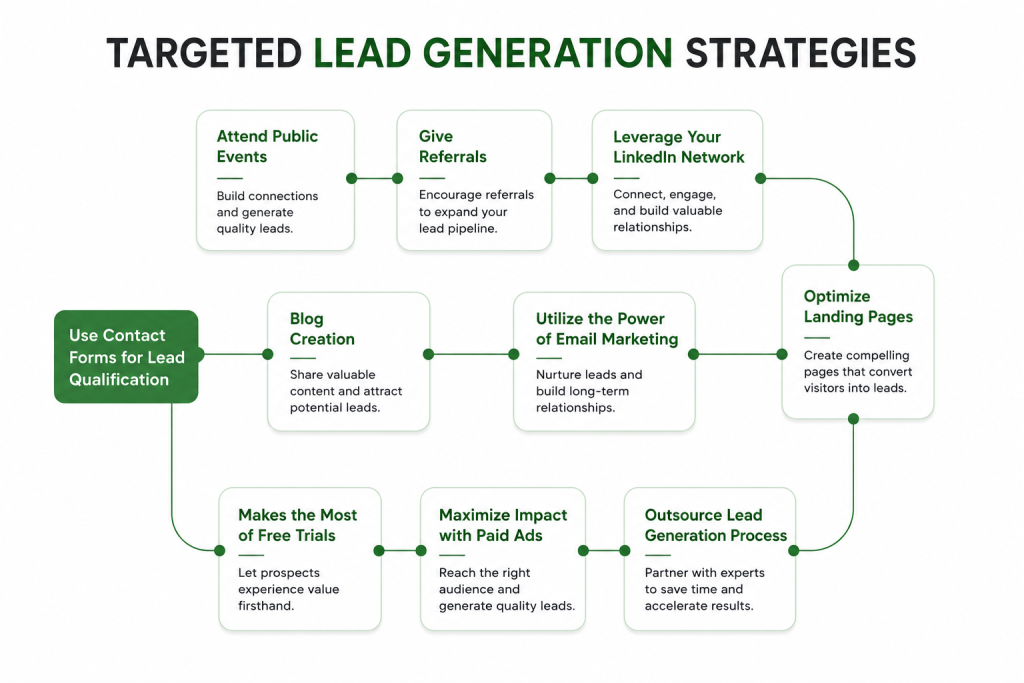
A commercial cleaning company may target:
- corporate offices;
- warehouses;
- medical facilities;
- retail locations;
- schools;
- property management companies;
- industrial facilities;
- apartment common areas;
- coworking spaces;
- restaurants;
- gyms;
- dealerships; and
- multi-location businesses.
The goal should not simply be to collect more phone numbers or email addresses.
A cleaning company needs qualified commercial cleaning leads businesses within its service area that have a realistic need, suitable building type, sufficient contract value, and an identifiable buying contact.
Why Is Commercial Cleaning Lead Generation Different?
Commercial cleaning sales are heavily influenced by timing and fit.
A company may be an ideal prospect but already have a cleaning contract in place.
That does not necessarily mean it is a bad lead.
It may mean the opportunity needs to be nurtured until:
- the contract approaches renewal;
- service quality declines;
- a new facility opens;
- the company relocates;
- its workforce expands;
- a property changes management;
- procurement reviews vendors;
- a new site is acquired; or
- cleaning requirements change.
SalesHive’s current commercial-cleaning positioning specifically highlights contract renewals, service failures, budget changes, and leadership changes as potential switching windows.
This is why a commercial cleaning pipeline should track when to contact an account, not only whether the account exists.
Who Should Commercial Cleaning Companies Target?
Your target audience depends on the type of cleaning contract you want.
Common Decision-Makers
Potential contacts include:
- Facility Managers
- Directors of Facilities
- Property Managers
- Office Managers
- Operations Managers
- Procurement Managers
- Strategic Sourcing Managers
- Building Managers
- General Managers
- Business Owners
Current cleaning-sector outbound providers similarly identify facility, property, procurement, and operations professionals as important buyer groups.
Build a Cleaning ICP
Your Ideal Customer Profile might look like this:
| Factor | Example |
|---|---|
| Location | Dallas, Texas |
| Facility type | Corporate office |
| Employees | 50–300 |
| Building size | 10,000–50,000 sq. ft. |
| Service | Recurring office cleaning |
| Frequency | 5 nights per week |
| Decision-maker | Facility Manager |
| Contract type | Recurring |
| Trigger | New office or vendor review |
This is much stronger than simply targeting:
“All businesses in Dallas.”
10 Effective B2B Lead Generation Strategies for Cleaning Services
1. Build a Targeted Local Prospect List
Start with companies your cleaning team can realistically service.
Filter prospects by:
- city;
- ZIP code;
- industry;
- company size;
- facility type;
- number of locations;
- employee count;
- job title; and
- expected cleaning requirement.
Then identify the appropriate decision-maker.
A good B2B database should contain more than an email address. LeadCanal approach includes information such as business name, industry, location, job title, company size, website, and verified contact details.
2. Target Contract-Renewal and Buying Triggers
One of the most valuable improvements a cleaning business can make is adding timing signals to prospecting.
Look for:
- new commercial leases;
- office relocations;
- newly opened locations;
- company expansion;
- new property management;
- new facility-management leadership;
- construction completion;
- facility complaints;
- vendor reviews; and
- RFP announcements.
If a facility manager tells you:
“Our contract does not expire until November.”
That is not necessarily a rejection.
Record November and create an appropriate follow-up before the review period.
This turns random prospecting into a structured pipeline.
3. Use Cold Email to Reach Commercial Buyers
Cold email can help cleaning businesses reach facility and property decision-makers without waiting for inbound enquiries.
The message should not sound like:
We offer high-quality cleaning at affordable prices.
Instead, make the email specific to:
- location;
- facility type;
- service;
- likely cleaning need; or
- relevant business change.
For example:
We provide recurring evening cleaning for professional offices in the Tampa area, including floor care, washrooms, workspaces and shared areas.
If your current cleaning contract comes up for review this quarter, would it be useful to compare scope and pricing?
That is clearer because the recipient immediately understands:
what you clean, where you work, and why you are contacting them.
LeadCanal offers cold email outreach built around targeted prospect data, personalised sequences, infrastructure and deliverability management.
For U.S. campaigns, businesses should also follow applicable commercial-email requirements. The FTC states that CAN-SPAM applies to commercial email, including B2B email, and includes requirements relating to accurate sender information, non-deceptive subject lines, postal-address disclosure, and opt-out mechanisms.
4. Use LinkedIn to Reach Facility and Property Managers
LinkedIn can complement email outreach.
Search for professionals with roles such as:
- Facilities Manager;
- Office Manager;
- Property Manager;
- Operations Director; or
- Procurement Manager.
Do not immediately send a long sales pitch.
Use LinkedIn to:
- identify relevant contacts;
- learn about the company;
- establish a legitimate connection;
- share useful proof;
- start a relevant conversation.
LeadCanal supports LinkedIn prospecting based on criteria including job title, industry, company size and geography.
Internal link: LinkedIn outreach
5. Optimise for Local Commercial Cleaning Searches
Commercial cleaning companies should also capture buyers actively searching for suppliers.
Useful search themes include:
- commercial cleaning services in [city];
- office cleaning company [city];
- janitorial services [city];
- warehouse cleaning services;
- medical office cleaning;
- industrial cleaning company;
- commercial cleaners near me;
- corporate office cleaning; and
- commercial janitorial company.
Create separate pages where the service and search intent genuinely differ.
Do not create dozens of almost identical city pages with only the location name changed.
Your Google Business Profile also matters for local visibility.
Google states that local results are primarily influenced by relevance, distance, and prominence, and recommends keeping business information accurate and complete.
6. Show Proof Before Asking for the Contract
Commercial buyers need confidence that your team can perform consistently.
Useful proof assets include:
- before-and-after photographs;
- facility-specific case studies;
- cleaning checklists;
- quality-control procedures;
- staff-training processes;
- insurance information;
- safety procedures;
- client references;
- inspection processes; and
- service-scope examples.
Instead of simply writing:
“We provide superior cleaning.”
Show how quality is monitored.
For example:
Our Commercial Cleaning Quality Process
- Facility walkthrough
- Custom cleaning scope
- Staff assignment
- Supervisor checklist
- Quality inspection
- Issue reporting
- Client feedback
- Corrective action
Specific processes build more credibility than generic claims.
7. Create Industry-Specific Cleaning Pages
Different facilities have different concerns.
Build useful pages around actual service categories such as:
Office Cleaning
Focus on workspaces, kitchens, washrooms, floors and after-hours scheduling.
Medical Facility Cleaning
Explain relevant sanitation procedures, staff training, scope and facility requirements.
Warehouse Cleaning
Cover high-traffic floors, break areas, offices, industrial dust and site-specific requirements.
Property Management Cleaning
Discuss shared spaces, multi-tenant buildings and repeatable service standards.
Post-Construction Cleaning
Explain debris removal, dust removal, final-detail cleaning and handover readiness.
Specificity improves both search relevance and sales messaging.
8. Build Referral Partnerships
Some of the strongest B2B cleaning opportunities can come from businesses that already interact with commercial properties.
Potential partners include:
- property managers;
- commercial real estate brokers;
- general contractors;
- flooring companies;
- restoration firms;
- HVAC providers;
- office furniture suppliers;
- moving companies; and
- facility maintenance providers.
For example, a commercial moving company knows when businesses relocate.
A construction contractor knows when a project is approaching completion.
Those moments may create cleaning demand.
9. Use Account-Based Outreach for Large Contracts
Do not treat a 3,000-square-foot office and a 500,000-square-foot multi-site opportunity the same way.
For high-value accounts, research:
- property portfolio;
- number of locations;
- existing vendor structure;
- relevant decision-makers;
- facility type;
- contract cycle;
- service requirements;
- recent expansion;
- procurement process.
Then approach multiple relevant stakeholders when appropriate.
This is an account-based commercial cleaning lead generation strategy.
Instead of simply chasing more leads, you concentrate more effort on accounts with greater potential value.
10. Improve the Walkthrough-to-Proposal Process
Lead generation does not end when someone replies.
For commercial cleaning, the walkthrough is often one of the most important conversion points.
Before the walkthrough, collect:
- facility size;
- service frequency;
- operating hours;
- floor types;
- washroom count;
- high-traffic areas;
- special requirements;
- current issues;
- expected start date.
After the walkthrough, provide a clear proposal containing:
- scope;
- frequency;
- exclusions;
- staffing assumptions;
- quality-control approach;
- communication process;
- pricing;
- next step.
More leads will not solve a weak sales process.
The entire journey matters:
Prospect → Conversation → Walkthrough → Quote → Contract
Inbound vs Outbound Lead Generation for Cleaning Services
| Inbound | Outbound |
|---|---|
| Prospect searches for cleaner | Cleaning company identifies prospect |
| SEO | Cold email |
| Google Business Profile | LinkedIn outreach |
| Google Ads | Direct calling |
| Referrals | Account-based outreach |
| Captures existing demand | Creates new conversations |
| Strong long-term channel | Precise local targeting |
Which Is Better?
Commercial cleaning companies generally benefit from combining inbound and outbound lead generation.
Inbound captures buyers already searching for a cleaning provider.
Outbound helps you reach suitable companies before they begin actively searching or before an existing contract comes up for review.
Step-by-Step B2B Cleaning Lead Generation Process
Step 1 Select Your Best Service
Choose one clear offer such as:
Recurring commercial office cleaning.
Step 2 Define Your Service Area
Target only locations your operation can serve profitably.
Step 3 Define Your Ideal Building
Example:
Professional offices with 50–300 employees.
Step 4 Identify Decision-Makers
Find facility, property, office, operations or procurement contacts.
Step 5 Build and Verify Your Prospect List
Remove irrelevant and invalid contacts.
Step 6 Identify Buying Triggers
Look for leases, relocations, expansions, construction completion and contract-review timing.
Step 7 Launch Outreach
Combine relevant email, LinkedIn and sales follow-up.
Step 8 Book a Walkthrough
Move qualified prospects from discussion to facility assessment.
Step 9 Send a Clear Proposal
Make scope and pricing easy to evaluate.
Step 10 Track Contract Revenue
Measure:
- qualified replies;
- walkthroughs;
- quotes;
- contract wins;
- monthly recurring revenue;
- acquisition cost.
Practical Example: Office Cleaning Lead Generation
Suppose a cleaning company services corporate offices around Atlanta.
Its ICP is:
Location: Atlanta metro
Employees: 50–250
Facility: Office
Decision-maker: Facility or Office Manager
Offer: Five-day recurring cleaning
The company builds a list of matching offices and separates prospects into:
- recently relocated businesses;
- rapidly growing companies;
- standard target accounts; and
- future contract-renewal opportunities.
It creates a dedicated Atlanta commercial-office-cleaning page, optimises its Google Business Profile,
publishes real cleaning-process photographs, runs targeted email outreach, and connects with facility managers through LinkedIn.
Prospects searching for a provider can discover the company through inbound channels.
Businesses that are not currently searching can enter the pipeline through outbound prospecting.
That combination creates a more resilient commercial cleaning lead generation system.
How Can LeadCanal Help Cleaning Companies Generate B2B Leads?
LeadCanal helps businesses create targeted B2B prospecting systems using verified data, cold email outreach, LinkedIn networking and deliverability-focused email infrastructure.
For a commercial cleaning company, LeadCanal can support:
- target-market research;
- geographic prospecting;
- facility and company segmentation;
- decision-maker identification;
- verified email lists;
- personalised cold email campaigns;
- LinkedIn outreach;
- follow-up systems; and
- email deliverability.
Instead of buying an unrelated database containing thousands of contacts, a cleaning business can build prospect segments around the locations, industries, companies and decision-makers it can realistically serve.
Build a More Predictable Commercial Cleaning Pipeline With LeadCanal
If your cleaning company wants to reach more facility managers, property managers and commercial decision-makers,
LeadCanal can help build the targeted data and outreach system needed to create qualified B2B conversations.

Frequently Asked Questions About B2B Lead Generation for Cleaning Services
What is B2B lead generation for cleaning services?
B2B lead generation for cleaning services is the process of identifying companies and commercial facilities that need cleaning services and converting them into qualified enquiries, walkthroughs, proposals and recurring contracts.
How do I generate commercial cleaning leads?
Use a combination of local SEO, Google Business Profile, targeted prospect lists, cold email, LinkedIn outreach, referrals, partnerships, account-based prospecting and consistent follow-up.
Who should commercial cleaning companies target?
Common buyers include facility managers, property managers, office managers, operations leaders, procurement professionals and business owners.
How do I get leads for cleaning contracts?
Identify organisations that match your service area and facility profile, research the appropriate buyer, monitor contract and facility triggers, and approach prospects with a specific commercial cleaning offer.
Does cold email work for cleaning companies?
Cold email can be useful for reaching relevant commercial decision-makers when prospect targeting, messaging, data quality, legal requirements and deliverability are handled properly.
Is Google good for commercial cleaning lead generation?
Yes. Search can capture buyers actively looking for commercial cleaning providers.
Google says local visibility is primarily determined by relevance, distance and prominence.
What are the best commercial cleaning leads?
The best lead depends on your operation, but generally a high-quality lead fits your service area, building type, capacity, contract value, service expertise and decision-maker criteria.
How can a cleaning company get more office cleaning contracts?
Focus on office-specific service pages, local search visibility, property and facility-manager prospecting, referrals, contract-renewal tracking and systematic follow-up.
Is B2B cleaning lead generation different from residential cleaning marketing?
Yes. Residential marketing generally targets individual households,
while B2B cleaning lead generation targets organisations and commercial decision-makers and can involve more formal vendor evaluations, walkthroughs, scopes and recurring contracts.
How can LeadCanal help commercial cleaning companies?
LeadCanal can support cleaning companies through targeted B2B contact data, decision-maker research, cold email outreach, LinkedIn prospecting and deliverability-focused email systems