100,000 Consumer Email List for Targeted Marketing & Lead Generation
On this page
- What Is a Consumer Email List Building Strategy?
- Quick Answer:
- Table of Contents
- 1. What Is a Consumer Email List?
- 2. Why Businesses Want a Large Consumer Email Audience
- 3. How to Build a Consumer Email List
- 4. Strategies for Growing Toward 100,000 Subscribers
- 5. Why Email Verification and Data Quality Matter
- 6. Email Authentication: SPF, DKIM, DMARC, and DNS
- 7. How to Prepare Domains for Email Campaigns
- 8. How to Segment Consumer Email Contacts
- 9. Consumer Email Marketing Best Practices
- 10. Common Email List Building Mistakes
- 11. How to Measure Email Marketing Performance
- 12. Frequently Asked Questions
- Conclusion
Need 100000 Consumer Email List? Build a Targeted Audience for Better Email Marketing and Business Growth
Building a large consumer email audience requires more than collecting thousan100,000 Consumer Email List for Targeted Marketing & Lead Generations of email addresses.
Businesses need a clear audience strategy, reliable contact information, relevant messaging, and responsible email marketing practices.
Whether a company wants to grow toward 100,000 subscribers or improve an existing database, long-term success depends on reaching the right people with content they actually want to receive.
A strong consumer email list building strategy combines audience research, permission-based subscriber acquisition, email verification, domain authentication, segmentation, and performance measurement. These elements help businesses develop a more organized marketing process while reducing avoidable data-quality and email-delivery problems.
Companies can also use specialized tools to review email addresses, inspect domain records, prepare authentication records, and evaluate campaign content.
LeadCanal provides resources for several of these tasks, including its email verifier, which can help businesses understand and manage email address validation as part of their data-quality workflow.
What Is a Consumer Email List Building Strategy?
Quick Answer:
A consumer email list building strategy is a structured process for attracting, organizing, and maintaining email contacts relevant to a business’s consumer audience.
Businesses can grow their audiences through website signup forms, valuable content, customer registrations, newsletters, loyalty programs, and appropriate partnerships.
They should also maintain accurate records, respect consent requirements, verify email addresses, configure email authentication, and segment subscribers according to their interests.
The goal is not simply to obtain 100,000 addresses. It is to develop a relevant, permission-based audience that supports meaningful customer communication and sustainable marketing performance.
Table of Contents
- What Is a Consumer Email List?
- Why Businesses Want a Large Consumer Email Audience
- How to Build a Consumer Email List
- Strategies for Growing Toward 100,000 Subscribers
- Why Email Verification and Data Quality Matter
- Email Authentication: SPF, DKIM, DMARC, and DNS
- How to Prepare Domains for Email Campaigns
- Consumer Email Audience Segmentation
- Email Marketing Best Practices
- Common Email List Building Mistakes
- How to Measure Campaign Performance
- Frequently Asked Questions
- Conclusion
1. What Is a Consumer Email List?
A consumer email list is a collection of email contacts associated with individual consumers rather than primarily with business decision-makers.
Depending on the business model, it may include newsletter subscribers, registered customers, loyalty-program members, or people who have agreed to receive specific communications.
Consumer email marketing is used by online retailers, travel companies, educational brands, subscription services, local businesses, and consumer product companies.
These organizations may send product updates, educational content, seasonal promotions, customer announcements, and newsletters.
For example, a retailer selling home products might invite visitors to subscribe to maintenance tips and new-product announcements. A travel company may offer a newsletter featuring destination inspiration and travel-planning resources.
The most suitable data source depends on the intended audience and the purpose of the campaign. A consumer newsletter audience is different from a purchased contact database, and neither should automatically be treated as permission to send marketing messages.
Businesses that also manage professional contact data can explore LeadCanal’s data cleansing and enrichment services to understand how record completeness, consistency, and data quality can be addressed in a structured workflow.
Consumer Email Lists vs. B2B Email Lists
| Feature | Consumer email list | B2B email list |
| Main audience | Individual consumers | Professionals and organizations |
| Typical purpose | Consumer products, services, and newsletters | Business outreach and professional marketing |
| Segmentation | Interests, preferences, customer journey, and location | Industry, company type, role, and business needs |
| Common content | Product updates, useful tips, consumer offers | Business resources, service information, and professional outreach |
| Key considerations | Privacy, consent, relevance, and opt-outs | Data sourcing, applicable marketing rules, relevance, and opt-outs |
Businesses should choose their data strategy according to the intended recipients and the applicable requirements.
2. Why Businesses Want a Large Consumer Email Audience
A large email audience can increase a business’s potential reach, but size alone does not guarantee engagement, sales, or deliverability.
Reach Interested Consumers
Email provides a direct communication channel for people who have chosen to receive updates from a business. A relevant newsletter can help a company share educational resources, new products, announcements, and useful offers.
Encourage Repeat Purchases
Retailers can send relevant product recommendations, customer education, and updates about complementary products. These messages should be consistent with the subscriber’s preferences and the expectations established during signup.
Build Long-Term Customer Relationships
Regular, useful communication can help a business maintain relationships beyond the first purchase. Educational content, product guidance, and customer support updates can provide value even when a subscriber is not ready to buy immediately.
Improve Marketing Decisions
Campaign results can help businesses understand which topics attract attention, which links receive clicks, and which messages lead to meaningful actions.
Companies that need to improve the accuracy of existing contact records can also review LeadCanal’s email appending services.
Email appending is a data-management activity, however, and adding an email address to a record does not automatically establish permission to send consumer marketing.
3. How to Build a Consumer Email List
A successful consumer email list building strategy starts with a clear understanding of the people a business wants to reach.
Here you can see the sample list. If you want to download these samples with dentists’ emails, please contact us or get a quote.

Define the Target Audience
Before collecting addresses, identify the consumer groups most likely to benefit from the company’s products, services, or content.
Useful segmentation criteria may include:
- Geographic area, where relevant and appropriately collected
- Product or service interests
- Preferred language
- Customer lifecycle stage
- Newsletter topics selected during signup
- Communication frequency preferences
- Purchase history, when lawfully and appropriately collected
Collect only the information needed for a clear purpose. Avoid gathering unnecessary personal details that increase privacy risks or make signup forms harder to complete.
Create Valuable Signup Offers
Consumers need a reason to subscribe. Useful incentives may include buying guides, educational newsletters, product instructions, event updates, downloadable checklists, or relevant exclusive content.
The offer should accurately describe what subscribers will receive. If someone signs up for educational content, the business should not quietly turn that subscription into an unrelated stream of promotions.
Optimize Website Signup Forms
Place signup opportunities on relevant pages, such as educational articles, product pages, resource libraries, or checkout flows where appropriate.
A good signup form should explain:
- What the subscriber will receive
- How frequently emails may be sent
- Which organization is collecting the information
- Where the privacy policy can be found
- How a subscriber can change preferences or unsubscribe
Use a suitable confirmation process and document consent where required. Businesses integrating email validation into signup forms can explore LeadCanal’s email verification API guide to understand how real-time validation can fit into data-entry workflows.
Use Content to Attract Relevant Subscribers
Publish helpful articles, tutorials, comparison resources, and product guides that answer genuine audience questions. Search traffic can introduce a business to people who already have an interest in the topic.
A strong content strategy prioritizes usefulness and accuracy rather than creating pages solely to collect contact details.
Develop Appropriate Partnerships
A business can collaborate with relevant publishers, creators, or complementary brands to introduce its newsletter to new audiences. Partnerships should be transparent about data collection and sharing.
A partner’s customer list should not be copied into another company’s marketing database without a suitable legal basis and the permissions required for the intended communication.
4. Strategies for Growing Toward 100,000 Subscribers
Reaching 100,000 subscribers is a substantial goal. The timeline depends on traffic, audience demand, the value of the offer, signup conversion, marketing resources, and subscriber retention.
Invest in Search-Friendly Educational Content
Create content around questions consumers already search for. Relevant guides and resources can attract visitors who may voluntarily subscribe for additional information.
Focus on matching content to the intended audience, answering questions accurately, and giving readers a clear reason to subscribe.
Promote Newsletter Signup Opportunities
Social channels, suitable advertising campaigns, and relevant landing pages can help introduce a newsletter to potential subscribers.
Promotional messages should explain the newsletter’s value and link to a signup process. Social media followers should not automatically be added to email marketing lists without the appropriate permission.
Use Referral Programs Responsibly
Existing subscribers may recommend a newsletter to friends who share similar interests. Referral programs should explain their terms clearly and avoid automatically enrolling referred individuals without the necessary consent.
Improve Signup Conversion and Retention
Track the number of visitors who subscribe, the quality of new subscribers, and the number who remain engaged.
Improving the signup experience can be more valuable than simply increasing traffic. Test clear calls to action, useful incentives, form length, and page placement.
Focus on Audience Quality, Not Just Size
A database containing 100,000 addresses is not necessarily more valuable than a smaller, relevant subscriber audience. Invalid addresses, duplicate records, poor targeting, and contacts without appropriate permission can undermine a campaign.
The better objective is to build an audience whose source, interests, and communication preferences are understood.
5. Why Email Verification and Data Quality Matter
Email verification helps businesses identify technical problems with addresses before sending campaigns. Depending on the validation process, it may help flag malformed addresses, invalid destinations, or other delivery risks.
Verification does not prove that an individual consented to receive marketing, guarantee inbox placement, or establish that an address belongs to the intended person.
Businesses reviewing address quality can explore LeadCanal’s email verifier as part of their data-quality workflow. They can also consult LeadCanal’s email verification resource for a broader overview of address validation.
Remove Invalid and Duplicate Records
Standardize email addresses, identify duplicate records, and suppress addresses associated with permanent delivery failures. Preserve relevant source and consent information so teams can understand why a contact is included in a campaign.
For organizations with large or mixed datasets, LeadCanal’s data cleansing and enrichment services provide a relevant resource for learning about data consistency and record quality.
Validate Addresses During Signup
Preventing errors at the point of collection can reduce the need for later corrections. Real-time validation can identify certain problems before an address enters a CRM or marketing platform.
Combine technical validation with appropriate signup confirmation, consent records, and abuse prevention.
Businesses evaluating automated validation can refer to LeadCanal email verification API guide for information about real-time and bulk-validation workflows.
Maintain a Regular Review Process
Email data changes over time. Addresses may become inactive, customers may change preferences, and some records may become outdated.
Establish a review schedule based on the age and source of the records, campaign frequency, bounce patterns, and engagement. Maintain suppression lists and honor opt-out requests.
6. Email Authentication: SPF, DKIM, DMARC, and DNS
A consumer email list is only one part of a reliable email marketing operation. The sending domain and email infrastructure also need appropriate configuration.
Email authentication helps receiving systems evaluate whether messages are authorized and whether certain aspects of a message can be verified. SPF, DKIM, and DMARC serve different but complementary purposes.
Authentication can support trust and deliverability, but correct records do not guarantee that messages reach the inbox. Reputation, recipient engagement, message content, and list quality also matter.
SPF: Identify Authorized Sending Servers
Sender Policy Framework (SPF) specifies which servers are authorized to send email on behalf of a domain.
Businesses can review their configuration using LeadCanal SPF Checker. Reviewing an existing SPF record can help identify configuration issues that need further investigation.
Organizations setting up a new record can explore LeadCanal SPF Record Generator to support the record-preparation process.
Before publishing an SPF record, confirm that it includes the legitimate sending services in use. Incorrect changes can interfere with email authentication.
DKIM: Verify Message Signatures
DomainKeys Identified Mail (DKIM) uses cryptographic signatures to help receiving servers verify that a message is associated with a signing domain and that signed content has not been altered in certain ways.
Businesses configuring DKIM can review LeadCanal DKIM Record Generator as a resource for preparing DKIM-related DNS records.
After configuration, LeadCanal DKIM Record Checker can be used as part of a review process to inspect DKIM records and investigate potential configuration issues.
DMARC: Establish a Domain Policy
Domain-based Message Authentication, Reporting, and Conformance (DMARC) builds on SPF and DKIM by allowing a domain owner to specify how receiving systems should handle messages that fail DMARC evaluation, subject to the published policy.
Businesses can inspect their domain’s DMARC configuration with LeadCanal DMARC Record Lookup.
Before changing a DMARC policy, review legitimate sending sources and monitor authentication results. Moving directly to a restrictive policy without proper preparation can affect legitimate mail streams.
DNS: Review Domain Records
Domain Name System (DNS) records provide configuration information used by services across the internet, including email infrastructure.
LeadCanal DNS Lookup can help businesses inspect DNS information as part of domain configuration review and troubleshooting.
A structured DNS review can complement SPF, DKIM, and DMARC checks when investigating email authentication problems.
7. How to Prepare Domains for Email Campaigns
Domain preparation is an important part of responsible email operations, particularly for businesses sending regular newsletters or promotional messages.
Review Domain Configuration
Confirm that the correct DNS records are published and that authorized email services are configured properly. Keep track of changes so teams can investigate unexpected delivery issues.
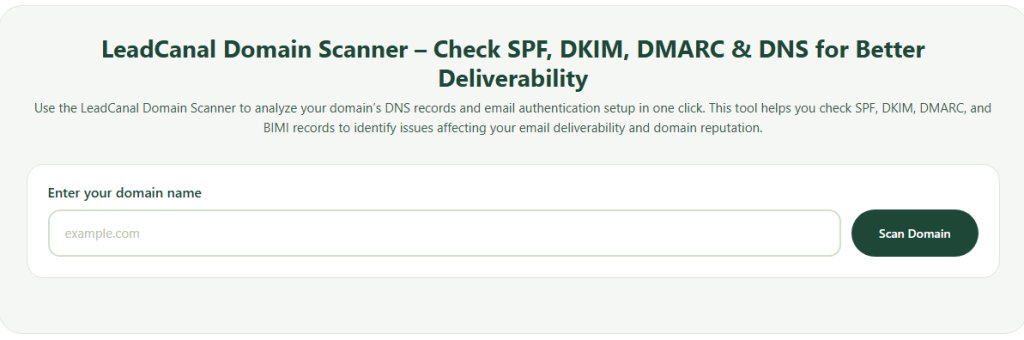
A broader domain review can include LeadCanal Domain Scanner, which businesses can explore as part of their domain-assessment workflow.
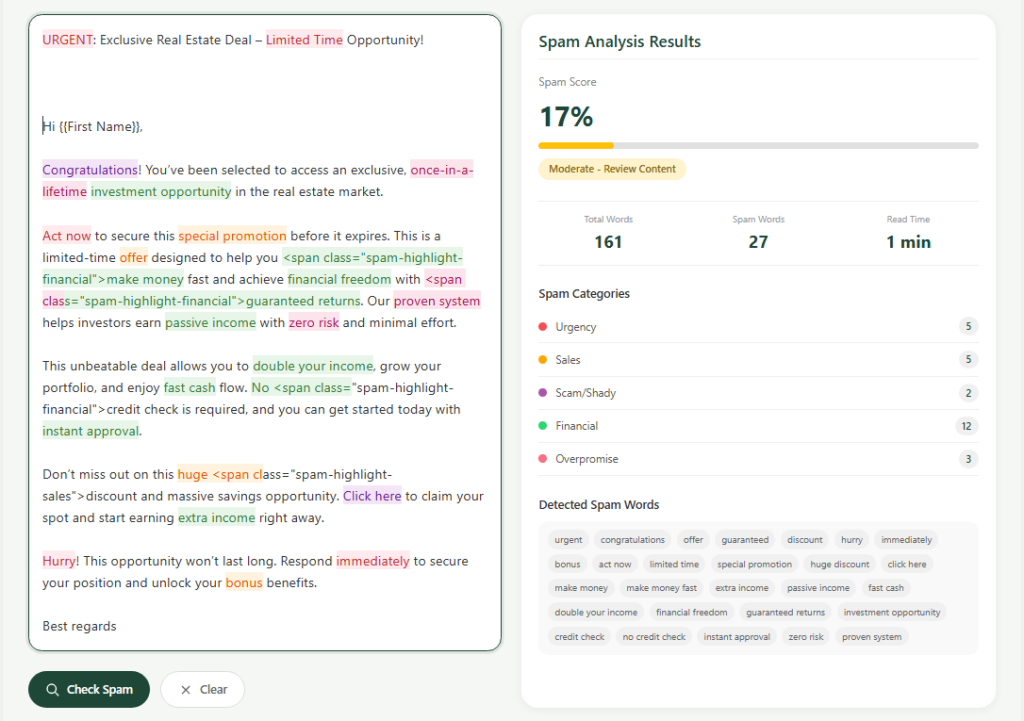
Evaluate Email Copy Before Sending
Email copy should be clear, relevant, accurate, and consistent with what subscribers expected when they signed up.
Businesses can review campaign content using LeadCanal Email Copy Spam Checker as one part of a pre-send quality-control process.
Automated content checks are not a guarantee of inbox placement. Avoid misleading subject lines, deceptive claims, hidden sender identities, and irrelevant mass messaging.
Plan Outreach Campaigns Carefully
Businesses conducting professional outreach may need to estimate campaign volume, resources, and expected outcomes before launching a campaign.
LeadCanal Cold Email Calculator is a relevant planning resource for cold-email workflows. Cold outreach and consumer newsletter marketing are different activities, however, and each should be evaluated under the applicable laws, platform rules, and recipient expectations.
8. How to Segment Consumer Email Contacts
Segmentation organizes subscribers into meaningful groups so businesses can send more relevant messages.
Segment by Interest
A retailer might separate subscribers interested in electronics, home products, clothing, or outdoor equipment. A publisher might organize subscribers by the topics they select during signup.
Segment by Customer Lifecycle
New subscribers, first-time customers, repeat buyers, and inactive subscribers may benefit from different communication. Keep each message appropriate to the relationship and the preferences the recipient has expressed.
Segment by Location
Location-based segmentation can help businesses provide relevant regional announcements, store updates, or event information. Use location information only when it is appropriately collected and useful for the stated purpose.
Segment by Engagement
Engagement data can help identify subscribers who regularly click links and those who have stopped interacting. Use this information to improve relevance and decide when to reduce or stop sending messages to inactive contacts.
Businesses managing both consumer marketing and professional prospecting should keep these audiences separate where appropriate. LeadCanal’s B2B companies email list resource illustrates the distinct requirements of business-to-business contact data.
9. Consumer Email Marketing Best Practices
Send Messages People Expect
Make the signup purpose clear and deliver the type of communication promised. Avoid changing a narrow subscription into unrelated marketing without an appropriate basis and permission.
Use Accurate Sender Details
Recipients should be able to identify the organization sending an email. Use clear sender information, honest subject lines, and accessible contact details.
Make Unsubscribing Easy
Provide a clear, working unsubscribe mechanism where required, and process opt-out requests promptly. Maintain suppression records to help prevent unsubscribed contacts from being added back to marketing campaigns.
Protect Personal Information
Restrict access to contact data, apply appropriate security controls, and establish retention policies. Collect only the information needed for a defined purpose and handle it according to applicable privacy requirements.
Understand Compliance Requirements
Email marketing rules vary by jurisdiction, recipient type, message, and how the contact information was obtained.
Businesses should review official resources such as the FTC’s CAN-SPAM Act Compliance Guide, the UK Information Commissioner’s Office direct-marketing guidance, and the European Commission’s data protection information.
These resources help explain important requirements, but businesses should assess which rules apply to their own activities.
For organizations working with professional contact datasets, LeadCanal compliant B2B data lists guide provides additional context on responsible data sourcing. B2B guidance does not replace the separate compliance assessment needed for consumer marketing.
10. Common Email List Building Mistakes
Focusing Only on the Number of Contacts
A database with 100,000 addresses is not automatically better than a smaller, engaged audience. Data source, relevance, accuracy, and permission all affect its practical value.
Treating Verification as Consent
A valid address does not mean that its owner agreed to receive marketing. Technical validation and permission management must remain separate processes.
Ignoring Unsubscribe Requests
Continuing to contact people after a valid opt-out can damage trust and create legal or platform-policy issues. Maintain reliable suppression procedures.
Collecting Unnecessary Information
Excessive signup fields can discourage subscribers and create additional privacy risks. Ask only for information that serves a clear purpose.
Sending the Same Message to Everyone
A generic campaign may not address the different needs and interests within an audience. Segmentation helps businesses make communication more relevant.
Ignoring Authentication Problems
Incorrect SPF, DKIM, or DMARC configuration can create avoidable authentication issues. Review records carefully and make changes only after understanding the domain’s legitimate sending setup.
Failing to Measure Results
Track delivery failures, complaints, unsubscribes, clicks, and conversions. Investigate negative signals and adjust campaigns instead of continuing an ineffective approach.
11. How to Measure Email Marketing Performance
A useful reporting process considers audience quality and campaign results together.
| Metric | What it measures |
| Subscriber growth | How quickly the audience is growing |
| Signup conversion rate | How effectively visitors become subscribers |
| Hard bounce rate | The proportion of messages that fail because of permanent delivery problems |
| Click-through rate | How often recipients click campaign links |
| Conversion rate | How often recipients complete the intended action |
| Unsubscribe rate | How often recipients leave the list |
| Spam complaint rate | How often recipients report messages as unwanted |
| Revenue per campaign | The commercial contribution of a campaign, where relevant |
Open rates can be affected by privacy features and automated activity, so they should not be treated as a complete measure of engagement.
Compare similar campaigns and segments over time. Establish a baseline, make controlled changes, and evaluate whether the results improve.
12. Frequently Asked Questions
How can I build a consumer email list of 100,000 subscribers?
Develop a scalable strategy using valuable content, relevant signup offers, search traffic, appropriate partnerships, and permission-based acquisition.
The time required depends on audience demand, resources, signup conversion, and subscriber retention.
Is buying a consumer email list the same as building an audience?
No. Obtaining a third-party database does not automatically create a relationship with its contacts or establish permission to send marketing.
Businesses must assess the source, applicable legal requirements, and permissions associated with the intended use.
Why is email verification important for a large list?
Verification can identify malformed, invalid, or potentially risky addresses and help reduce avoidable delivery problems. It does not guarantee inbox placement, engagement, or consent.
What is the difference between a consumer email list and a B2B email list?
A consumer list focuses on individuals and consumer markets, while a B2B list focuses on professional contacts and organizations.
Their audience criteria and marketing considerations may differ.
How do SPF, DKIM, and DMARC support email marketing?
SPF identifies authorized sending servers, DKIM uses message signatures for authentication, and DMARC defines a domain policy for handling messages that fail its authentication requirements. Correct configuration supports authentication but does not guarantee inbox delivery.
Can a spam checker guarantee that an email reaches the inbox?
No. A spam-checking tool can help review content, but inbox placement also depends on authentication, sender reputation, recipient engagement, list quality, and the receiving provider’s filtering systems.
How often should a consumer email list be cleaned?
Review data before important campaigns and establish a regular schedule based on list age, acquisition source, bounce patterns, and engagement.
Suppress invalid addresses and honour opt-out requests promptly.
Does a valid email address mean that marketing can be sent?
No. Technical validity and marketing permission are separate matters. Businesses must consider the source of the contact, the intended communication, the applicable laws, and the rules of their email service provider.
Conclusion
A successful consumer email list building strategy requires more than reaching a large subscriber count. Businesses need clear audience targeting, useful signup offers, accurate records, relevant segmentation, and responsible marketing practices.
For organizations working toward 100,000 subscribers, the priority should be building an audience that is relevant to the business and interested in the communication it receives.
Email verification and data cleansing can help maintain record quality. SPF, DKIM, DMARC, and DNS reviews can support a properly configured sending domain, while content checks and campaign analytics help teams identify opportunities for improvement.
LeadCanal provides resources for email verification, domain lookup, authentication record checks, record generation, and email campaign preparation.
Choose the tools that match your workflow, verify their output before making technical changes, and keep consumer marketing permission separate from address validity and domain authentication.
Editorial Policy
This article provides educational information about consumer email list building, email data quality, domain authentication, and email marketing. Recommendations should be adapted to the business model, contact-data source, applicable jurisdiction, and email service provider’s policies.
Content Transparency Statement
This article does not guarantee subscriber growth, campaign performance, inbox placement, or legal compliance. Email verification does not establish consent, and authentication records alone do not guarantee deliverability. Businesses should independently evaluate their data sources and seek qualified advice when necessary.
About the Author
LeadCanal Editorial Team publishes educational resources about email verification, contact-data quality, domain authentication, lead generation, and email marketing workflows. Its content aims to help businesses make informed decisions about data management and relevant, responsible outreach.