Introduction
Reaching the right decision-maker is one of the most important parts of B2B sales and lead generation.
A company can have thousands of employees, but only a limited number may influence budgets, approve vendors, evaluate strategic solutions, or participate in major purchasing decisions.
A c-level contacts email list is a specialized B2B database designed to identify senior executives such as CEOs, CFOs, CIOs, CTOs, CMOs, COOs, CROs, CISOs, CHROs, and other chief-level professionals.
The value of this type of database does not come from simply having a large number of executive names.
A useful C-level contact database should connect the right executive with the right company, industry, location, business function, and outreach objective.
For example, a cybersecurity provider may need CISOs and CIOs, while an accounting software company may focus on CFOs and Controllers.
A marketing technology provider may need CMOs and Chief Growth Officers.
This article explains how C-level contact databases work, what information they should contain, how to segment and verify executive contacts, and how B2B companies can use them for targeted prospecting, account-based marketing, and executive outreach.
What Is a C-Level Contacts Email List?
Quick Answer:
A C-level contacts email list is a B2B database containing professional contact information for senior executives who hold chief-level positions within organizations.
It may contain:
- CEO contacts
- CFO contacts
- CIO contacts
- CTO contacts
- CMO contacts
- COO contacts
- CRO contacts
- CISO contacts
- CHRO contacts
- CPO contacts
- Chief Data Officers
- Chief Digital Officers
- Chief Legal Officers
- Chief Compliance Officers
A well-structured database can also include company name, industry, employee range, revenue, location, website, executive function, professional profile, and email verification status.
The strongest use case is role-specific prospecting: identifying executives whose responsibilities actually align with the product, service, or business solution being offered.
Table of Contents
- What Is a C-Level Contacts Email List?
- Who Are C-Level Contacts?
- Which Executive Titles Should You Target?
- Why C-Level Contacts Matter in B2B Sales
- What Information Should a C-Level Database Include?
- C-Level Contacts vs. General Business Contacts
- How to Build a C-Level Contacts Email List
- How to Segment C-Level Contacts
- C-Level Contacts Email List Sample
- How to Verify C-Level Business Emails
- C-Level Contacts for Account-Based Marketing
- How to Use C-Level Contacts for B2B Outreach
- C-Level Contacts by Industry
- How to Improve Executive Email Campaigns
- Common C-Level Prospecting Mistakes
- LeadCanal’s B2B Data and Verification Workflow
- Data Quality Checklist
- Responsible Use of Executive Contact Data
- FAQs
- Internal Linking Strategy
- Editorial Policy
- Content Transparency Statement
- About the Author
- Conclusion
What Is a C-Level Contacts Email List?
A C-level contacts email list is a targeted collection of business contacts occupying executive-level positions.
The phrase C-level refers to senior roles whose titles generally begin with “Chief.”
These leaders can have responsibility for areas such as:
- Corporate strategy
- Finance
- Technology
- Information systems
- Marketing
- Sales
- Operations
- Cybersecurity
- Human resources
- Product development
- Data
- Compliance
- Procurement
The exact responsibilities depend on the organization.
For example, a Chief Technology Officer may be heavily involved in technology architecture and product engineering, while a Chief Information Officer may focus more heavily on enterprise information systems and internal technology operations.
That distinction is important when creating a prospect database.
A targeted C-level database should therefore be built around business function and buying responsibility, not just executive seniority.
Who Are C-Level Contacts?
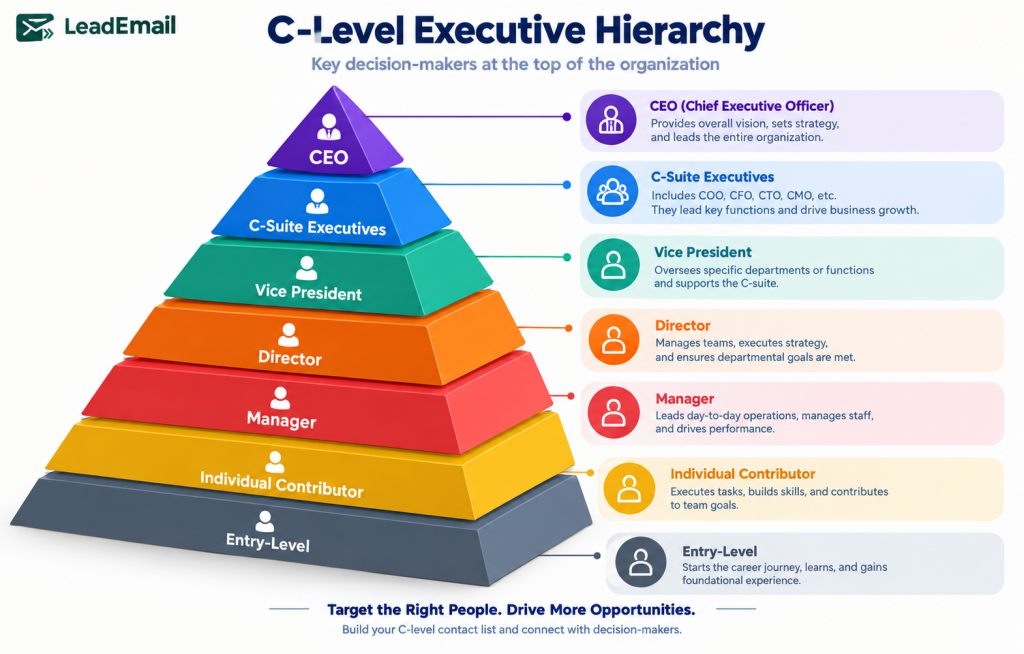
C-level contacts are senior executives responsible for major organizational functions or overall corporate leadership.
Some of the most common roles include:
| Acronym | Executive Title | Common Responsibility |
| CEO | Chief Executive Officer | Overall company leadership |
| CFO | Chief Financial Officer | Finance and financial strategy |
| CIO | Chief Information Officer | Enterprise IT |
| CTO | Chief Technology Officer | Technology and technical strategy |
| CMO | Chief Marketing Officer | Marketing and brand |
| COO | Chief Operating Officer | Operations |
| CRO | Chief Revenue Officer | Revenue and commercial growth |
| CISO | Chief Information Security Officer | Cybersecurity |
| CHRO | Chief Human Resources Officer | Human resources |
| CPO | Chief Product Officer | Product strategy |
| CDO | Chief Data Officer | Data strategy |
| CLO | Chief Legal Officer | Legal affairs |
| CCO | Chief Compliance/Commercial Officer | Compliance or commercial functions |
Some companies also use specialized titles such as Chief Digital Officer, Chief AI Officer, Chief Procurement Officer, Chief Experience Officer, and Chief Sustainability Officer.
Therefore, a comprehensive C-level contact search should account for title variations, synonyms, and organizational differences.
Which Executive Titles Should You Target?
The correct executive depends on what your company sells.
If You Sell Cybersecurity Solutions
Potential targets:
- CISO
- CIO
- CTO
- Chief Security Officer
- Chief Risk Officer
If You Sell Financial Software
Potential targets:
- CFO
- COO
- CEO
- Chief Accounting Officer
- Controller
If You Sell Marketing Technology
Potential targets:
- CMO
- CRO
- Chief Growth Officer
- Chief Digital Officer
- VP Marketing
If You Sell HR Technology
Potential targets:
- CHRO
- Chief People Officer
- COO
- Chief Talent Officer
If You Sell Enterprise IT Services
Potential targets:
- CIO
- CTO
- CISO
- Chief Digital Officer
- Chief Data Officer
LeadCanal verified IT decision-maker contacts can complement a broader C-level campaign when the product is targeted toward technology leaders.
Why Do C-Level Contacts Matter in B2B Sales?
C-level professionals can influence strategic initiatives, budgets, vendor relationships, and organizational priorities.
However, seniority by itself does not make someone a qualified lead.
The important question is:
Does this executive have a relevant business responsibility connected to the solution being offered?
Consider an enterprise cybersecurity platform.
A CMO may be a senior executive, but a CISO or CIO may be more directly connected to the cybersecurity buying process.
Similarly, if a company sells financial planning software, a CFO may be more relevant than a CTO.
This is why role-based targeting is essential.
What Information Should a C-Level Contacts Database Include?
A professional executive contact database should provide enough information to qualify the record before outreach.
Contact Information
Useful contact fields include:
- First name
- Last name
- Job title
- Executive level
- Department
- Business email
- Professional profile
- Verification status
Company Information
Useful company fields include:
- Company name
- Company website
- Industry
- Sub-industry
- Employee range
- Revenue range
- Headquarters
- City
- State or region
- Country
Additional Business Intelligence
Depending on the data source, additional fields can include:
- Company technology
- SIC code
- NAICS code
- Company type
- Funding stage
- Parent company
- Subsidiary information
- Growth indicators
- Account status
Current C-level data providers commonly position company size, industry, geography, executive title, firmographics, and verification as important filtering criteria.
C-Level Contacts vs. General Business Contacts
A general B2B contact database may contain employees from sales, marketing, finance, IT, HR, operations, and other departments.
A C-level database narrows the audience to executive leadership.
| Category | General B2B Contacts | C-Level Contacts |
| Seniority | Multiple levels | Executive level |
| Audience | Broad workforce | Senior leadership |
| Targeting | Job title/company | Executive function/company |
| Messaging | Departmental | Strategic/business-focused |
| ABM | Possible | Strong use case |
| Executive targeting | Limited | Core purpose |
| Buying influence | Varies | Often strategic |
| Data requirements | General | Role + company context |
The correct database depends on the sales process.
A product purchased by technical specialists may not require C-level targeting.
A strategic enterprise solution may require multiple executive stakeholders.
How to Build a C-Level Contacts Email List
Creating a useful database starts with your ideal customer profile (ICP).
Step 1: Define Your Ideal Customer
Document:
- Industry
- Geography
- Company size
- Revenue
- Business model
- Technology
- Growth stage
- Relevant executive roles
For example:
- Industry: B2B SaaS
- Company size: 200–2,000 employees
- Geography: United States
- Product: Enterprise sales platform
- Target executives: CRO, CEO, COO
- Campaign: Account-based sales
This gives your prospecting team a specific framework.
Step 2: Define Executive Title Variations
Do not rely on only one exact title.
For example, a finance campaign might include:
- CFO
- Chief Financial Officer
- Chief Finance Officer
- Finance Executive
- Chief Accounting Officer
- VP Finance
Title variations help account for differences between companies.
Step 3: Identify Target Companies
Build the account list according to your ICP.
Useful filters include:
- Industry
- Country
- State
- City
- Employee count
- Revenue
- Technology
- Business model
Step 4: Identify Relevant Executives
Map appropriate executives to each company.
Instead of collecting random executives, ask:
Who is likely to own, influence, approve, or sponsor this type of purchase?
Step 5: Enrich the Records
Add useful company and executive information.
This may include:
- Current job title
- Company website
- Industry
- Employee count
- Revenue
- Location
- Professional profile
- Technology information
Step 6: Verify Business Emails
Before launching outreach, check the email addresses.
LeadCanal Email Verifier can be used as part of an email-list hygiene workflow to identify invalid or risky addresses.
How to Segment C-Level Contacts
Segmentation helps businesses move from a broad executive database to a focused prospecting audience.
Segment by Executive Role
Examples:
- CEOs
- CFOs
- CIOs
- CTOs
- CMOs
- COOs
- CROs
- CISOs
- CHROs
- CPOs
Segment by Industry
Examples include:
- Technology
- SaaS
- Healthcare
- Banking
- Finance
- Manufacturing
- Insurance
- Retail
- Logistics
- Real estate
- Travel
- Professional services
LeadCanal finance and banking email list is an example of narrowing B2B data around a particular industry and decision-making audience.
Segment by Company Size
| Company Size | Potential Targeting |
| 1–50 employees | CEO / Founder |
| 51–200 | CEO / COO / Functional executives |
| 201–500 | C-suite + VP stakeholders |
| 501–1,000 | Multiple executive stakeholders |
| 1,001–5,000 | Enterprise buying groups |
| 5,000+ | Multi-department executive committees |
C-Level Contacts Email List Sample
A sample table helps potential customers understand the type of fields a database can contain.
The following records are fictional examples created for demonstration only and should not be interpreted as real contacts.
Here you can see the sample list. If you want to download these samples with dentists’ emails, please contact us or get a quote.

What Does This Sample Demonstrate?
A structured executive database can connect:
Person → Executive Role → Company → Industry → Firmographics → Location → Contact Status
That context is more useful for prospecting than a spreadsheet containing only names and email addresses.
How to Verify C-Level Contacts
Executive contact information can change quickly.
A person may:
- Change companies
- Receive a promotion
- Move to another executive function
- Leave an organization
- Change their corporate email
- Become inactive
For that reason, verification should be treated as a continuing part of data management.
A practical workflow is:
Research → Enrich → Verify → Segment → Suppress Risky Records → Personalize → Send → Monitor
LeadCanal’s Email Verification API can be integrated into workflows where email addresses need to be checked programmatically before outreach.
A verification workflow can evaluate technical factors such as syntax, domain configuration, mail-server information, and other deliverability-related signals.
However:
A verified email address is not the same as permission to send marketing communication.
Businesses should separately consider applicable privacy and marketing requirements.
C-Level Contacts for Account-Based Marketing
C-level contacts can be particularly useful for account-based marketing (ABM).
ABM focuses on selected organizations and coordinates marketing and sales activities around those accounts.
A typical workflow looks like:
Target Accounts → Identify Executives → Map Buying Committee → Enrich → Verify → Personalize → Engage → Measure
For example, an enterprise software company could select 100 target accounts.
For each account, the team might identify:
- CEO
- CIO
- CTO
- CFO
- CISO
- COO
- Relevant VP
This approach creates a broader picture of the buying committee.
It also reduces the risk of depending entirely on one contact at a target organization.
How to Use C-Level Contacts for B2B Outreach
C-level outreach should be concise, relevant, and connected to business priorities.
1. Start With the Executive’s Responsibility
A CFO is generally more interested in financial outcomes than technical implementation details.
A CTO may care about:
- Architecture
- Integration
- Scalability
- Engineering efficiency
A CMO may care about:
- Pipeline
- Acquisition
- Attribution
- Marketing performance
The message should reflect the recipient’s business function.
2. Personalize Around the Company
Useful personalization can include:
- Industry
- Company size
- Business model
- Market
- Technology
- Business initiative
- Executive function
The goal is to demonstrate relevance rather than simply inserting a first name.
3. Keep the Value Proposition Clear
An executive should be able to understand quickly:
- Why you contacted them
- What problem you address
- Why it may matter to their organization
- What next step you are suggesting
4. Use a Structured Follow-Up
A campaign may contain several touches, but every follow-up should provide a reason for the recipient to continue the conversation.
Avoid sending repetitive messages that add no new information.
LeadCanal cold email outreach service covers prospect research, list building, personalized messaging, follow-ups, and campaign optimization as components of a broader outbound workflow.
C-Level Contacts by Industry
Executive targeting changes considerably between industries.
Technology
Potential contacts:
- CTO
- CIO
- CISO
- CPO
- CEO
- Chief Digital Officer
Technology businesses may use executive data for:
- SaaS sales
- Cloud services
- Cybersecurity
- Data platforms
- IT consulting
Healthcare
Potential contacts:
- CEO
- CFO
- CIO
- COO
- CMO
- Chief Medical Officer
Healthcare organizations often have multiple stakeholders, so C-level targeting may need to be combined with department-level contacts.
LeadCanal hospital decision-makers email list provides a related example of targeting healthcare organizations through decision-maker data.
Banking and Finance
Potential contacts:
- CFO
- CIO
- COO
- CISO
- CEO
- Chief Risk Officer
Financial organizations can have complex procurement and compliance structures, so executive contact targeting should be supported by account research.
SaaS
Potential contacts:
- CEO
- CTO
- CRO
- CMO
- CPO
- COO
SaaS companies may use C-level contact data for sales, partnerships, technology services, consulting, and enterprise solutions.
How to Improve C-Level Email Campaigns
A good contact database is only one component of a successful campaign.
Improve Data Quality
Regularly:
- Remove duplicates
- Verify email addresses
- Update job titles
- Update company information
- Suppress invalid records
- Replace outdated contacts
Improve Segmentation
Separate audiences by:
- Executive role
- Industry
- Geography
- Company size
- Revenue
- Technology
- Account priority
Improve Messaging
Build role-specific messages rather than one generic template.
Improve Sending Infrastructure
Monitor:
- SPF
- DKIM
- DMARC
- Sender reputation
- Bounce rates
- Complaint rates
- Sending volume
LeadCanal email deliverability resource covers authentication, sender reputation, blacklist monitoring, email warm-up, and related deliverability practices.
Its 2026 email deliverability guide provides additional context on authentication, reputation, and inbox placement.
C-Level Contacts and Multichannel Prospecting
Executive prospecting does not need to rely on email alone.
Depending on the campaign, companies can combine:
- Content marketing
- Retargeting
- Sales calls
- Events
- Account-based advertising
LeadCanal LinkedIn outreach service can complement email campaigns by helping businesses identify and engage relevant professional contacts through LinkedIn.
The objective should be consistency rather than sending the same message repeatedly across every channel.
Common C-Level Contact List Mistakes
Mistake 1: Choosing Volume Over Relevance
A database with millions of contacts is not automatically better.
The right executive at the right company can be more valuable than thousands of unrelated contacts.
Mistake 2: Targeting Every C-Level Role
Not every executive is relevant to every product.
Build campaigns around buying responsibility.
Mistake 3: Ignoring Company Size
A CFO at a startup may have very different responsibilities from a CFO at a multinational organization.
Mistake 4: Using Outdated Job Titles
Executives change positions.
A database should be refreshed rather than treated as permanent.
Mistake 5: Sending Identical Messages
Different executive functions have different priorities.
Mistake 6: Ignoring Email Verification
Invalid contacts can increase bounce rates and reduce the efficiency of campaigns.
Mistake 7: Confusing Verification With Consent
Technical validity does not establish permission.
Mistake 8: Measuring Only Open Rates
Better campaign measurements can include:
- Delivery rate
- Bounce rate
- Positive replies
- Qualified conversations
- Meetings
- Opportunities
- Revenue
LeadCanal’s C-Level Contact Data Workflow
LeadCanal broader B2B prospecting resources can be connected into a structured executive-data workflow.
Phase 1: Targeting
Define:
- ICP
- Industry
- Geography
- Company size
- Executive role
Phase 2: Contact Research
Identify executives associated with the target accounts.
Phase 3: Enrichment
Add:
- Company data
- Professional data
- Firmographics
- Relevant business context
Phase 4: Verification
Use the LeadCanal Email Verifier to help identify invalid or risky addresses before campaigns.
Phase 5: Segmentation
Organize contacts by:
- Executive function
- Industry
- Geography
- Company size
- Account priority
Phase 6: Outreach
Use relevant messaging through:
- Sales development
- Account-based campaigns
Phase 7: Deliverability
Support the campaign with appropriate authentication and sender-reputation practices.
Phase 8: Refresh
Continue updating executive and company records as organizational changes occur.
This creates a connected system instead of treating the contact database as a standalone spreadsheet.
C-Level Contact Data Quality Checklist
Before using a C-level contact database, review the following.
Contact Data
- Current name
- Current job title
- Relevant executive function
- Business email
- Verification status
- Duplicate removal
Company Data
- Company name
- Website
- Industry
- Employee range
- Revenue range
- Location
Targeting
- Correct ICP
- Correct executive role
- Correct geography
- Correct industry
- Correct company size
Campaign Preparation
- Role-specific messaging
- Email verification
- Suppression process
- Unsubscribe process
- SPF
- DKIM
- DMARC
- Bounce monitoring
How Often Should C-Level Contact Data Be Updated?
There is no universal update period that works for every business.
The appropriate frequency depends on:
- Industry
- Executive turnover
- Database age
- Campaign frequency
- Market
- Company growth
- Data source
High-value prospect databases should be reviewed periodically.
A simple status system can help:
| Contact Status | Recommended Action |
| Recently verified | Eligible for review |
| Verification aging | Recheck |
| New job title | Re-enrich |
| Left company | Replace or suppress |
| Invalid email | Remove or replace |
| Uncertain record | Hold for review |
| Opted out | Keep suppressed |
Responsible Use of C-Level Contact Data
Professional contact data should be handled responsibly.
Before launching a campaign, review:
- Where the data came from
- Why you are contacting the person
- Whether the information is appropriate for the intended use
- Applicable privacy rules
- Applicable marketing requirements
- Opt-out procedures
- Suppression processes
- Data retention policies
For U.S. commercial email, the FTC explains that CAN-SPAM applies to commercial email, including B2B messages, and covers requirements related to truthful header information, subject lines, identification, physical address information, and opt-out mechanisms.
International campaigns may be subject to additional requirements depending on the recipient’s jurisdiction and the nature of the communication.
A useful principle is:
Reliable contact data should support relevant communication, not indiscriminate messaging.
Frequently Asked Questions About C-Level Contacts Email Lists
What is a C-level contacts email list?
A C-level contacts email list is a B2B database containing professional information about senior executives such as CEOs, CFOs, CIOs, CTOs, CMOs, COOs, CROs, CISOs, and other chief-level professionals.
What information can a C-level contact record contain?
A record may include the executive’s name, job title, company, business email, industry, company size, location, website, professional profile, and verification status.
Who uses C-level contact databases?
B2B software companies, consultants, technology providers, cybersecurity companies, agencies, recruiters, financial services providers, and professional-service firms may use executive contact databases when those roles are relevant to their sales or marketing objectives.
Which C-level executives should I target?
Targeting depends on your product. Cybersecurity providers may focus on CISOs and CIOs, financial software companies may target CFOs, and marketing technology companies may target CMOs or CROs.
How can I build a C-level contacts email list?
Start with an ideal customer profile, identify target accounts, select relevant executive titles, research contacts, enrich records, verify emails, segment the database, and prepare role-specific outreach.
Why is email verification important for executive contacts?
Verification can help identify invalid or risky email addresses before a campaign. This supports cleaner data and can help reduce avoidable bounces.
Does a verified email mean I can send marketing messages?
No. Technical verification and marketing permission are different issues. Businesses should evaluate applicable laws, policies, recipient expectations, and opt-out requirements.
Can C-level contacts be used for ABM?
Yes. Executive contacts can be mapped to target accounts and organized according to the company’s buying committee and campaign objectives.
How should C-level contacts be segmented?
Useful segmentation includes executive role, industry, geography, company size, revenue, technology, account priority, and business function.
What makes a high-quality C-level contact database?
Important factors include accurate executive titles, relevant company information, current business emails, verification, segmentation, duplicate control, data freshness, and responsible data practices.
Editorial Policy
This article is designed to provide educational information about C-level business contacts, B2B prospecting, contact-data organization, email verification, segmentation, account-based marketing, and executive outreach.
LeadCanal recommends evaluating data relevance, freshness, verification status, campaign purpose, recipient expectations, and applicable requirements before using business contact information for outreach.
No business contact record should be assumed to remain accurate indefinitely.
Content Transparency Statement
This article was developed specifically around the search intent behind “c-level contacts email list” and closely related queries such as:
- C-level contacts database
- C-level executive email list
- C-level decision makers
- C-suite contacts
- executive contact database
- verified executive contacts
- CEO contacts
- CFO contacts
- CIO contacts
- CTO contacts
Search-result research indicates that competing pages commonly emphasize executive titles, verified email addresses, firmographic information, company size, industry, geographic targeting, sample records, and ABM applications.
This article expands the topic by connecting those concepts with:
- ICP development
- Executive-role segmentation
- Data enrichment
- Email verification
- Deliverability
- Account-based marketing
- Cold outreach
- LinkedIn prospecting
- Industry-specific targeting
- Responsible data use
The sample contact table in this article contains fictional demonstration records and is not presented as a real contact database.
About the Author
Writing by M.SHAHZAD focuses on B2B lead generation, business contact data, email verification, data enrichment, cold email outreach, LinkedIn prospecting, and email deliverability.
Its resources cover multiple B2B industries and professional audiences, allowing businesses to build prospecting workflows around their ideal customer profile rather than relying solely on broad contact volume.
Conclusion: Turn C-Level Contact Data Into a More Relevant B2B Prospecting Strategy
A c-level contacts email list can provide a structured starting point for businesses that need to identify senior decision-makers across specific industries, companies, and markets.
But the value of executive contact data comes from relevance and context, not simply the number of records.
A practical strategy is:
Define Your ICP → Identify Target Companies → Select Executive Roles → Build Contact Records → Enrich Company Data → Verify Emails → Segment Contacts → Personalize Messaging → Configure Deliverability → Launch Outreach → Measure Results → Refresh Data
a cybersecurity provider, that may mean prioritizing CISOs and CIOs.
For a financial solution, it could mean CFOs and COOs.
marketing technology, CMOs and CROs may be more relevant.
enterprise technology services, CIOs, CTOs, CISOs, and Chief Digital Officers may be appropriate targets.
The same principle applies across industries: start with the business problem, identify the executive function connected to that problem, and then build the contact database around that relationship.
LeadCanal’s ecosystem of email verification, CIO contacts, IT decision-makers, cold email outreach, LinkedIn outreach, and email deliverability resources can support different stages of this process.
Ultimately, a successful C-level prospecting strategy combines accurate contact information, relevant executive targeting, strong segmentation, responsible outreach, and sound email infrastructure.
That makes a C-level contacts email list more than a collection of names. It becomes a structured B2B prospecting resource that can help sales and marketing teams focus their efforts on relevant organizations and decision-making roles.