
Introduction
The semiconductor industry sits at the center of modern technology, powering smartphones, data centers, artificial intelligence systems, automobiles, industrial equipment, IoT devices, telecommunications networks, and countless other products.
For B2B companies selling semiconductor equipment, manufacturing solutions, engineering services, materials, software, automation, testing systems, logistics, or technology infrastructure, reaching the right professional is often more important than simply having a large contact database.
A Semiconductor Industry Email List can help sales and marketing teams identify relevant companies, map decision-makers, segment prospects by business function, and create more focused B2B outreach campaigns.
However, a useful semiconductor contact database is not simply a collection of email addresses.
It should connect the right company with the right department, job function, location, technology segment, and business need.
This article explains how to build and use a targeted semiconductor industry email list, which decision-makers to target, how to improve data quality,
how email verification fits into the workflow, and how semiconductor companies can be segmented for B2B sales.
What Is a Semiconductor Industry Email List?
Quick Answer:
A Semiconductor Industry Email List is a B2B prospect database containing professional contacts from organizations involved in semiconductor design, manufacturing, fabrication, equipment, materials, packaging, testing, distribution, and related technologies.
A high-quality list can be segmented by:
- Semiconductor company
- Manufacturing segment
- Job title
- Department
- Geography
- Company size
- Technology area
- Purchasing responsibility
- Engineering function
- Supply chain role
- Business application
For example, a semiconductor equipment supplier may target fab directors and manufacturing managers, while an engineering software company may focus on IC design engineers, ASIC teams, VLSI professionals, CTOs, and engineering directors.
The objective is not maximum contact volume. The objective is better-fit business contacts that match a defined ideal customer profile.
Table of Contents
- What Is a Semiconductor Industry Email List?
- Semiconductor Industry Segments to Target
- Semiconductor Manufacturing Email List
- Semiconductor Decision-Makers and Job Titles
- Semiconductor Contact Database by Technology
- What Data Should a Semiconductor Email List Include?
- How to Build a Targeted Semiconductor Email List
- Email Verification and Data Quality
- Semiconductor Lead Segmentation
- Semiconductor B2B Outreach Strategies
- Semiconductor Email List vs. Generic Technology Lists
- Common Data Problems to Avoid
- Compliance and Responsible B2B Prospecting
- Frequently Asked Questions
- Final Takeaway
What Is a Semiconductor Industry Email List?
A semiconductor industry email list is designed to identify business professionals working across the semiconductor ecosystem.
The ecosystem is broader than chip manufacturers alone.
It can include:
- Semiconductor manufacturers
- Chip design companies
- Integrated device manufacturers
- Foundries
- Semiconductor equipment manufacturers
- Semiconductor materials suppliers
- IC design organizations
- ASIC companies
- VLSI engineering organizations
- Packaging and testing providers
- Semiconductor distributors
- Automotive semiconductor businesses
- Power semiconductor companies
- AI and HPC chip companies
- IoT semiconductor companies
- Telecommunications chip suppliers
- Semiconductor software providers
This distinction matters because different companies participate in different stages of the semiconductor value chain.
A semiconductor manufacturing company may need production equipment and materials, while an IC design company may be more interested in EDA software, engineering tools, cloud infrastructure, or verification solutions.
That is why an effective semiconductor contact database should be built around business requirements rather than a single industry label.
Semiconductor Industry Segments to Target
A strong semiconductor companies email list can be divided into multiple segments.
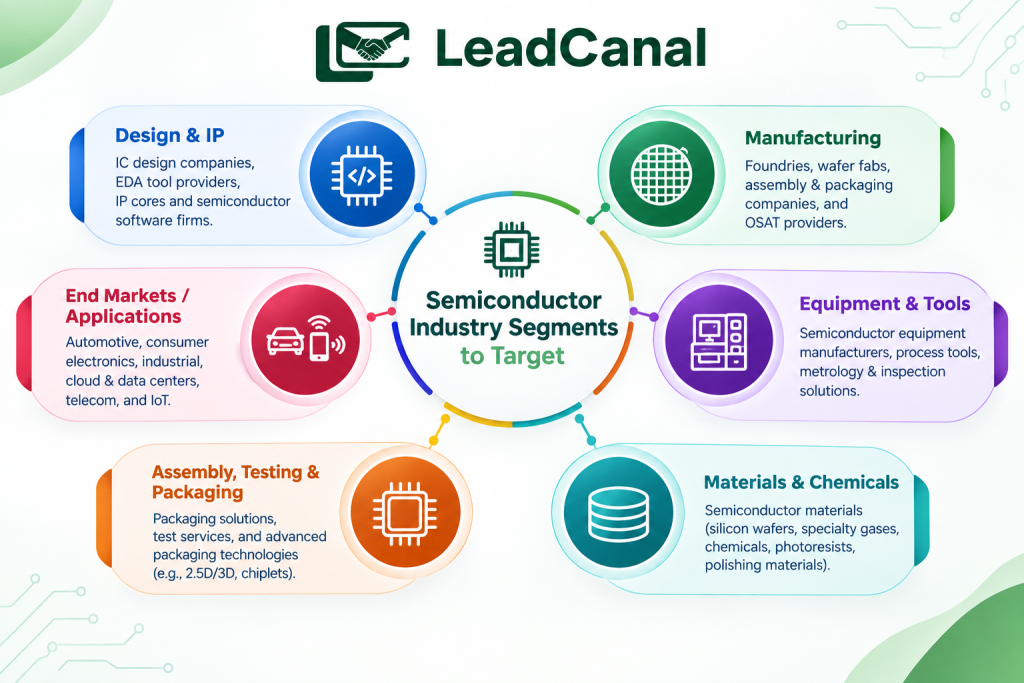
1. Semiconductor Manufacturing Companies
Manufacturing organizations can include companies involved in wafer fabrication, chip production, semiconductor processing, and related manufacturing operations.
Potential contacts include:
- Fab Directors
- Manufacturing Directors
- Plant Managers
- Operations Directors
- Process Engineering Managers
- Production Managers
- Procurement Managers
- Supply Chain Directors
- Quality Managers
These contacts can be relevant for companies selling manufacturing equipment, automation, industrial software, testing systems, materials, maintenance solutions, and production technologies.
2. Semiconductor Design Companies
Chip design organizations require specialized engineering, software, testing, verification, and development solutions.
Relevant prospects may include:
- ASIC Engineers
- VLSI Engineers
- IC Design Engineers
- Chip Architects
- Design Directors
- Engineering Managers
- Verification Engineers
- CTOs
- VP Engineering
- R&D Directors
3. Semiconductor Equipment Companies
Semiconductor equipment suppliers operate in a highly specialized B2B environment.
Potential target departments include:
- Equipment Engineering
- Manufacturing
- Procurement
- Operations
- Field Service
- Supply Chain
- Product Engineering
- Quality Assurance
4. Semiconductor Materials Suppliers
Materials companies may supply products used throughout semiconductor production.
Target contacts can include:
- Procurement Heads
- Materials Managers
- Operations Directors
- Supply Chain Managers
- Manufacturing Managers
- Quality Directors
- R&D Professionals
5. Semiconductor Packaging and Testing
Packaging and testing are important parts of the semiconductor supply chain.
Potential prospects include:
- Packaging Engineers
- Test Engineers
- Quality Engineers
- Operations Managers
- Manufacturing Directors
- Procurement Professionals
- Supply Chain Leaders
For companies selling testing equipment, quality systems, engineering software, automation, or production solutions, this segment can be especially relevant.
Semiconductor Manufacturing Email List: Why Industry Segmentation Matters
A semiconductor manufacturing email list should not be treated as identical to a general electronics mailing list.
Semiconductor manufacturing involves specialized processes, technologies, equipment, quality requirements, engineering teams, procurement cycles, and supply-chain relationships.
For example, a company selling wafer-processing equipment should not rely exclusively on generic electronics contacts.
Its ideal customer profile may require:
- Industry: Semiconductor manufacturing
- Company type: Fab / foundry / manufacturing organization
- Department: Engineering / Manufacturing / Procurement
- Seniority: Manager, Director, VP, Executive
- Location: Target market
- Technology: Relevant manufacturing capability
This creates a more precise prospecting environment.
The same principle applies when building a semiconductor manufacturing industry mailing list for equipment vendors, industrial technology providers, logistics companies, engineering firms, or enterprise software vendors.
Semiconductor Decision-Makers: Who Should You Target?
One of the biggest weaknesses of generic B2B databases is that they may identify a company without identifying the people involved in the buying process.
For semiconductor sales, the buying committee may include several stakeholders.
Semiconductor Executives
Possible titles include:
- CEO
- COO
- CTO
- CIO
- President
- VP Operations
- VP Engineering
- VP Manufacturing
- VP Supply Chain
Engineering Decision-Makers
Potential targets include:
- Engineering Director
- R&D Director
- Process Engineering Manager
- IC Design Manager
- VLSI Engineering Manager
- Verification Manager
- Product Engineering Director
Procurement Decision-Makers
Procurement contacts may include:
- Chief Procurement Officer
- Procurement Director
- Procurement Manager
- Strategic Sourcing Manager
- Purchasing Manager
- Supply Chain Director
Quality Professionals
Quality-related prospects may include:
- Quality Director
- Quality Manager
- Quality Engineer
- Supplier Quality Manager
- Manufacturing Quality Manager
For additional B2B targeting ideas, a relevant Quality Control Professionals Email List can also demonstrate how job-function-based segmentation works when the target audience includes quality teams.
Semiconductor Industry Email List by Job Title
Job-title targeting is one of the most important parts of building a semiconductor lead database.
Instead of targeting everyone inside a company, marketers can create separate campaigns for different buying roles.
| Job Function | Example Target Titles | Potential Business Need |
|---|---|---|
| Executive | CTO, COO, CEO | Strategy, technology, operations |
| Engineering | VP Engineering, Engineering Director | Technical solutions |
| Manufacturing | Fab Director, Manufacturing Manager | Production solutions |
| Procurement | Procurement Director, Sourcing Manager | Purchasing and suppliers |
| R&D | R&D Director, R&D Manager | Innovation and development |
| Quality | Quality Director, Quality Engineer | Quality systems |
| Supply Chain | Supply Chain Director, Manager | Logistics and sourcing |
| IT | CIO, IT Director, Infrastructure Manager | Enterprise technology |
| Operations | COO, Operations Director | Process and efficiency |
For technology-oriented campaigns, an IT Decision Makers Email List can also be useful as a reference point for targeting senior technology professionals based on role rather than relying only on company-level targeting.
Semiconductor Contact Database by Technology
The semiconductor sector includes multiple technology categories, so segmentation can become even more specific.
A semiconductor database may be organized around:
- AI semiconductors
- Automotive semiconductors
- Power semiconductors
- IoT chips
- 5G semiconductor technology
- Data-center processors
- High-performance computing
- Memory technology
- Microcontrollers
- Sensors
- Analog semiconductors
- Mixed-signal ICs
- ASIC
- FPGA
- VLSI
- IC design
- Advanced packaging
- Semiconductor testing
- Semiconductor equipment
This approach allows marketers to create campaigns around the actual technology or application rather than using a broad industry category.
What Data Should a Semiconductor Email List Include?
A B2B semiconductor database becomes more useful when each record contains meaningful business context.
Depending on the campaign, useful fields may include:
- First name
- Last name
- Job title
- Company name
- Business email
- Company website
- Industry
- Sub-industry
- Department
- Seniority
- Country
- State or region
- City
- Company size
- Technology segment
- Manufacturing role
- LinkedIn profile where appropriate
- Verification status
- Data-source information
- Last verification date
The goal is to create a usable sales intelligence dataset, not simply a spreadsheet of addresses.
If duplicate, outdated, incomplete, or inconsistent records are present, the database should go through a dedicated data cleansing and enrichment process before activation.
How to Build a Targeted Semiconductor Industry Email List
Here you can see the sample list. If you want to download these samples with dentists’ emails, please contact us or get a quote.

Step 1: Define the Ideal Customer Profile
Start with the company rather than the contact.
Define:
- Industry segment
- Company type
- Geography
- Company size
- Technology
- Revenue range where relevant
- Buying department
- Required job titles
For example:
Target semiconductor manufacturing companies in North America with engineering and procurement teams responsible for advanced production technologies.
This is much more useful than simply searching for “semiconductor companies.”
Step 2: Identify Target Companies
Create an account list based on the ICP.
Potential company categories include:
- Semiconductor manufacturers
- Chip designers
- Foundries
- Equipment suppliers
- Materials companies
- Packaging providers
- Testing companies
- Semiconductor software companies
Step 3: Map the Buying Committee
A single account may contain multiple relevant contacts.
Instead of collecting one person per company, identify the departments participating in the buying process.
For example:
Technical buyer → Engineering Director
Economic buyer → VP Operations
Procurement stakeholder → Procurement Manager
Operational stakeholder → Manufacturing Manager
This account-based approach can make B2B prospecting much more structured.
Step 4: Collect Business Contact Data
Collect relevant professional information according to the campaign requirements.
Prioritize:
- Relevant job title
- Correct company
- Business email
- Current employment
- Relevant department
- Geographic fit
Step 5: Clean the Database
Before outreach, remove:
- Duplicate records
- Incomplete records
- Obsolete contacts
- Invalid domains
- Clearly unusable addresses
- Irrelevant job titles
A strong data cleansing and enrichment workflow can help standardize records before they enter the sales or marketing process.
Step 6: Verify Email Addresses
Email verification is a critical quality-control step.
A professional Email Verifier workflow can evaluate signals such as:
- Email syntax
- Domain status
- DNS/MX records
- Mailbox-related signals
- Disposable domains
- Role-based addresses
- Catch-all behavior
- Risk indicators
Verification does not guarantee that an address belongs to an interested buyer. It is primarily a data-quality step.
For teams handling large volumes or automated workflows, an Email Verification API can be used as part of a real-time validation process.
Step 7: Enrich and Segment
After verification, enrich the database with relevant business attributes.
Then create segments such as:
- Semiconductor executives
- Fab directors
- Procurement managers
- R&D leaders
- Semiconductor engineers
- Quality professionals
- Supply chain managers
- IT decision-makers
Step 8: Activate the Database
Once the data is clean and segmented, connect it to the appropriate sales workflow.
That may include:
- Cold email
- LinkedIn prospecting
- Account-based marketing
- Sales development
- Lead nurturing
- CRM workflows
- Event outreach
Semiconductor Email Verification: Why List Quality Matters
A large database can still perform poorly when its underlying records are inaccurate.
Outdated contacts can result from:
- Job changes
- Company restructuring
- Domain changes
- Mergers and acquisitions
- Department changes
- Duplicate records
- Old email addresses
- Incorrect data entry
For this reason, semiconductor prospecting should use a repeatable clean → verify → enrich → segment → activate workflow.
A dedicated resource on B2B Sales Email Verification Techniques can be used to understand how syntax, domain, DNS, SMTP-related signals, catch-all behavior, disposable addresses, and duplicate records fit into a broader data-quality process.
Semiconductor Lead Segmentation Strategy
Segmentation should reflect the actual reason a prospect could buy.
Segment by Department
Create separate groups for:
- Engineering
- Manufacturing
- Procurement
- Operations
- Quality
- R&D
- Supply Chain
- IT
Segment by Seniority
For example:
- C-Level
- VP
- Director
- Manager
- Engineer
- Specialist
Segment by Technology
Create technology-focused groups such as:
- AI
- Automotive
- IoT
- 5G
- Power electronics
- ASIC
- VLSI
- FPGA
- Advanced packaging
Segment by Geography
Campaigns can also be separated by:
- United States
- Canada
- Europe
- Asia-Pacific
- Middle East
- Other target regions
Geographic segmentation can help adapt messaging, sales coverage, language, business hours, and market-specific requirements.
Semiconductor Industry Email List vs. Generic Technology Email List
| Feature | Semiconductor Industry List | Generic Technology List |
|---|---|---|
| Industry focus | Semiconductor ecosystem | Broad technology |
| Job targeting | Highly specific | Often broad |
| Manufacturing roles | Strong focus | Limited |
| Engineering segmentation | IC/VLSI/ASIC/etc. | General engineering |
| Procurement targeting | Semiconductor-specific | General |
| Technology segmentation | Detailed | Broad |
| Buying committee mapping | More specialized | Less specialized |
| Outreach personalization | Industry-specific | Generic |
The key difference is context.
A semiconductor prospect may have completely different priorities from a general software or IT buyer, even when both hold similar seniority levels.
How to Use a Semiconductor Companies Email List for B2B Sales
A semiconductor database can support multiple sales and marketing workflows.
Cold Email Outreach
Cold outreach works better when the message reflects the prospect’s business context.
Instead of:
“We provide solutions for technology companies.”
A more relevant message could focus on a specific semiconductor business problem, technology segment, manufacturing process, or procurement requirement.
LeadCanal Cold Email Outreach service can be used as a reference for combining targeted prospect data, personalization, campaign structure, and deliverability considerations.
LinkedIn Prospecting
LinkedIn can complement email outreach by helping sales teams research accounts and decision-makers.
A semiconductor campaign may target:
- Engineering Directors
- CTOs
- Procurement Directors
- Manufacturing Managers
- R&D Leaders
A targeted LinkedIn Outreach workflow can be combined with email prospecting rather than treating the channels as completely separate activities.
Account-Based Marketing
For strategic semiconductor accounts, build account-level segments.
For each company, identify:
- Company profile
- Relevant departments
- Decision-makers
- Technical influencers
- Procurement stakeholders
- Business email addresses
- Outreach status
This creates a more complete account view.
Build a Campaign-Ready Semiconductor Database
A raw contact list is different from a campaign-ready database.
A useful Email Campaign Database should connect contacts with information such as:
- Contact identity
- Company
- Job title
- Segment
- Geography
- Verification status
- Campaign status
- Engagement information
- Suppression status
This structure helps sales teams avoid repeatedly contacting the same prospects and makes campaign segmentation easier.
Email Deliverability for Semiconductor B2B Outreach
Even a highly targeted database can create problems if email infrastructure is poorly configured.
Before launching campaigns, review:
- SPF
- DKIM
- DMARC
- Sending-domain configuration
- Bounce management
- List hygiene
- Sending volume
- Authentication alignment
A Domain Scanner can help review important DNS and email-authentication records.
An SPF Record Generator can assist with creating the appropriate SPF record structure, while a DKIM Record Generator can help generate DKIM DNS information for supported email platforms.
The objective is not simply to send more messages. It is to maintain a healthy sending environment while contacting relevant business prospects.
Common Semiconductor Email List Problems
1. Buying Based Only on Contact Volume
A larger database does not automatically mean a more useful database.
2. Ignoring Job Titles
A semiconductor company may contain hundreds or thousands of employees, but only a small group may influence a specific purchase.
3. Using Generic Electronics Contacts
Electronics and semiconductor businesses overlap, but they are not identical markets.
4. Skipping Email Verification
Unverified data can increase the risk of invalid addresses and unnecessary bounce activity.
5. Ignoring Data Freshness
A contact who was relevant two years ago may no longer hold the same role.
6. Sending One Message to Every Segment
Engineering, procurement, quality, manufacturing, and executives usually require different messaging.
7. Ignoring Compliance
B2B prospecting still requires attention to applicable laws, regulations, platform policies, suppression requirements, and organizational preferences.
Compliance and Responsible B2B Prospecting
A compliant B2B data strategy is more than having accurate email addresses.
The appropriate approach depends on factors such as:
- Data source
- Jurisdiction
- Purpose of processing
- Type of communication
- Applicable privacy requirements
- Opt-out and suppression processes
- Platform policies
Businesses should therefore review their specific requirements before launching campaigns.
LeadCanal resource on Compliant B2B Data Lists provides additional context on sourcing, data quality, compliance considerations, and responsible B2B prospecting.
Semiconductor Email List Quality Checklist
Before activating a semiconductor database, review the following:
- ICP clearly defined
- Semiconductor segment identified
- Target companies matched to ICP
- Relevant departments selected
- Job titles mapped
- Duplicate records removed
- Business emails checked
- Invalid records filtered
- Data enriched
- Geography segmented
- Technology segment identified
- Suppression requirements reviewed
- Email authentication checked
- Outreach messaging personalized
- Database refresh process established
This checklist helps turn a static contact file into a repeatable B2B prospecting asset.
Frequently Asked Questions
1. What is a semiconductor industry email list?
A semiconductor industry email list is a B2B database containing professional contacts from semiconductor manufacturing, chip design, equipment, materials, packaging, testing, and related technology companies.
2. Who should be targeted with a semiconductor email list?
Targeting depends on the product or service, but potential audiences include CTOs, engineering directors, fab directors, procurement managers, R&D leaders, manufacturing managers, quality professionals, and supply chain decision-makers.
3. What is a semiconductor manufacturing email list?
It is a specialized B2B database focused on professionals working for organizations involved in semiconductor production, fabrication, manufacturing operations, equipment, materials, and related processes.
4. Should semiconductor leads be segmented by job title?
Yes. Job-title segmentation can help separate technical buyers, economic buyers, procurement stakeholders, engineering teams, and operational decision-makers.
5. Why verify semiconductor business email addresses?
Verification can identify potentially invalid or risky addresses before outreach and improve overall database hygiene. It does not guarantee engagement, purchasing intent, or permission to contact.
6. Can a semiconductor email list be segmented by technology?
Yes. Depending on the available data, segmentation can include AI chips, automotive semiconductors, power semiconductors, IoT, 5G, ASIC, VLSI, FPGA, advanced packaging, sensors, and other technology categories.
7. How often should a semiconductor contact database be refreshed?
There is no universal refresh interval. The appropriate cadence depends on contact turnover, market changes, campaign frequency, and the importance of data freshness. High-value databases should be monitored and revalidated regularly.
8. Is a semiconductor company email list the same as an electronics email list?
No. Electronics is a broader category. A semiconductor list focuses specifically on organizations and professionals involved in semiconductor design, manufacturing, equipment, materials, packaging, testing, and related technologies.
9. Can semiconductor leads be used for cold email campaigns?
They can be used for B2B prospecting when the campaign follows applicable laws, regulations, platform requirements, and responsible outreach practices. Data quality and relevance should be reviewed before activation.
10. What makes a semiconductor contact database valuable?
The combination of accurate company information, relevant job titles, current business contact data, technology segmentation, verification, enrichment, and useful account context makes a semiconductor database more actionable.
Final Takeaway
A strong Semiconductor Industry Email List is not simply a collection of semiconductor company names and email addresses.
Its value comes from connecting:
Target companies + relevant technologies + decision-makers + accurate business data + verification + segmentation + personalized outreach.
For semiconductor equipment vendors, chip design companies, manufacturing suppliers, engineering firms, software providers, materials companies, testing organizations, and other B2B businesses, this approach can create a much more structured prospecting workflow.
Start with a clearly defined ICP. Identify the right semiconductor companies. Map the buying committee.
Clean and enrich the data. Verify business emails. Segment prospects by job function, technology, geography, and seniority.
Then activate the database through personalized and responsible B2B outreach.
The strongest semiconductor prospecting strategy is therefore not based on database size alone. It is based on relevance, data quality, buying-context, and repeatable sales execution.
Editorial Policy
This article is intended for educational and B2B marketing purposes. Examples are illustrative and should not be interpreted as guarantees of campaign performance, deliverability, response rates, or sales results.
Content Transparency Statement
Where examples are provided, they are illustrative. Contact databases change over time because employees change roles, companies restructure, domains change, and business information becomes outdated. Email verification is a data-quality process and does not guarantee deliverability, engagement, consent, or purchasing intent.
About the Author
Written by M Shahzad
LeadCanal specializes in B2B lead generation, targeted data research, email list building, data verification, data cleansing and enrichment, cold outreach, and sales intelligence solutions.
The LeadCanal approach focuses on building prospect databases around an organization’s ideal customer profile rather than simply maximizing the number of contacts.