How Many Follow-Up Emails Is Too Many?
Sending more than 3 to 5 follow-up emails is usually too many, especially when the recipient has not opened, clicked, replied, or shown any interest For most professional outreach,
the safest approach is 1 initial email followed by 2 to 3 well-spaced follow-ups. In sales or B2B outreach, you may go up to 4 or 5 total emails if the prospect is highly relevant and every message adds value.
The real problem is not simply the number of emails. The problem is sending repetitive, rushed, or pushy messages that do not give the recipient a good reason to respond.
A strong follow-up strategy respects timing, keeps the message useful, and knows when to stop.
At Leadcanal, we believe follow-ups should feel helpful, not desperate. The goal is not to flood inboxes. The goal is to reach the right people with the right message at the right time.
Quick Answer: How Many Follow-Up Emails Should You Send?
For most situations, 2 to 3 follow-up emails are enough. This gives your prospect or contact a fair chance to notice your message without feeling pressured.
A good rule is:
| Situation | Recommended Follow-Ups | Maximum Limit |
|---|---|---|
| Cold sales outreach | 2 to 4 follow-ups | 5 total emails |
| Warm B2B lead | 3 to 5 follow-ups | 6 total emails |
| After no response | 2 to 3 follow-ups | 4 total emails |
| After job application | 1 follow-up | 2 maximum |
| After interview | 1 to 2 follow-ups | 3 maximum |
| Networking email | 1 to 2 follow-ups | 3 maximum |
If you have already sent 5 emails and received no response, it is usually better to stop, pause the sequence, or try another channel such as LinkedIn or a phone call.
Why Follow-Up Emails Matter
Follow-up emails matter because people are busy. Your first email may arrive during a meeting, get buried under other messages, or be opened at the wrong time. A polite follow-up gives your message another chance.
In sales, many conversations do not start from the first email. Prospects may need time to understand your offer, check your company, compare options, or wait for the right business need.
That is why a follow-up email after no response can still work if it is relevant and respectful.
However, follow-ups only work when they add value. If every email says “just checking in,” the sequence becomes annoying. If every follow-up gives a useful reason to reply, it becomes a professional reminder.
When Do Follow-Up Emails Become Too Many?
Follow-up emails become too many when they start hurting trust instead of building interest. This usually happens when you send too often, repeat the same message, or ignore clear signs that the recipient is not interested.
Here are signs you are sending too many follow-up emails:
- The recipient has not opened or engaged with multiple emails.
- You are sending follow-ups every day without a reason.
- Your messages sound impatient or demanding.
- You keep repeating the same CTA.
- The recipient unsubscribes or asks you to stop.
- Your email performance drops over time.
- You are more focused on volume than relevance.
A third follow-up email is not automatically bad. It becomes bad when it is poorly timed or adds nothing new. A helpful third follow-up can work if it introduces a case study,
A new benefit, a short question, or a clear final option.
The Best Follow-Up Email Cadence
A strong follow-up cadence gives people enough time to respond. Sending too soon can feel pushy. Waiting too long can make the conversation cold.
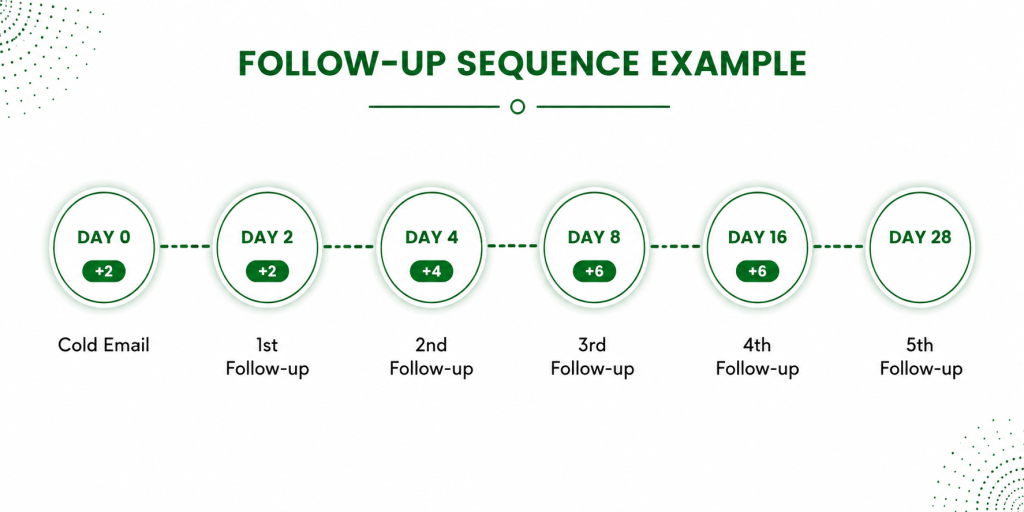
Here is a simple follow-up email cadence for sales and B2B outreach:
| Timing | Purpose | |
|---|---|---|
| Initial email | Day 1 | Introduce the offer |
| Follow-up 1 | Day 3 or 4 | Remind and add value |
| Follow-up 2 | Day 7 to 10 | Share proof, result, or new angle |
| Follow-up 3 | Day 14 | Ask a simple decision-based question |
| Final breakup email | Day 18 to 21 | Close the loop politely |
This cadence works because it gives space between messages. It also gives each email a different purpose. Your first follow-up should not repeat your first email.
Your second follow-up should not repeat your first follow-up. Each message should move the conversation forward.
How Many Follow-Up Emails After No Response?
After no response, 2 to 3 follow-up emails are usually enough. If the person has shown no interest after that, sending more emails may reduce your chances instead of improving them.
A good no-response follow-up sequence looks like this:
- First follow-up: Remind them of your original message and add one clear benefit.
- Second follow-up: Share a short proof point, result, example, or useful resource.
- Third follow-up: Ask if they are the right person or if you should close the loop.
The final email should be polite and easy to answer.
For example:
“Should I close this out for now, or would it be worth revisiting next month?”
This gives the recipient control and avoids pressure.
Sales Follow-Up Emails vs Job Follow-Up Emails
Not all follow-ups are the same. A sales follow-up email and a job application follow-up email have different rules.
In sales or cold outreach, you can usually send more follow-ups because the goal is to start a business conversation. A prospect may ignore the first message but reply later when the timing becomes relevant. For this reason, 3 to 5 total emails can be acceptable in B2B outreach.
For a job application, you should be more careful. If you applied for a role and have not heard back, one follow-up email after 7 to 10 business days is usually enough.
If you still receive no response, it is better to move on unless you have a direct recruiter contact.
After an interview, send a thank-you email within 24 hours. If the employer gave you a timeline, wait until that timeline passes before following up.
If no timeline was given, wait around one week before sending a polite follow-up. Sending too many emails after an interview can make you look impatient.
Is It Bad to Send a Follow-Up Email?
No, it is not bad to send a follow-up email. In fact, a thoughtful follow-up can show professionalism, interest, and persistence. The key is to follow up in a way that respects the other person’s time.
A good follow-up email is short, specific, and helpful. It reminds the recipient why you are reaching out and gives them an easy way to respond.
A bad follow-up email sounds like this:
“Just following up again. Please respond.”
A better follow-up sounds like this:
“I wanted to share one quick idea that may help your team reduce manual prospecting time. Would it be useful if I sent over a short example?”
The second version gives value and makes the next step clear.
How to Follow Up Without Sounding Pushy
To avoid sounding pushy, make every follow-up useful. Do not just bump the email thread. Add something new.
Here are a few ways to improve your follow-up emails:
- Keep your message short.
- Use a clear subject line.
- Personalize the first line.
- Mention one relevant pain point.
- Add a useful resource or insight.
- Ask one simple question.
- Avoid guilt-based language.
- Do not use aggressive urgency.
- Give the recipient an easy way out.
For example, instead of saying:
“I have emailed you several times and still have not heard back.”
Say:
“I know timing may not be right. Should I check back later, or is this not a priority right now?”
This keeps the tone professional and respectful.
When Should You Stop Following Up?
You should stop following up when you have sent 3 to 5 total emails with no engagement, when the recipient asks you to stop, or when your offer is clearly not relevant.
Stopping does not mean the lead is worthless. It means the timing may not be right. You can pause the contact and revisit later with a better reason, such as a new offer,
new case study, seasonal campaign, or updated business need.
For sales teams, this is where lead quality matters. If your lead list is weak, you may feel forced to send too many follow-ups. If your leads are targeted, relevant, and well-matched,
you can get better results with fewer emails.
That is where Leadcanal helps businesses build smarter outreach systems. Instead of sending more emails to the wrong people, Leadcanal helps you focus on better leads, better targeting, and better follow-up timing.
Follow-Up Email Examples
First Follow-Up Email
Subject: Quick follow-up
Hi [Name],
I wanted to quickly follow up on my last email. I noticed that [company] may be working on [specific goal or challenge], and I thought this could be relevant.
At Leadcanal, we help businesses connect with more qualified prospects without wasting time on poor-fit leads.
Would it make sense to send over a quick example?
Best,
[Your Name]
Second Follow-Up Email
Subject: Thought this might help
Hi [Name],
Just wanted to share one more thought. Many teams struggle not because they are not sending enough emails, but because they are following up with the wrong audience.
A targeted lead list and a clear follow-up sequence can make outreach feel more natural and improve reply quality.
Would you be open to seeing how this could work for your team?
Best,
[Your Name]
Final Breakup Email
Subject: Should I close this out?
Hi [Name],
I do not want to keep following up if this is not relevant.
Should I close this out for now, or would it be better to reconnect at a later time?
Best,
[Your Name]
How Leadcanal Helps You Follow Up Smarter
More follow-up emails are not always the answer. Better targeting is usually the answer.
Leadcanal helps businesses improve their outreach by focusing on the right prospects, cleaner lead data, and smarter follow-up strategies. When your emails are sent to people who actually match your offer, you do not need to chase as hard.
A good follow-up system should help you:
- Reach qualified prospects.
- Avoid wasting time on poor-fit leads.
- Send fewer but better emails.
- Personalize outreach at scale.
- Know when to continue and when to stop.
- Improve response quality instead of only increasing volume.
If your team is sending too many follow-up emails and still not getting replies, the problem may not be the follow-up count. The problem may be the lead source, message quality, or outreach strategy.

Final Answer: How Many Follow-Up Emails Is Too Many?
More than 3 to 5 follow-up emails is usually too many. For most outreach, 2 to 3 follow-ups are enough. In sales and B2B outreach, you can use up to 4 or 5 total emails if each message is valuable, well-spaced, and relevant.
The best follow-up strategy is simple: be helpful, be patient, and know when to stop. A good follow-up should feel like a useful reminder, not pressure.
If you want better replies, do not just send more emails. Send better emails to better leads.
FAQs
How many follow-up emails is too many?
More than 3 to 5 follow-up emails is usually too many. For most professional outreach, 2 to 3 follow-ups are enough.
How many follow-up emails should you send after no response?
You should usually send 2 to 3 follow-up emails after no response. If there is still no engagement, stop or pause the sequence.
Is sending a third follow-up email too much?
No, sending a third follow-up email is not too much if it is polite, spaced properly, and adds new value. It becomes too much if it repeats the same message or sounds pushy.
How long should you wait before sending a follow-up email?
For sales outreach, wait 3 to 4 days before the first follow-up. For job applications or interviews, wait around one week unless the recruiter gave you a specific timeline.
How many follow-up emails is too many after an interview?
After an interview, 1 to 2 follow-up emails are usually enough. Send a thank-you email within 24 hours, then follow up after the expected decision timeline has passed.
Is it bad to send a follow-up email?
No, it is not bad to send a follow-up email. A polite and useful follow-up can improve your chances of getting a response.
When should you stop following up?
Stop following up when the recipient asks you to stop, when you have sent 3 to 5 total emails with no engagement, or when your message is no longer relevant.


