 Skip to content

What Are Business Telemarketing Lists?
Quick Answer:
Business telemarketing lists are targeted B2B databases containing company phone numbers and other information used by sales teams to contact prospective businesses by telephone.
A useful telemarketing list may include the company name, business phone or direct dial, decision-maker name, job title, industry, SIC or NAICS classification, location, company size, revenue range and other qualification data.
The strongest business telemarketing lists do more than provide thousands of phone numbers. They help sales teams answer four questions before calling
Is this the right company? this the right person? Is this account commercially relevant? Do we have enough context to make the call useful?
Current telemarketing-list providers commonly allow targeting by factors such as geography, industry, employee count, sales volume and other company characteristics.
Telephone Lists, for example, currently offers extensive business-record filtering, while Salesgenie markets customizable telemarketing lists containing business and consumer phone data.
That makes targeting quality more important than simply buying the largest possible list.
Table of Contents
- What Is a Business Telemarketing List?
- What Should a B2B Calling List Include?
- Business Telemarketing Lists vs Ordinary Phone Lists
- Who Should You Target?
- How to Build a Business Telemarketing List
- SIC and NAICS Targeting
- How to Find the Right Decision-Makers
- Direct Dials vs Main Business Numbers
- How to Score Telemarketing Leads
- Buying vs Building a Cold Calling List
- How to Clean Existing Phone Data
- How to Use Telemarketing Lists Effectively
- Telemarketing Compliance Considerations
- How LeadCanal Can Support B2B Prospect Data
- FAQs
What Is a Business Telemarketing List?
A business telemarketing list, also called a B2B phone list, business calling list, telemarketing database or cold calling phone number list, is a collection of business prospect data prepared for telephone outreach.

Basic lists may contain:
- Company name
- Address
- Main phone number
More useful B2B databases can add:
- Decision-maker name
- Job title
- Direct phone
- Industry
- SIC code
- NAICS code
- Employee count
- Revenue range
- Website
- Geography
- LinkedIn profile
- Email address
- Company size
- Account notes
Telephone Lists currently positions business records around company and demographic/firmographic filters
while other telemarketing-list vendors similarly combine phone numbers with company and contact-level information.
The real value is therefore not the phone number itself.
It is the business context attached to the number.
Business Telemarketing Lists vs a Random Phone Number List
This distinction matters.
Imagine two databases.
List A
- 50,000 business phone numbers
- No contact names
- No industry filtering
- No account qualification
List B
- 2,500 manufacturing businesses
- 50–500 employees
- Located in Texas
- Operations or Plant Manager identified
- Business phone included
- Industry classified
- Relevant company data added
For a company selling industrial services, List B is significantly more actionable.
A large phone list answers:
Who can we dial?
A targeted B2B list answers:
Which companies should we call first, and who should we try to speak with?
What Should a High-Quality B2B Telemarketing List Include?
Think about the data in three layers.
1. Company Data
Include:
- Company name
- Website
- Industry
- Business address
- City
- State
- Country
- Employee count
- Revenue range
- SIC/NAICS classification
2. Contact Data
Where relevant and lawfully obtained:
- Decision-maker name
- Current job title
- Department
- Business telephone
- Direct dial where available
- Business email
- LinkedIn profile
3. Sales Qualification Data
This is where you can go beyond generic competitors.
Add:
- ICP match
- Number of locations
- Growth stage
- Hiring activity
- Technology used
- Recent expansion
- Last verification date
- Last call date
- Call outcome
- Account priority
- Follow-up status
LeadCanal current LinkedIn Prospecting service researches company size, industry, decision-makers, job titles, seniority, hiring trends and growth signals, which can add useful commercial context to basic contact records.
Who Should Be on Your Business Telemarketing List?
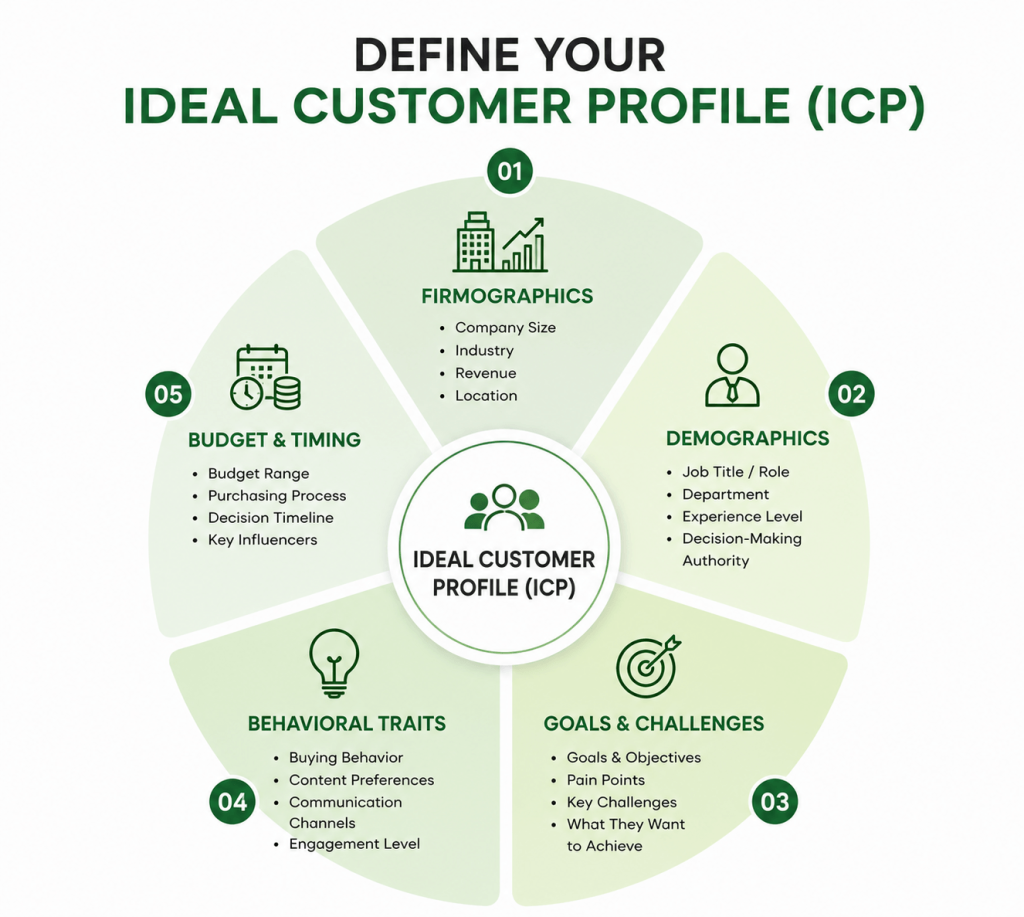
Start with the Ideal Customer Profile, not the phone data.
For example, suppose you sell cybersecurity services.
Your telemarketing brief could be:
Industry: Professional services
Country: United States
Employees: 50–500
Decision-makers: CTO, IT Director, Head of IT
Offer: Managed cybersecurity
Priority: Companies growing their IT teams
That is far more useful than requesting:
“10,000 U.S. business phone numbers.”
Step 1: Define the Companies You Want to Call
Start with firmographic filters such as:
Industry
Examples:
- Manufacturing
- Construction
- SaaS
- Logistics
- Real estate
- Healthcare
- Professional services
Company Size
A local service provider might target 10–100 employees, while enterprise software may require substantially larger organisations.
Geography
Use:
- Country
- State
- City
- ZIP/postcode
- Sales territory
Revenue
Revenue ranges can help distinguish small companies from larger commercial accounts.
Business Characteristics
Depending on the campaign:
- Multi-location company
- Franchise
- Startup
- Established business
- Technology user
- Growing employer
- Specific business model
Step 2: Use SIC and NAICS Codes Carefully
Searchers looking for business telemarketing lists by SIC code usually want precise industry targeting.
SIC and NAICS classifications can help narrow business records by economic activity.
For example, instead of broadly targeting:
Construction companies
you may create separate groups for:
- General contractors
- Roofing contractors
- Electrical contractors
- Plumbing businesses
- Commercial construction firms
Telephone Lists specifically promotes SIC-based business-list filtering, which helps explain why terms such as B2B phone lists by SIC code appear prominently in this SERP.
However, classification alone should not be your entire ICP.
Combine it with:
industry code + company size + geography + decision-maker + business need.
Step 3: Identify the Actual Decision-Maker
A common weakness in cheap cold calling lists is that they identify a company but not the correct buyer.
Your target depends on the offer.
| What You Sell | Possible Decision-Maker |
|---|---|
| Marketing services | CMO / Marketing Director |
| Recruiting | HR Director / Talent Leader |
| Manufacturing supplies | Procurement / Purchasing Manager |
| IT services | CTO / IT Director |
| Facility services | Facilities Manager |
| Accounting services | CFO / Finance Director |
| Logistics technology | Logistics / Operations Director |
| Sales software | VP Sales / Revenue Operations |
LeadCanal B2B Companies Email List article follows the same principle for email prospecting: useful business data should include decision-maker and firmographic information instead of only an address.
That principle applies equally well to telephone prospecting.
Step 4: Decide Between Main Numbers and Direct Dials
Not every phone number has the same purpose.
Main Company Number
Useful when:
- The company is small
- Reception can route calls
- Named direct contact data is unavailable
Direct Dial
Useful when:
- You know the decision-maker
- The business has many departments
- You want to reduce routing friction
Mobile Number
This requires additional care because telemarketing and automated-calling requirements may differ depending on the jurisdiction, number type and technology used.
For that reason, do not treat every phone number purchased from a data provider as automatically callable.
Step 5: Validate and Clean the Data
Business records change.
Companies:
- Move offices
- Change phone systems
- Close locations
- Merge
- Rebrand
Employees:
- Leave
- Change departments
- Get promoted
This is why list quality should be reviewed before large campaigns.
A useful cleansing workflow is:
Deduplicate → standardise → verify company → validate number → update role → classify account → import to CRM
LeadCanal Data Cleansing Services currently include business phone verification, duplicate removal, company-data standardisation and enrichment of missing contact information.
Step 6: Score Your Telemarketing Leads Before Calling
This is an area where your article can offer more value than a standard “buy a calling list” page.
Instead of giving every record equal priority, create a Call Priority Score.
| Signal | Score |
|---|---|
| Exact target industry | +3 |
| Ideal company size | +2 |
| Right geography | +2 |
| Relevant decision-maker found | +3 |
| Direct dial available | +2 |
| Strong business trigger | +3 |
| Outside target market | -4 |
| Outdated contact | -3 |
Suppose:
Company A
Target industry → +3
Correct company size → +2
Right geography → +2
Operations Director identified → +3
Recent expansion → +3
Score: 13
Company A should probably be called before a generic record scoring 4.
That turns your business telemarketing database into a prioritised sales asset.
Should You Buy a Business Telemarketing List or Build One?
Both approaches have legitimate use cases.
Pre-Built List
Can be useful when:
- Market is broad
- Speed matters
- Common filters are enough
- You need large-scale market coverage
Custom-Built List
Usually provides more control when:
- Your market is narrow
- Specific decision-makers matter
- Account value is high
- Geography is restricted
- You need additional qualification fields
Consider this comparison:
50,000 U.S. business numbers
versus:
1,200 Operations Directors at U.S. logistics companies with 50–500 employees in your service territories.
The second database is smaller, but it may fit the sales campaign far more closely.
LeadCanal Email List Building service uses this custom-list philosophy for B2B prospecting by researching companies according to industry, company size, location and decision-maker criteria.
The same ICP-first approach can inform phone prospecting.
How to Use a Business Telemarketing List Effectively
Do not simply upload the database and tell sales reps to dial from top to bottom.
Create segments.
Segment by Industry
Different industries have different problems.
Segment by Decision-Maker
A CEO and Operations Director should not automatically receive the same opening.
Segment by Company Size
Small businesses and enterprise buyers often have different purchasing processes.
Segment by Trigger
Separate high-priority accounts showing:
- Expansion
- Hiring
- New location
- Leadership change
- Relevant business activity
Then prepare an appropriate call opener for each group.
Example B2B Cold Calling Opener
A weak opener sounds like:
Hi, we’re a leading company offering innovative solutions. Can I tell you about our services?
A better version provides context:
Hi Sarah, I’m calling because we work with commercial cleaning companies that are trying to generate more contracts from property and facility teams.
I noticed your team operates across Dallas, so I wanted to see whether outbound lead generation is something you’re actively working on.
The objective of the first few seconds is not to recite your full offer.
It is to establish:
Who you are → why this company → why the conversation might be relevant.
Combine Telemarketing With Email and LinkedIn
A business telemarketing list does not have to remain a phone-only asset.
A richer prospect record can support:
Call + email + LinkedIn + CRM follow-up
For example:
Day 1: Research company
Day 2: Relevant cold email
Day 3: Phone call
Day 6: LinkedIn touchpoint
Day 9: Follow-up
LeadCanal currently offers both Cold Email Outreach and LinkedIn Prospecting alongside its list-building and data services, making those natural internal links when discussing multichannel prospecting.
Are Business Telemarketing Lists Legal to Use?
There is no universal “yes” simply because the numbers belong to businesses.
The answer depends on:
- Jurisdiction
- Recipient
- Type of telephone number
- Calling technology
- Purpose
- Applicable opt-out/DNC rules
- Whether automated or pre-recorded calls are used
For U.S. federal rules, the FTC states that most business-to-business sales calls are exempt from the Telemarketing Sales Rule’s Do Not Call provisions, although there are exceptions.
That does not mean every form of B2B telephone outreach is unrestricted.
The TCPA and FCC rules can impose separate restrictions, particularly around AutoDialed or pre-recorded calls, and state rules may add additional requirements.
The FTC also expanded certain TSR protections concerning deceptive practices in B2B telemarketing, reinforcing why businesses should not treat “B2B” as a blanket compliance exemption.
Before launching a campaign, determine which requirements apply to your exact calling method and audience.
What Should You Check Before Buying a Telemarketing List?
Instead of asking only:
How many phone numbers do I get?
ask:
Where does the data come from?
Understand the provider’s sourcing approach.
When was it updated?
Old phone data creates wasted calls.
Can I filter by industry?
Especially important for B2B prospecting.
Can I filter by company size?
Useful for ICP matching.
Are decision-maker names available?
A named account is more actionable than a generic number.
Are direct dials distinguishable from switchboards?
These should ideally be identified separately.
Can the list support CRM enrichment?
Look for structured fields.
What compliance screening has been performed?
Do not assume a provider’s database automatically satisfies every legal obligation applicable to your campaign.
Sales genie currently states that it maintains state and federal Do-Not-Call screening for its telemarketing data, while Data man Group advertises DNC-scrubbing options.
Those are provider claims and should not replace your own compliance assessment.
How LeadCanal Can Support Better B2B Telemarketing Data
LeadCanal strongest role in this topic is not positioning itself as another generic phone-number marketplace.
Its current site focuses on:
- Custom prospect research
- Decision-maker identification
- B2B list building
- Phone and contact-data enrichment
- Data cleansing
- LinkedIn research
- Cold email outreach
- Multichannel prospecting
A telemarketing project could therefore start with:
Industry: Commercial construction
Region: Florida
Employees: 20–250
Decision-makers: Owner, Operations Director, Business Development Director
Required fields: Company, website, contact, title, business phone, email, LinkedIn, location, company size
Priority: Companies matching the exact ICP
The workflow becomes:
Define ICP
↓
Find companies
↓
Map decision-makers
↓
Collect business contact information
↓
Clean and enrich data
↓
Score accounts
↓
Call high-priority prospects
↓
Use email/LinkedIn for follow-up
That is a more complete B2B prospecting system than simply purchasing a CSV containing telephone numbers.

Frequently Asked Questions About Business Telemarketing Lists
What is a business telemarketing list?
A business telemarketing list is a database of companies and telephone contact information prepared for B2B sales calling.
It may include company names, phone numbers, decision-maker information, industry, location, employee count and other firmographic data.
Where can I get B2B phone lists?
Businesses can use commercial B2B databases, specialist list providers or custom prospect-research services.
The best option depends on whether you need broad market coverage or highly specific decision-makers.
What is a cold calling phone number list?
A cold calling phone number list is a prospect database containing telephone numbers used to contact people or businesses that have not previously spoken with the salesperson.
Can I buy a list of business phone numbers?
Commercial data providers sell or license business phone datasets, but data availability and permitted use vary.
Evaluate sourcing, freshness, targeting and applicable calling rules before using any purchased data.
What information should a B2B telemarketing list include?
Useful fields include company name, business phone, contact name, title, industry, geography, company size and other information relevant to the campaign.
Can business telemarketing lists be filtered by SIC code?
Yes. Some B2B list providers allow businesses to filter records using SIC and other industry criteria. Telephone Lists currently promotes SIC-based business-list selection.
Are direct dial numbers better than company switchboards?
Direct dials can reduce routing friction when the correct decision-maker is already known, while main company numbers can still be useful for smaller companies or when routing through reception is appropriate.
Should telemarketing lists include email addresses too?
If your strategy includes multichannel outreach, adding verified business email and LinkedIn information can help coordinate phone, email and professional-network follow-up.
How often should a telemarketing list be cleaned?
There is no universal interval suitable for every database. Review records according to their age, change rate and campaign importance, and validate older data before major calling campaigns.
Are B2B calls exempt from the U.S. Do Not Call Registry?
The FTC states that most calls made to businesses to solicit sales from those businesses are exempt from the federal DNC provisions, but exceptions and other telemarketing rules still exist.
Can LeadCanal help create targeted business prospect data?
LeadCanal currently provides custom list building, decision-maker research, phone/contact enrichment, data cleansing and LinkedIn prospecting that can support B2B sales prospecting.
Conclusion: Better Telemarketing Starts With Better Targeting
The best business telemarketing lists are not necessarily the lists with the most telephone numbers.
A useful B2B calling database connects:
Company → industry → ICP → decision-maker → phone data → firmographics → account context → priority → call outcome.
Start by defining who should buy from you. Build or acquire data around that audience. Clean outdated information.
Identify the correct decision-makers. Score high-value accounts before calling, and connect phone outreach with email or LinkedIn where appropriate.
For businesses that need custom B2B prospect research instead of a generic bulk database, LeadCanal can support list building, decision-maker research, data cleansing and multichannel outreach.
CTA
Need a targeted B2B prospect database for your sales team?
Use LeadCanal to build and enrich prospect data around your exact industry, company size, geography and decision-maker criteria then turn that data into structured outbound outreach.


