 Skip to content

Author: Muhammad Shahzad
You can have the best domains.
You can have perfect DNS records.
and you can have Google Workspace, Microsoft 365, warmed-up mailboxes, and excellent deliverability.
But if your email copy is weak, none of it matters.
Cold email success is not determined by how many emails you send.
It is determined by how many conversations you start.
Every successful cold email campaign comes down to one simple question:
Will the prospect care enough to reply?
The biggest mistake beginners make is writing emails that sound like advertisements.
Most cold emails look like marketing brochures instead of business conversations.
Prospects don’t want to read sales pitches.
They want solutions to their problems.
The purpose of cold email copywriting is not to sell immediately.
The purpose is to start a conversation.
A successful cold email should:
- Capture attention
- Build curiosity
- Show relevance
- Demonstrate value
- Generate a reply
In this guide, you’ll learn:
- Subject lines that get opens
- Personalization that feels real
- Offer positioning
- CTA frameworks
- AI copywriting
- Spam trigger words
- Reply generation techniques
- How to consistently turn cold prospects into booked meetings
By the end of this lesson, you’ll understand the same copywriting principles used by successful lead generation agencies, SaaS companies, appointment setters, recruiters,
and outbound sales teams.
The Real Goal of a Cold Email
Many beginners believe the goal of a cold email is to sell.
It isn’t.
Your goal is not to:
- Close a deal
- Send a proposal
- Explain your entire service
- Pitch your company
Your goal is:
Get a Reply
Once a prospect replies, the conversation begins.
Once the conversation begins, the chances of booking a meeting increase dramatically.
Every part of your email should support that objective.
Why Most Cold Emails Fail
Most cold emails fail because they focus on the sender.
Examples:
“We are a leading digital marketing agency.”
“We have 10 years of experience.”
“or We help businesses grow.”
“And we provide innovative solutions.”
The problem is simple:
Nobody cares.
Your prospect is thinking:
“How does this help me?”
If your email does not answer that question quickly, it will probably be ignored.
Think Like Your Prospect
Before writing any cold email, ask yourself:
What does the prospect want?
Usually they want one of four things:
- More revenue
- Lower costs
- More time
- Less risk
Your email should connect your solution to one of these outcomes.
For example:
Instead of:
“We provide lead generation services.”
Write:
“We help SaaS companies book qualified demos without hiring additional SDRs.”
The second version explains the outcome.
People buy outcomes.
Not services.
The Perfect Cold Email Structure
Most successful cold emails follow a simple framework:
Personalization
↓
Problem
↓
Solution
↓
Call-To-Action
Let’s look at an example.
Hi John,
I noticed your company recently expanded into healthcare.
Many SaaS companies entering healthcare struggle to generate qualified demos because sales cycles become longer and more complex.
We’ve helped similar companies build outbound systems that consistently generate meetings without increasing advertising spend.
Open to a quick conversation next week?
Simple.
Clear.
Easy to understand.
Easy to reply to.
Subject Lines: Getting Your Email Opened
The first battle in cold email is getting opened.
If nobody opens your email, nothing else matters.
The purpose of a subject line is not to sell.
The purpose is to create enough curiosity for someone to open the email.
Best Cold Email Subject Line Types
Simple Subject Lines
Examples:
- Quick question
- Question
- Quick idea
- Thought this might help
- Regarding your growth strategy
Simple often performs better than clever.
Personalized Subject Lines
Examples:
- John, quick question
- About LeadCanal
- Saw your recent hiring post
- Regarding your healthcare expansion
Personalized subject lines can increase open rates because they feel relevant.
Curiosity-Based Subject Lines
Examples:
- A possible idea
- One observation
- Noticed something interesting
- Thought I’d reach out
These create curiosity without sounding spammy.
Subject Lines to Avoid
Avoid:
- FREE OFFER
- GUARANTEED LEADS
- MAKE MONEY FAST
- LIMITED TIME DEAL
- EXCLUSIVE BONUS
These phrases often resemble spam and can hurt both deliverability and open rates.
Personalization That Actually Works
Most people think personalization means:
“Hi John”
That is not personalization.
That is mail merge.
Real personalization proves you researched the prospect.
Weak Personalization
Hi John,
Hope you’re doing well.
Strong Personalization
Hi John,
I noticed your company recently expanded into Germany and appears to be growing the sales team.
The second example demonstrates effort.
Prospects can immediately see that you researched them.
What Can You Personalize?
You can personalize using:
- LinkedIn activity
- Company news
- Job openings
- Funding announcements
- Product launches
- Podcasts
- Blog articles
- Social media posts
Even one relevant sentence can significantly improve response rates.
Offer Positioning: Why Should They Care?
Many cold emails fail because they explain what the sender does instead of explaining why it matters.
Let’s compare.
Bad Example:
“We provide cold email services.”
Better Example:
“We help agencies generate meetings without hiring SDRs.”
Bad Example:
“We offer lead generation.”
Better Example:
“We help SaaS founders build predictable sales pipelines.”
The second versions focus on outcomes.
That is what prospects care about.
How to Position Your Offer Correctly
Most successful offers focus on one of these benefits:
Increase Revenue
“We help B2B companies generate more qualified sales opportunities.”
Reduce Costs
“We help businesses lower customer acquisition costs.”
Save Time
“We automate prospecting so sales teams can focus on closing deals.”
Reduce Risk
“We help companies build outbound systems without damaging domain reputation.”
When possible, focus on business outcomes rather than features.
Why Short Emails Usually Win
One of the biggest mistakes beginners make is writing long emails.
Many cold emails are:
- 300 words
- 500 words
- Multiple paragraphs
Busy decision-makers rarely read them.
Most successful cold emails are often:
50–120 words.
Short emails feel easier to respond to.
Remember:
Your email is not a sales presentation.
It is a conversation starter.
CTA Frameworks That Generate Replies
A CTA (Call-To-Action) tells the prospect what to do next.
Most people ask for too much.
Examples:
“Can we schedule a 60-minute strategy session?”
That’s a large commitment.
Instead, lower the barrier.
Better CTA Examples
- Worth exploring?
- Open to learning more?
- Interested?
- Would it make sense to discuss?
- Curious to see how it works?
- Open to a quick chat?
These CTAs feel conversational.
And conversations generate replies.
The Psychology Behind Replies
People reply when:
- They feel understood
- The message feels relevant
- The request is simple
- The email is easy to read
People ignore emails when:
- They feel generic
- They feel salesy
- They feel complicated
- They require too much effort
Your goal is to reduce friction.
AI Copywriting for Cold Email
AI has become a powerful tool for cold email marketers.
However, AI should support your strategy not replace it.
Many beginners ask AI:
“Write a cold email.”
The result is usually generic.
Professional marketers use AI for:
- Research
- Personalization ideas
- Subject line testing
- Email variations
- CTA testing
- Prospect summaries
AI can help create drafts quickly.
But human insight is still necessary.
Spam Trigger Words to Avoid
Some words create unnecessary spam risk. if you want to check your email copy for spammy keywords before launching a campaign,
you can use LeadCanal Spam Checker Tool to identify potential deliverability issues and improve inbox placement.
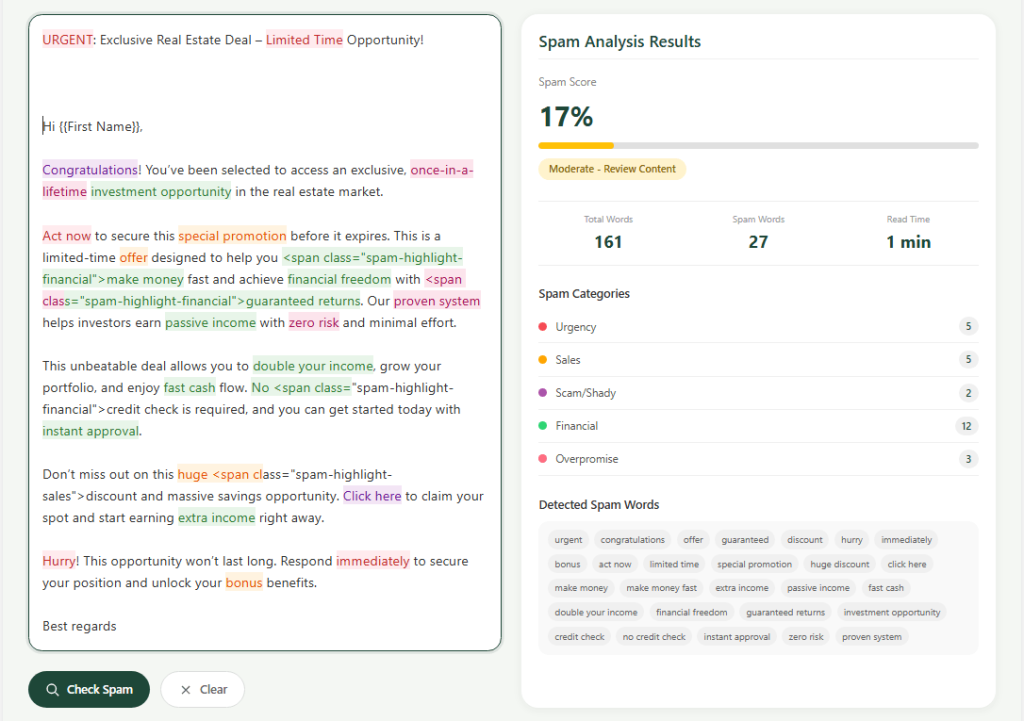
Examples include:
- Guaranteed
- Risk-Free
- Double Your Income
- Act Now
- Free Money
- Limited Time Offer
- 100% Success
- Instant Results
Professional cold emails should sound like business communication.
Not advertisements.
How to Sound Human
Many cold emails fail because they sound robotic.
Example:
“We leverage innovative growth strategies to maximize organizational opportunities.”
Nobody talks like that.
A better version:
“We help companies book more qualified meetings.”
Simple wins.
Always.
How to Generate More Replies
The highest-performing cold emails usually:
- Focus on the prospect
- Use simple language
- Highlight outcomes
- Ask easy questions
- Keep emails short
- Sound human
- Avoid selling too hard
The easier your email is to read, the more likely someone is to reply.
Example of a High-Converting Cold Email
Subject:
Quick question
Email:
Hi John,
I noticed your team recently expanded into the healthcare space.
Many companies entering healthcare struggle to generate qualified demos because the buying process becomes more complex.
We’ve helped SaaS companies create outbound systems that consistently generate meetings without increasing ad spend.
Open to seeing how it works?
Thanks,
James
This email is:
- Short
- Personalized
- Relevant
- Easy to reply to
That is exactly what you want.
Cold Email Copy Checklist
Before launching a campaign, ask yourself:
- Is the email short?
- Is it personalized?
- Does it focus on the prospect?
- Or Does it explain a benefit?
- Does it avoid spam language?
- Does it sound human?
- Is the CTA easy to answer?
If the answer is yes, you’re probably moving in the right direction.
Final Thoughts
Cold email copywriting is not about clever writing.
It is about relevance.
The best cold emails are:
- Simple
- Personalized
- Valuable
- Easy to understand
- Easy to reply to
Always remember:
Prospects do not care about your service.
They care about solving their problems.
If your email helps them see a better outcome, your reply rates will increase dramatically.


